
It only takes a split second for a curious child to swallow something dangerous.
Coins are among the most common, but magnets, button batteries, small plastic pieces, and metal parts can be just as dangerous and in some cases, even more serious.
Studies report that 80 to 90 percent of swallowed objects pass through the digestive system on their own without complications. Around 10 to 20 percent need removal through endoscopy, and less than 1 percent require surgery.1, 2
However, these numbers do not apply to button batteries, magnets, or sharp objects, which always need urgent medical attention regardless of symptoms.3
This guide explains what to do if your child swallows a coin, magnet, button battery, plastic piece, or metal object, and when the situation becomes a pediatric emergency.
First Step When a Child Swallows Something
A swallowed object can become lodged in the esophagus very quickly. If your child is choking or cannot breathe, call emergency services immediately. Otherwise, pause and assess the situation calmly, because the type of object matters more than anything else.
If you have seen the child swallow something, gently try to determine what they swallowed. If the object is unknown, look for clues nearby such as a missing toy, battery, or coin.
Do not try to make your child vomit, and do not give them any food or water.
Vomiting increases the risk of choking or further internal injury, while fluids can worsen battery burns or delay emergency hospital procedures.
Instead, focus on these immediate steps:
- Check if your child is breathing normally
- Look for coughing, choking, or difficulty swallowing
- Ask your child what they swallowed, if they can speak clearly
- Keep them calm and avoid unnecessary movement
- Remove any remaining objects from their mouth if they are safely visible
If your child is showing signs like drooling, chest pain, persistent coughing, or trouble breathing, this is a medical emergency and needs immediate attention.
Even if your child looks completely fine, the swallowed object still needs to be identified. Button batteries and magnets in particular can cause severe internal injury before any outward symptoms appear.
Symptoms a Child May Show After Swallowing Something
Sometimes a child clearly tells you they swallowed something. In other cases, the only clues are new symptoms that appear suddenly during play, eating, or bedtime.
Common symptoms can include:
- Gagging or repeated coughing
- Refusing food or difficulty eating
- Throat pain or chest discomfort
- Drooling or trouble swallowing saliva
- Noisy breathing or wheezing
- Vomiting
- Abdominal pain or swelling
- Persistent irritability in younger children
- Fever appearing hours or days later
- Breathing difficulty or choking
Some children may show very few symptoms at first, especially after swallowing button batteries or magnets. That is why any suspected ingestion of a dangerous object should be taken seriously, even if the child initially appears well.
Objects Children Commonly Swallow
Young children naturally explore the world by putting objects into their mouths, which is why accidental swallowing is so common.
According to the American Academy of Pediatrics,4 common objects children swallow or choke on include:
- Coins
- Toy parts
- Balloons
- Beads
- Lego pieces
- Pen or marker caps
- Button batteries
- Magnets
- Earrings
- Screws
Most small smooth objects pass safely through the digestive system. However, button batteries, magnets, sharp metal objects, and large items can become dangerous very quickly and may require emergency treatment.
Coins Swallowed by a Child: What You Should Do

When a child swallows a coin, the key question is whether it is moving through the body or stuck somewhere it should not be.
The answer depends on a few factors: the child’s age, the size of the coin, and where it has ended up.
A coin in the stomach will usually pass through the body naturally in the stool without causing any issues.5
However, coins found in the esophagus need to be removed within 24 hours even in children who appear well. If symptoms such as drooling, difficulty swallowing, or breathing trouble are present, removal becomes an immediate emergency.6
When Home Observation May Be Possible
If your doctor agrees that watchful waiting is safe, it is typically appropriate only if:
- The child is calm and comfortable.
- There is no coughing, choking, or drooling.
- The child is able to swallow their own saliva completely normally.
- You are certain the swallowed object is just a standard coin.
If an X-ray confirms the coin has safely reached the stomach, it usually passes naturally in the stool within 4 to 7 days.
If it does not pass within two weeks, notify your doctor. Still, it is important to watch closely for any change in symptoms during this time.
Warning Signs That Need Medical Attention
Seek immediate medical care if your child develops:
- Persistent vomiting or refusal to eat.
- Chest, stomach, or throat pain.
- Drooling or difficulty swallowing.
- Coughing or breathing difficulty.
- Ongoing distress or discomfort.
These signs may mean the coin is stuck in the esophagus (food pipe) and needs urgent medical evaluation.
2. Magnets Swallowed by a Child: Why This Is Urgent

Many parents assume small magnets are harmless, especially when the child seems perfectly okay afterward. Unfortunately, that assumption can become dangerous very quickly.
Why Magnets Are So Dangerous
A single swallowed magnet may sometimes pass safely, but medical evaluation and follow-up imaging are still important because magnets can behave unpredictably.7
They can break into pieces, and multiple magnets will not pass safely on their own.
When more than one magnet is swallowed, or a single magnet alongside a metal object, they can attract each other through different loops of the intestinal wall.
This is why prompt medical intervention is critical to prevent rapid tissue death, internal punctures, severe bleeding, or serious infection.
Because this damage can happen before a child even looks sick, waiting is not an option. Even a child who seems perfectly well may need an immediate X-ray and urgent surgical evaluation.
When to Treat It as an Emergency
Seek emergency medical care immediately if:
- Your child swallowed more than one magnet.
- A magnet was swallowed along with a metal object.
- You are uncertain about how many magnets were swallowed.
- Your child has any abdominal pain, vomiting, drooling, or trouble swallowing.
- The child seems unusually tired, irritable, or uncomfortable.
What You Should Do
- Go to the nearest emergency department right away.
- Do not try to make your child vomit, as this can cause further internal tearing.
- Do not give food, water, laxatives, or home remedies unless a doctor explicitly advises it.
Button Batteries Swallowed by a Child: This Is a Critical Medical Emergency

Button batteries are among the most dangerous objects a child can swallow.
Unlike coins or small toys, a button battery lodged in tissue quickly generates an electrical current that reacts with internal fluids, causing severe deep tissue burns within as little as two hours, often before a child shows any symptoms at all.8
If there is any chance your child has swallowed a button battery, or placed one in their nose or ear, go to the hospital immediately. Do not wait for symptoms to appear.
This is a most serious injuries and fatalities involve children under 5, but this is a medical emergency at any age.
What to Avoid
- Do not induce vomiting. Forcing a child to vomit can cause further damage to the throat and digestive tract.
- Do not give food or drink until a doctor has evaluated your child.
- Do not give any medication or attempt to neutralize the object at home.
Sharp Objects Swallowed by a Child: When It Becomes Dangerous
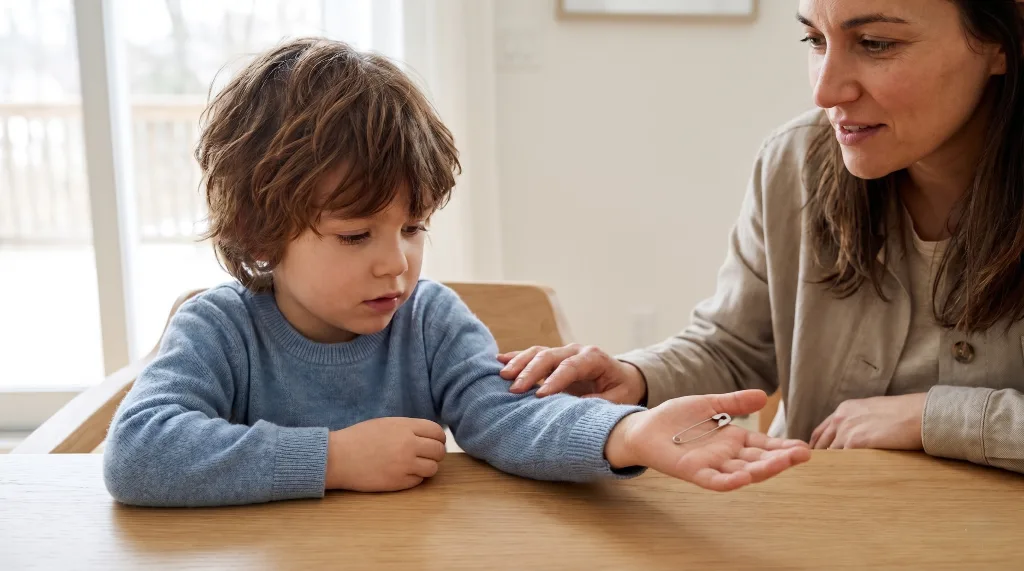
Sharp or pointed objects can injure the digestive tract much more easily than smooth items like coins.
Common examples include pins, sewing needles, safety pins, nails, screws, toothpicks, bones, and sharp toy pieces.
In some cases, small sharp objects pass naturally without causing harm. However, these objects carry a higher risk of cuts, internal bleeding, perforation, or becoming lodged in the throat or digestive tract.
If a sharp object is stuck in the esophagus, doctors recommend removal within 6 hours due to the high risk of internal puncture and serious infection.10
Why Sharp Objects Are Concerning
Unlike smooth objects, sharp items can scrape or puncture delicate tissue as they move through the body. They may become stuck in the esophagus, stomach, or intestines and can sometimes lead to infection or an intestinal blockage.
The risk is higher if the object is:
- Long or pointed
- Made of metal
- Jagged or irregularly shaped
- Causing pain or swallowing difficulty
Seek Emergency Care Immediately If
Go to the hospital right away if your child:
- Has throat, chest, or abdominal pain
- Is drooling or struggling to swallow
- Has vomiting or blood in vomit
- Develops coughing, wheezing, or breathing difficulty
- Swallowed a needle, open safety pin, toothpick, or large sharp object
These symptoms may suggest internal injury or airway obstruction and need urgent evaluation.
What You Should Do
- Keep your child calm
- Do not make your child vomit
- Do not give food, bread, or bulky foods to push the object down
- Seek urgent medical evaluation as soon as possible
Doctors usually perform imaging such as an X-ray to locate the object. Depending on where it is, the sharp object may need removal through endoscopy to prevent serious complications.
Small Plastic Pieces and Toy Parts Swallowed by a Child

Small plastic pieces and toy parts are among the most commonly swallowed objects during play, especially by younger children.
Smooth, non-sharp pieces usually pass through the digestive system without causing harm, but size, shape, and the object’s location in the body all affect the risk.
If your child is active, comfortable, and showing no distress, this is generally less urgent than magnets or button batteries. Still, it is worth watching your child closely over the next day or two.
When it is usually less concerning
You may monitor at home if:
- The child is calm, comfortable, and breathing normally.
- There is no coughing, choking, or drooling.
- The object is small, smooth, and has no sharp edges.
- Your child shows no pain or difficulty swallowing.
In such cases, the object often passes naturally within a few days.
Warning signs to watch for
Seek medical care if you notice:
- Vomiting or refusal to eat
- Abdominal pain or swelling
- Coughing or breathing difficulty
- Drooling or trouble swallowing
- Blood in the vomit, stool or persistent discomfort
These signs may suggest the object is stuck or causing irritation.
When to Seek Emergency Care Immediately
While many cases of a child swallowing something can be safely observed, some situations require urgent medical attention without delay.
The type of object and your child’s symptoms together determine how serious the situation is.
Seek medical evaluation if:
- Your child is having difficulty breathing
- There is persistent coughing or choking
- The child is drooling or cannot swallow properly
- There is chest, throat, or severe abdominal pain
- The child is vomiting repeatedly
- You suspect a button battery or multiple magnets were swallowed
- There is blood in vomit or stool
- The child becomes unusually drowsy or very irritable
Objects That Are Always an Emergency
Seek immediate care even if your child has no symptoms:
- Button batteries
- Multiple magnets (or a magnet and metal combination)
- Sharp objects such as pins, needles, open safety pins, screws, or glass fragments
- Large objects that could block the airway or intestine
These objects can cause serious internal damage before any outward signs appear. When in doubt, go. A quick evaluation is always better than a wait that turns serious.
What Happens at the Hospital
When you arrive, the medical team will make sure your child’s airway is safe, then carry out a physical exam and imaging to locate the object.
Treatment is based on where the object is, not just how your child feels. A coin sitting in the stomach can often be monitored, while an object lodged in the esophagus will need prompt removal through endoscopy — a quick, non-surgical procedure.
High-risk objects like batteries or magnets are treated as urgent regardless of symptoms.
Will My Child Need Surgery?
In the vast majority of cases, no. Most swallowed objects either pass naturally or are safely removed through endoscopy.
Surgery is only considered as a last resort when:
- The object has caused a perforation in the digestive tract.
- The object has moved somewhere endoscopy can not reach.
- High-risk objects like multiple magnets have caused a severe complication with no other treatment option.
If your child swallowed a coin or small smooth object and has no symptoms, the chances of needing surgery are exceptionally low.
Safe Home Monitoring After Swallowing Low-Risk Objects
If a doctor has confirmed that observation at home is safe, close monitoring over the next few days is all that is needed. This applies mainly to small, smooth, non-toxic objects like coins or plastic pieces.
How to monitor your child at home
- Keep your child calm and continue normal routines.
- Watch eating, drinking, and activity levels for any changes.
- Check the stool for the object passing. A disposable plastic colander placed over the toilet can help you spot it safely if your doctor advised checking.
- Note any new symptoms, even mild ones.
- Follow any specific instructions given by your doctor.
Most small objects pass naturally within a few days.
When to stop home monitoring
Return to medical care immediately if your child develops vomiting, abdominal pain, breathing difficulty, drooling, or blood in the stool. Do not wait it out if symptoms appear a day or two later. They still need prompt evaluation.
Why follow-up matters
Some objects may move slowly through the digestive system or get temporarily caught before passing completely. A follow-up X-ray or pediatric review may be recommended in certain cases to ensure the object has cleared safely.
If your doctor suggested a check-in after a few days, do not skip it—even if your child seems perfectly fine.
The Takeaway
Not every swallowed object is an emergency, but the type of object matters far more than how your child looks in the first few minutes.
Button batteries and multiple magnets are always immediate emergencies, even with no symptoms. Sharp objects and large items that could cause a blockage also require immediate hospital care.
Coins, small smooth plastic pieces, and similar low-risk items often pass naturally, but they still need to be identified. If your doctor clears you for home observation, monitor closely and return immediately if anything changes.
Never try to make your child vomit regardless of what was swallowed. It does not help and can cause choking, aspiration, or further injury.
If something feels wrong, go to the hospital. When there is uncertainty, medical evaluation is always the safest choice.
Frequently Asked Questions
Q1. How do I know if my child swallowed something?
Sometimes swallowing is not seen directly. Signs may include coughing, gagging, drooling, refusal to eat, throat discomfort, or unusual irritability. If a small object like a coin, battery, or toy part may be missing, get medical advice or go to the hospital without delay.
Q2. What should I do first if my child swallows something?
Stay calm and identify what was swallowed. Do not force vomiting. Check if your child is breathing normally, speaking, and swallowing without difficulty. If there are any signs like choking, drooling, or breathing trouble, seek emergency care immediately.
Q3. Which swallowed objects are most dangerous for children?
Button batteries and multiple magnets are the most dangerous because they can cause internal injury even without early symptoms. Sharp metal objects and large items that may block the food pipe or intestine also require urgent medical attention.
Q4. Can a child sleep after swallowing a coin?
Yes, if your child is breathing normally, has no symptoms, and a doctor has confirmed the coin is low risk or already in the stomach. Seek urgent care immediately for choking, drooling, chest pain, vomiting, or breathing difficulty.
Q5. How long does it take for a swallowed object to pass?
Most small smooth objects such as coins or plastic pieces pass naturally within 4 to 7 days, though some may take up to 2 weeks. Button batteries, magnets, and sharp objects should never be monitored at home waiting to pass.
Q6. How do I know if a swallowed object is stuck?
Warning signs include difficulty swallowing, drooling, chest or throat pain, vomiting, coughing, or breathing difficulty. Any of these symptoms need immediate medical evaluation.
Q7. Is it safe to wait at home after my child swallows something?
Home observation is only appropriate for low-risk cases such as small smooth objects with no symptoms, and only when a doctor has confirmed it is safe. If there is any doubt about the object or your child develops symptoms, hospital evaluation is the safest option.
Q8. Should I try to make my child vomit after swallowing something?
No. Inducing vomiting is not safe and can cause choking or further injury, especially with batteries, magnets, or sharp objects.
Q9. My child swallowed something but seems fine, should I still go to the hospital?
It depends on what was swallowed. Button batteries, magnets, and sharp objects always need immediate hospital care, even with no symptoms. These can cause serious internal damage before any signs appear. For small smooth objects like coins, home observation may be appropriate after speaking with your doctor first. When in doubt, go. No parent has ever regretted getting their child checked.
Q10. What happens at the hospital if my child swallows something?
Doctors will assess your child’s condition, check breathing and symptoms, and usually perform an X-ray to locate the object. Depending on the findings, the object may pass naturally or need removal through endoscopy.
Q11. When is swallowing something an emergency?
Always treat it as an emergency if your child swallows a button battery, multiple magnets, or a sharp object, or if they show symptoms like breathing difficulty, persistent vomiting, chest pain, or severe discomfort.
Q12. Can a child swallow something without showing symptoms?
Yes. Button batteries and magnets in particular may cause no immediate symptoms but can still cause serious internal injury. A doctor should be informed any time ingestion of a high-risk object is suspected, even without symptoms.
Q13. Can a swallowed object cause problems weeks later?
Yes. In some cases a swallowed object that appeared to pass can cause delayed complications such as infection, abscess, or intestinal obstruction. If your child develops unexplained abdominal pain, fever, vomiting, or changes in bowel habits weeks after a suspected swallowing incident, see a doctor and mention the possibility of a swallowed object.
Q14. How are foreign objects removed endoscopically?
Endoscopy is a quick, non-surgical procedure. A thin flexible tube with a camera and small tool is gently passed through the mouth while the child is under sedation, so they do not feel pain. The object is carefully removed within minutes, with no cuts or stitches. Most children recover quickly and go home the same day.
Q15. What is the safest action if I am unsure what my child swallowed?
If you are unsure, do not wait. Go to the hospital for an evaluation. A quick check or X-ray can confirm exactly what you are dealing with.
References
📚 Click to view references
- Athanassiou N, et al. Foreign Body Ingestion in Children. Clinical Endoscopy. 2018. View source
- Ikenberry SO, et al. Foreign Bodies. National Library of Medicine. View source
- Management of Ingested Foreign Bodies in Children: A Clinical Report of the NASPGHAN Endoscopy Committee. View source
- Choking Prevention for Babies & Children: What Every Parent Needs to Know. View source
- Kramer RE, et al. Management of Ingested Foreign Bodies in Children. PMC. 2021. View source
- Litovitz T, et al. Emerging Battery Ingestion Hazard. PubMed. 2015. View source
- Ikenberry SO, et al. Foreign Bodies. National Library of Medicine. View source
- Kramer RE, et al. Button Battery Ingestion in Children. PMC. 2016. View source
- ESPGHAN Button Battery Advice Guide. European Society for Paediatric Gastroenterology, Hepatology and Nutrition. View source
- Mina, et al. The drop of a pin: Accidental ingestion of a sharp foreign body. View source
