
Written by: MediHealth PRO Editorial Team
Scientifically Reviewed by: Dr. Amit Pande, PhD
Molecular Biologist & Independent Scientific Advisor
Key Takeaways
- ADHD sensory issues can make everyday sounds, lights, textures, touch, or movement feel more intense or difficult to manage.
- Children may be sensory seeking, sensory avoiding, or show both patterns in different situations.
- Sensory challenges often become more noticeable during transitions, mealtimes, school, or crowded places.
- Simple changes to the environment, daily routines, and sensory supports can help reduce sensory stress.
- If sensory challenges continue to affect everyday life, an occupational therapy evaluation may be helpful.
Parents often notice that their child with ADHD responds strongly to everyday sights, sounds, textures, or movement.
A shirt tag may feel unbearable, the sound of a hand dryer may cause real distress, or the child may keep jumping, spinning, or crashing into furniture. These behaviors are often linked to ADHD sensory issues, not a discipline problem.
Read more: ADHD in Children (Ages 2–12): Complete Guide to Symptoms, Diagnosis, and Treatment
What Are ADHD Sensory Issues?
ADHD sensory issues happen when a child’s brain responds differently to sensory information, such as visual input, sounds, touch, smells, tastes, or movement.1 These differences are sometimes described as sensory processing differences.
For example, a child may refuse certain food textures, cover their ears during loud sounds, or seek deep pressure by pushing against objects or squeezing into tight spaces.
Sensory issues are common in children with ADHD but are not part of the official diagnostic criteria.2 Not every child with ADHD experiences them. Some may have mild preferences, while others may need significant sensory support in their daily routines.
When sensory differences interfere with daily activities, an occupational therapist can assess the child’s sensory patterns and recommend practical support strategies.
Why Do Children With ADHD Have Sensory Issues?
Children with ADHD often experience sensory issues because brain networks involved in attention, alertness, and self-regulation also play a role in processing sensory information.3
These brain networks work differently in ADHD, which may affect how the brain filters, organizes, and responds to incoming sensory signals. Some sensory input may feel overwhelming, while other input may be less noticeable. These responses reflect differences in how the nervous system processes sensory information rather than a child’s behavioral choice.
Sensory Seeking vs. Sensory Avoiding in ADHD
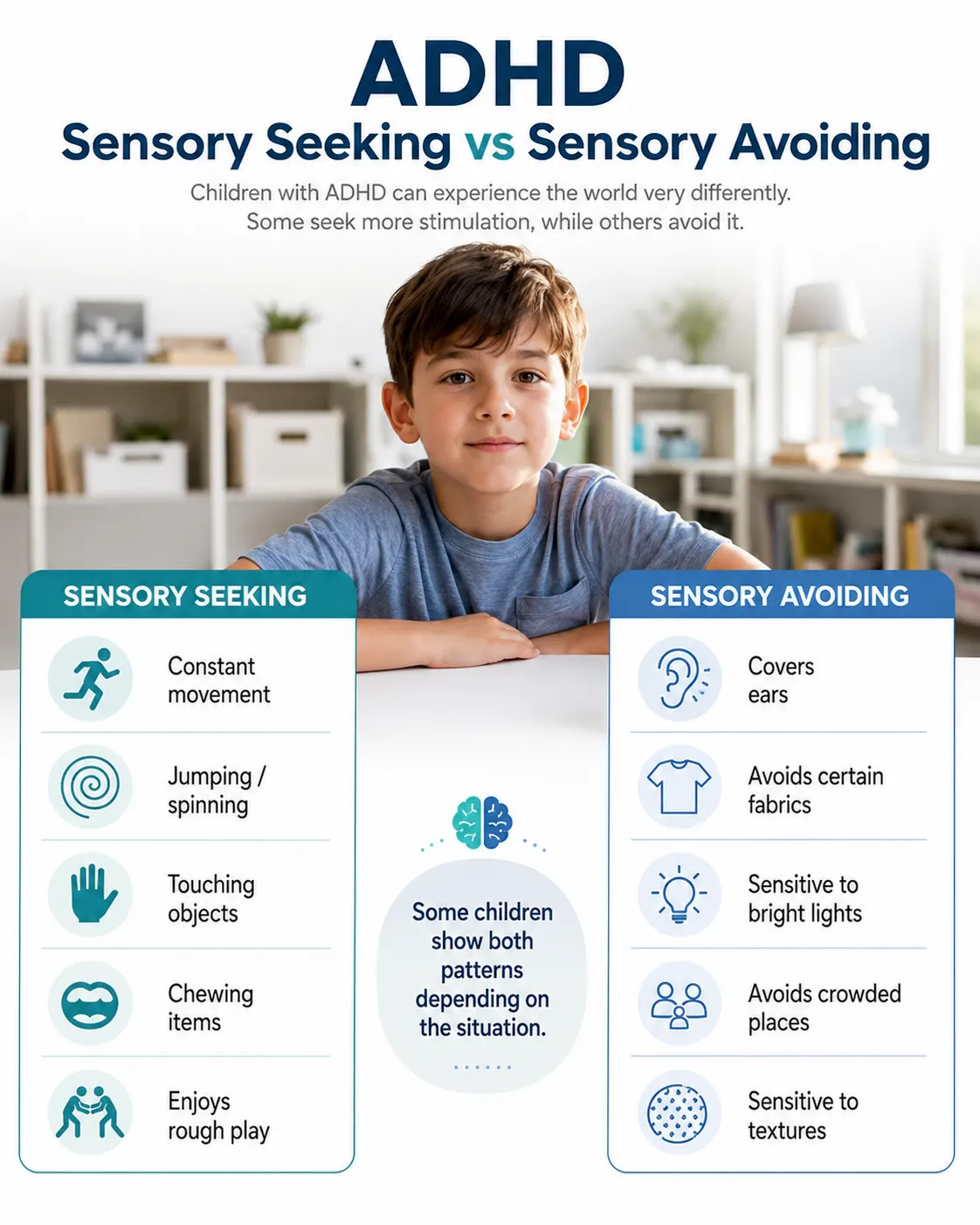
Children with ADHD generally respond to sensory input in one of two ways, seeking extra sensory input or avoiding sensations that feel uncomfortable or overwhelming, though many children show a mix of both patterns depending on the situation, environment, or type of sensory input.
Recognizing whether a child is primarily sensory seeking, sensory avoiding, or a combination of both can help parents, teachers, and healthcare professionals better understand their behavior and choose support strategies that match the child’s individual sensory needs.
The infographic below provides a quick comparison of common sensory-seeking and sensory-avoiding behaviors in children with ADHD.
Interoception: Understanding Internal Body Signals
Most people think of sensory processing as responding to sights, sounds, or touch. However, the brain also processes signals from inside the body through a sense called interoception.4 This helps children recognize hunger, thirst, tiredness, pain, and the need to use the bathroom.
Some children may have difficulty noticing or responding to these internal signals until they become stronger. Because ADHD affects focus and self-control, a child may easily miss these quiet internal cues. They may suddenly become irritable before realizing they are hungry, delay using the bathroom, or struggle to recognize early signs of fatigue or stress.
Common Signs of ADHD Sensory Issues
ADHD sensory issues can affect one or several senses at the same time, meaning every child has a unique sensory profile.
Some children are more sensitive to certain types of sensory input (hypersensitive), while others notice it less (hyposensitive) or actively seek additional sensory input.
Sensory Patterns by Category
Touch (Tactile)
- Avoids stiff fabrics, like denim, and strongly prefers seamless or pre-washed clothing.
- Resists grooming activities, such as hair brushing, nail trimming, or teeth brushing.
- Pulls away from unexpected hugs or light physical contact.
- Runs hands along walls or frequently touches nearby objects while walking.
- Chews on non-food items, such as shirt collars or pen caps, to help maintain focus.
Sound (Auditory)
- Becomes visibly distressed by sudden noises, such as vacuums, sirens, or fire alarms.
- Is easily distracted by faint background noises that others easily tune out.
- Struggles to follow conversations or concentrate in bustling environments like school cafeterias.
Sight (Visual)
- Covers eyes or becomes agitated under bright fluorescent lighting.
- Is easily distracted by continuous movement in their peripheral vision.
- Becomes fixated on moving objects or intricate visual patterns for extended periods.
Movement and Balance (Vestibular)
- Craves vigorous physical activity, requiring constant movement to feel calm and regulated.
- Struggles to remain seated without rocking, excessive fidgeting, or tipping their chair.
- Avoids rapid movements or becomes dizzy much faster than their peers.
Body Awareness (Proprioception)
- Frequently bumps into people or misjudges space in doorways and hallways.
- Struggles to gauge physical force, often slamming doors or inadvertently dropping objects.
- Seeks deep physical pressure by pushing, pulling, or carrying heavy items.
Taste and Smell (Oral and Olfactory)
- Has a highly restricted diet because of strong aversions to certain food textures, such as mushy or very crunchy foods.
- Detects and complains about faint odors that others do not notice.
- Actively smells non-food objects as a primary way of exploring their environment.
Note: It’s normal for this pattern to shift. A child might be overwhelmed by sound today, but seek out intense physical movement tomorrow.
How ADHD Sensory Issues Affect Daily Life
ADHD sensory issues can affect a child throughout the day. The same child who dislikes a scratchy clothing tag may also struggle with a noisy classroom, unfamiliar foods, or a bright bedroom at night.
At Home
Daily routines can be a source of conflict rather than comfort. A child may refuse certain clothes because of the fabric, become upset by the sound of a vacuum cleaner, or struggle when a routine changes without warning.
At School
Classrooms pack in sights, sounds, and movement all at once. Background noise, bright lighting, or a crowded room can make it harder to pay attention, finish schoolwork, or stay calm through the day.
During Meals
Some children avoid foods because of texture, smell, or appearance rather than taste. This can turn mealtimes into a daily standoff and narrow the range of foods a child is willing to eat.
During Play and Social Activities
Sensory differences shape how a child plays and connects with others. Some children seek out rough play or constant motion, while others pull back from noisy groups, crowded spaces, or activities that feel unfamiliar.
Sleep and Bedtime
Some children struggle to settle at night because small sounds, light, or uncomfortable bedding keep the nervous system alert. Others sleep better with calming sensory input built into the bedtime routine, such as a weighted blanket or consistent white noise.
Read more: ADHD Burnout in Children: Signs, Causes, and How Parents Can Help.
Sensory Overload and Meltdowns in ADHD
Sensory overload happens when the brain receives more sensory information than it can comfortably process. Busy classrooms, crowded stores, or loud parties can quickly become too much for a child with ADHD sensory issues.
When the brain can no longer cope with all this sensory input, a sensory meltdown may happen. Unlike a tantrum, a sensory meltdown is not a child’s choice or a way to get attention. The child may cry, shout, push things away, try to leave the area, or become unusually quiet until the overload passes.
The best response is to reduce sensory input rather than argue or discipline. Move to a quieter space, lower noise or bright lights, and give the child time to recover. Afterward, identify what triggered the overload. Knowing whether it was noise, a crowded environment, bright lights, or an uncomfortable texture can help prevent similar situations in the future.
Read more: ADHD Hyperfocus in Children: Signs, Benefits, Challenges, and How to Manage It.
ADHD Sensory Issues vs Autism Sensory Issues: Key Differences
Sensory issues can be common in both ADHD and autism, and they may look similar on the surface. However, the overall pattern, consistency, and reasons behind these sensory responses can be different.
Sensory differences are part of the official diagnostic criteria for autism, while sensory issues in ADHD are common but are not included as a formal diagnostic requirement.
In autism, sensory responses are often more consistent across situations. In ADHD, sensory reactions may change depending on factors such as attention, fatigue, boredom, or emotional state.
Research suggests that autism is more strongly associated with sensory sensitivity and reactivity, while ADHD is more often linked to differences in sensory regulation and seeking additional sensory input.5
The table below highlights the key differences between sensory patterns in ADHD and autism.
| ADHD | Autism |
|---|---|
| Sensory issues are common but not present in every child | Sensory differences are counted as one of the diagnostic signs |
| Sensory responses may change with the environment or attention level | Sensory responses are often more consistent across settings |
| Children may seek movement to stay focused or alert | Children may seek or avoid input in more repetitive or predictable patterns |
| Attention and impulsivity are usually the main challenges | Social communication and repetitive behaviors are the main challenges |
ADHD and autism can also occur together, so sensory signs alone cannot distinguish between them. A comprehensive evaluation looks at the child’s overall development, communication, behavior, and sensory responses.
Read more: Autism vs ADHD vs Speech Delay: Key Differences, Overlaps & Early Warning Signs
Is Sensory Processing Disorder (SPD) the same as ADHD sensory issues?
Some parents assume that Sensory Processing Disorder (SPD) and ADHD sensory issues are the same because both can involve strong reactions to sounds, lights, touch, clothing textures, or food textures. They are not the same.
Many children with ADHD have sensory sensitivities or sensory-seeking behaviors as a common associated feature of ADHD. However, some children have more persistent and severe sensory processing difficulties that interfere with daily activities beyond what is typically seen in ADHD.
This pattern is often referred to as Sensory Processing Disorder (SPD) and may require additional evaluation and management, such as occupational therapy, alongside ADHD treatment.
Home Strategies to Manage ADHD Sensory Issues
Small changes at home can make everyday life easier for a child with ADHD sensory issues. The goal is not to remove every sensory trigger but to help the child feel calm, comfortable, and better able to cope.
Adjust the Environment
Reduce unnecessary noise, bright lights, and visual clutter. If the child seeks sensory input, provide a safe space for movement, such as floor cushions, a mini trampoline, or a sensory corner.
Keep Routines Predictable
Regular routines help children know what to expect. A simple visual schedule for mornings, meals, homework, and bedtime can make daily transitions easier.
Build in Movement
Short movement breaks between homework or other activities can improve focus and reduce restlessness. Walking, stretching, jumping, or bouncing on a yoga ball are simple options.
Heavy Work Activities
Some children benefit from heavy work activities, which involve pushing, pulling, or carrying to provide body-based sensory input. Simple examples include carrying books, pushing a laundry basket, helping with household tasks, or climbing.
These activities may help some children feel calmer and more ready for tasks that require focus, such as homework or mealtimes.
Offer Sensory Tools
Some children benefit from fidget toys, chewable jewelry, or noise-reducing headphones. Choose tools that match the child’s sensory needs and use them when appropriate.
Create a Calm Space
Set aside a quiet area where the child can take a break when feeling overwhelmed. Soft lighting, comfortable seating, and familiar items can help the child relax.
Watch for Food Triggers
Some parents notice behavior patterns around certain foods or drinks. For example, a child may react differently after foods with strong smells, unusual textures, or unfamiliar ingredients. Keeping a short food and behavior diary may help identify patterns to discuss with a healthcare provider.
Read more: Does Sugar Cause Hyperactivity in Children? The Sugar Rush Myth vs Facts (2026 Research Update)
School Strategies to Manage ADHD Sensory Issues
School can be hard for a child with ADHD sensory issues, since classrooms are often noisy, busy, and full of distractions. Small changes can help a child stay comfortable, focused, and ready to learn.
Reduce Distractions
Seat the child away from doors, windows, or busy areas. This makes it easier to concentrate and reduces visual and auditory clutter.
Allow Movement Breaks
Short movement breaks help a child release extra energy. A quick stretch or walk between lessons helps the child return to class ready to focus.
Use Sensory Tools
Fidget tools, noise-reducing headphones, or seat cushions can help a child self-regulate. Use these only if the school allows them.
Give Clear Instructions
Short, simple instructions are easier to follow than long explanations. This matters most in a busy or noisy classroom.
Plan for Sensory Breaks and Disruptions
A quiet space or short break can prevent overload before it builds into a meltdown. A little warning before a fire drill or schedule change also helps.
Work With the School
Share the child’s sensory needs with the teacher, and ask if the school offers any support plan for children with sensory or attention needs. Regular communication keeps strategies consistent.
When to Seek an Occupational Therapy Evaluation for ADHD Sensory Issues
Home and school strategies work well for many children. Others need more support than everyday adjustments can provide.
Consider an occupational therapy evaluation if the child shows:
- Frequent sensory meltdowns
- Avoidance of everyday activities such as eating, dressing, haircuts, or tooth brushing
- Sensory reactions that regularly disrupt home, school, or social activities
- Little improvement despite consistent home and school strategies
An occupational therapist evaluates how the child responds to sensory input during everyday activities.
According to a position statement from the American Occupational Therapy Association,6 this evaluation involves a thorough assessment of sensory discrimination, modulation, and how the child integrates sensory information, then builds a plan around the specific challenges identified.
A pediatrician can refer the family to an occupational therapist, or parents can contact a children’s hospital or therapy clinic that offers pediatric occupational therapy services.
What Is a Sensory Diet?
A sensory diet is not related to food. It is a personalized plan of sensory activities designed to support a child’s regulation and participation in daily routines. It may include movement activities, calming strategies, or heavy work activities based on the child’s individual needs.
An occupational therapist may recommend these strategies after assessing the child’s sensory patterns and daily challenges. The goal is not to use the same activities for every child, but to choose supports that match the child’s specific needs.
The Bottom Line
A child who avoids certain textures or constantly seeks movement is often responding to sensory input differently, not simply refusing or acting out. Understanding these sensory patterns can help parents, teachers, and healthcare professionals make practical adjustments that reduce stress and support the child’s success at home, at school, and in everyday life.
Frequently Asked Questions About ADHD Sensory Issues
Can a child have ADHD sensory issues without autism?
Yes. Many children with ADHD have sensory issues without having autism. They may be unusually sensitive to sounds, touch, lights, or movement, or they may seek extra sensory input. Sensory issues alone do not mean a child has autism. A healthcare professional can determine the correct diagnosis.
Can ADHD cause sensory issues with clothes and food?
Yes. Some children with ADHD are unusually sensitive to clothing textures, tags, seams, or tight-fitting clothes, while others have strong reactions to certain food textures, temperatures, or smells. These sensory differences can make dressing and mealtimes more challenging. However, not every child with ADHD experiences these sensory sensitivities, and the type and severity vary from one child to another.
Are sensory issues part of the ADHD diagnosis?
No. Sensory issues are not included in the official diagnostic criteria for ADHD. However, research shows they are common in children with ADHD and can affect attention, behavior, learning, and daily activities.
Can ADHD sensory issues improve with age?
Yes. Many children learn to manage sensory challenges as they grow and develop. Supportive home and school strategies, occupational therapy when needed, and ADHD treatment can all help reduce the impact of sensory issues over time
What causes sensory overload in children with ADHD?
Sensory overload happens when the brain receives more sensory information than it can process. Loud noises, bright lights, crowded places, strong smells, or several sensory inputs at the same time are common triggers.
Are sensory issues more common in ADHD or autism?
Sensory issues can occur in both ADHD and autism. In autism, sensory differences are part of the diagnostic criteria. In ADHD, they are common but are not required for diagnosis. Some children have both conditions.
Do all children with ADHD have sensory issues?
No. Not every child with ADHD has sensory issues. Some children are highly sensitive to sensory input, while others have few or no sensory challenges. The type and severity vary from one child to another.
Scientific References
📚 Click to view references
- Lane SJ, Reynolds S. Sensory Over-Responsivity as an Added Dimension in ADHD. Front Integr Neurosci. 2019 Sep 6;13:40. View Source
- Jurek L, Duchier A, Gauld C, et al. Sensory Processing in Individuals With Attention-Deficit/Hyperactivity Disorder Compared to Control Populations: A Systematic Review and Meta-Analysis. Journal of the American Academy of Child & Adolescent Psychiatry. 2025;64(10):1132-1147. View Source
- Corbo D, Grandi LC. Neurobiological Convergence in SPDs and ADHD: Insights from a Narrative Review. Biology (Basel). 2026 Jan 21;15(2):198. View Source
- Smith LK; PLOS Biology staff editors. The body sends a signal: Perspectives on interoception. PLoS Biol. 2025 Nov 14;23(11):e3003517. View Source
- Neufeld J, Taylor MJ, Lundin Remnélius K, Isaksson J, Lichtenstein P, Bölte S. A co-twin-control study of altered sensory processing in autism. Autism. 2021 Jul;25(5):1422-1432. View Source
- American Occupational Therapy Association. (2023). Sensory Integration Approaches for Children and Youth in Occupational Therapy Practice. American Journal of Occupational Therapy, 77(Supplement 3), 7713410230. View Source
