
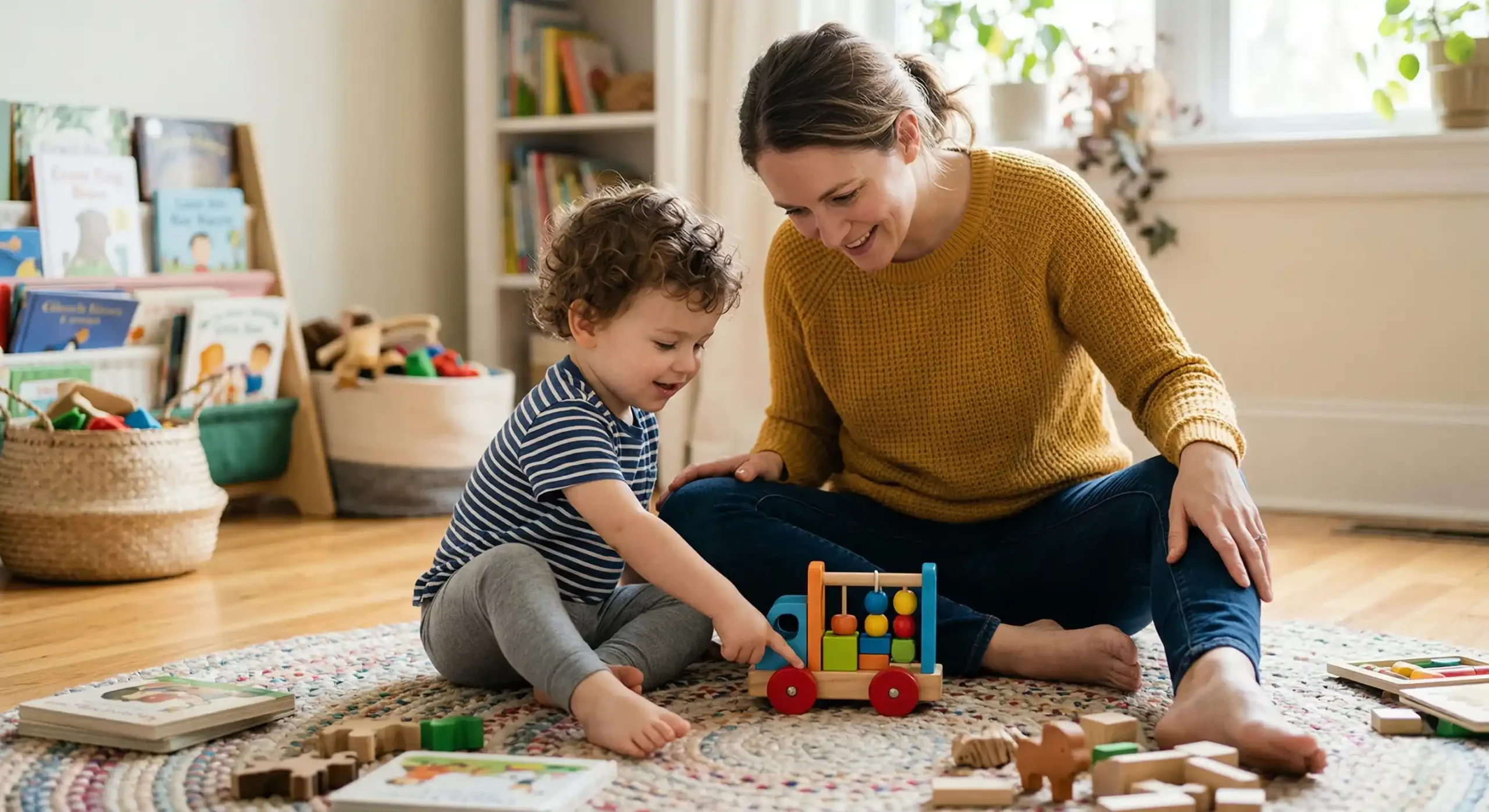
Is your 2-year-old not talking yet, even though they understands your simple instructions? Many parents notice that their child responds with gestures and follows directions, yet the words they are waiting for still have not come. This situation is often described as being a “late talker.” or showing signs of speech delay in toddlers.
There are many reasons a 2-year-old is babbling but not talking. At age two, language development milestones typically begins to grow at a lightning-fast pace. Most toddlers start combining words, naming familiar objects, and expressing their simple needs.
However, when these milestones do not appear on the expected timeline, it is natural for parents to feel concerned — but it does not always mean something is wrong. Research shows that proactive early intervention for speech can make a big difference in long-term communication outcomes.
In this guide, we’ll walk you through what’s considered normal speech development at age two, explain when to worry about speech delay and seek professional help, and share science‑backed activities to encourage speech.
Is It Normal for a 2-Year-Old Not to Talk Yet? (Quick Summary)
By age two, most toddlers use 50+ words and begin combining simple phrases. While many “late talkers” catch up over time, clinical research highlights the importance of receptive language (what your child understands) and social gestures like pointing or showing.
According to the American Academy of Pediatrics (AAP) and CDC milestones, if your child understands well, responds to their name, and uses gestures, it often suggests that the brain pathways for speech are still developing—even if spoken words are not yet consistent.1
However, if speech delay is accompanied by limited eye contact, poor joint attention, or a lack of symbolic play, it may indicate neurodevelopmental concerns such as Autism Spectrum Disorder (ASD) or ADHD. In these cases, early intervention is the clinical gold standard.
Two-Year-Old Speech Development Milestones
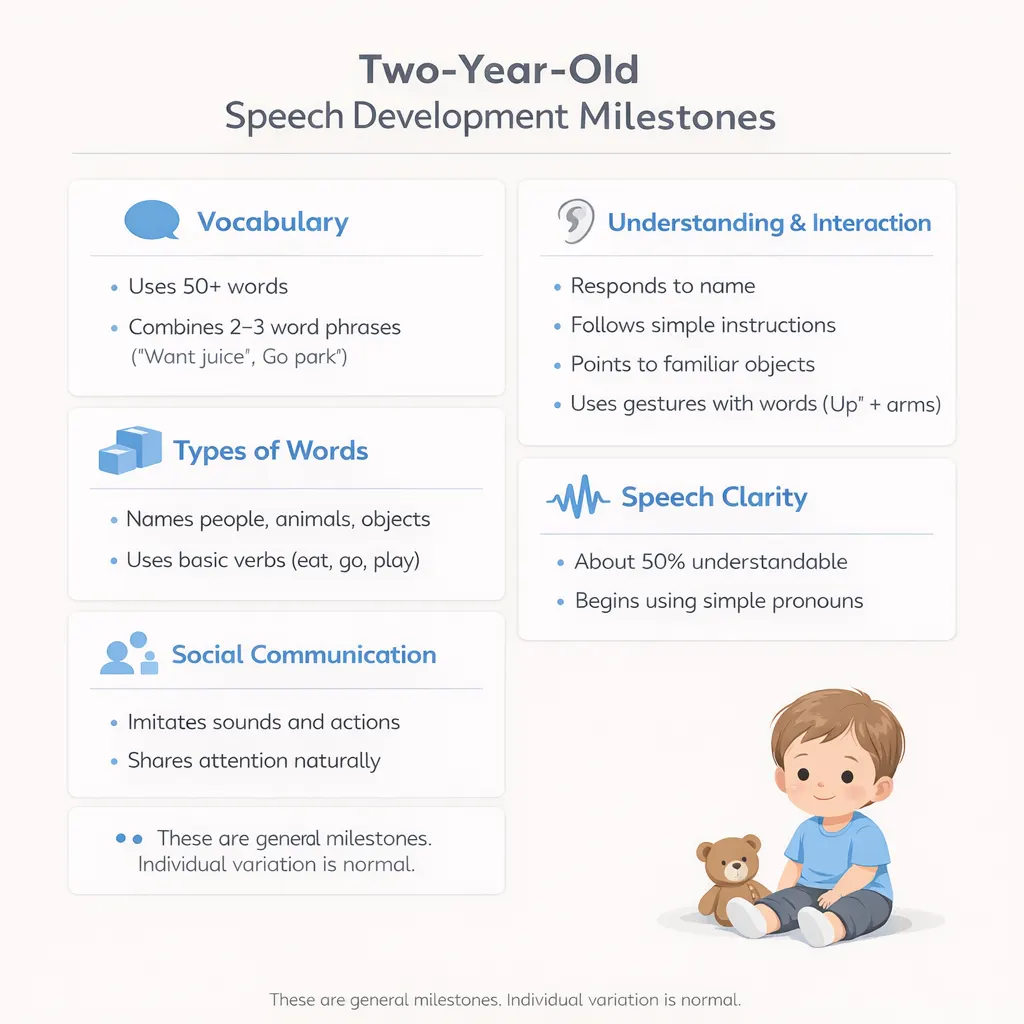
At around two years of age, children show a wide range of normal language development. While every child progresses at their own pace, the AAP and CDC clinical guidelines suggest most toddlers at this stage: 1, 2
1. Vocabulary
- Uses 50+ words (“Ball, dog, milk”)
- Combines 2–3 word phrases (“Want juice”, “Go park”)
2. Understanding & Interaction
- Responds to name (When you call “Aarav!”, he looks at you)
- Points to objects when named (Say “Where’s the car?” → child points to toy car)
- Follows simple one‑step instructions (“Give me the spoon” → child hands it over)
- Uses gestures along with sounds (Raises arms and says “Up”)
3. Types of Words
- Names people, animals, objects (“Mama”, “dog”, “ball”)
- Uses basic verbs (“Eat”, “go”, “play”)
4. Speech Clarity
- About 50% understandable (Strangers catch about half of what they say)
- Begins using simple pronouns (“Me do it”, “My toy”)
5. Social Communication
- Good imitation (Repeats “bye‑bye” while waving)
- Good joint attention (Looks at book picture, then back at you to share interest)
- Shares attention (Points to airplane in sky to show you)
- Expresses needs and feelings (“Want cookie”, “No sleep”)
Crucially, receptive language (what they understand) usually develops faster than expressive language (what they say). If your child understands much more than they can say, it is often a sign that the foundation for speech is being built, even if the “output” is delayed.
Signs of a Healthy Late Talker in Toddlers
These are the key signs that your toddler may be a healthy late talker rather than showing a speech delay
- Babble frequently with varied sounds
- Responds to their name consistently
- Communicate effectively using pointing, eye contact, and physical actions.
- Follows simple commands (e.g., “Go get your shoes”) even without speaking.
- Show a consistent interest in social play and interaction.
The key is not just how many words your child says, but how they connect, understand, and communicate in their own way. If progress stalls, or if there are concerns about hearing, comprehension, or social interaction, it is always best to seek professional guidance early.
Read More: If you are trying to distinguish between developmental stages, see our guide: Is It ADHD or Normal 3-Year-Old Behavior?
Late Talker vs. Speech Delay: Understanding Key Differences
Not all speech delays are the same. This table highlights key differences to help you know when to wait and when to act.
| Feature | Late Talker (Late Bloomer) | Speech Delay (Clinical Concern) |
|---|---|---|
| Receptive Language | Understands well; follows simple instructions. | Struggles with basic directions; limited understanding. |
| Non-Verbal Cues | Uses pointing, waving, and eye contact. | Limited gestures; weak eye contact. |
| Social Interaction | Engages in play; responds to name. | Avoids eye contact; low social engagement. |
| Imitation | Copies actions, sounds, or words. | Rarely imitates; limited effort. |
| Play Skills | Pretend play (toys, dolls). | Little pretend play; repetitive actions. |
| Babbling & Sounds | Frequent, varied sounds. | Limited or repetitive sounds. |
| Progress Over Time | Slow but steady; often catches up. | Stalled or regressing; minimal progress. |
| Neurological Note | Speech output delay. | Broader developmental concerns. |
| Need for Intervention | Improves with rich language input. | Early intervention recommended. |
Will My Late Talker or Speech Delayed Children ‘Grow Out of It’?
Many late talkers do eventually catch up, especially if they show strong receptive language skills (understanding instructions), use gestures like pointing, and demonstrate an interest in social play. In these cases, spoken words often emerge between ages 3 and 4 as the brain’s language pathways mature.
However, clinical observations suggest that approximately 40–50% of late talkers do not “grow out of it” without support. As researcher Leslie Rescorla found in her longitudinal studies, while many “late bloomers” eventually reach the average range of language use, they often continue to lag behind their peers in subtle areas of grammar and vocabulary into their school years if not supported early.3
From a neurological perspective, ages 2 to 5 are a critical window for brain development. Waiting to “see what happens” can mean missing the best time for progress.
The Researcher’s Perspective: The Brain Behind the Speech
Speech is not just about the mouth; it is about the maturation of the brain’s internal wiring. Specifically, we look at:
- Broca’s Area: The region responsible for speech production.4
- The Arcuate Fasciculus: The neural “bridge” that connects our understanding of language to our ability to speak it.5
When a 2‑year‑old is not talking yet, it often reflects differences in how these brain systems are maturing. Just like walking, these neural connections don’t follow a rigid schedule—some children build these “bridges” earlier, while others take longer to develop the same level of linguistic output.
Read More: If you want to learn how brain “wiring” affects behavior, see: ADHD Transition Difficulties in Kids
Common Causes of Speech Delays in 2-Year-Olds
Speech delays in toddlers are common, but understanding the possible causes helps parents know when to seek help. Below are the most frequent reasons why a 2‑year‑old may not be talking as expected:
1. Hearing Problems
Hearing loss or frequent ear infections can make it difficult for toddlers to hear and imitate sounds. If a child cannot clearly hear words, speech development may be delayed.
2. Limited Language Exposure
Children learn language by listening and interacting. A home environment with fewer conversations, reading, or play opportunities may slow vocabulary growth.
3. Opportunities for Interaction and Play
Toddlers need daily opportunities to interact with caregivers and peers. Limited playtime or reduced social interaction can delay speech and language skills.
4. Exposure to Language at Home and in Social Settings
Children thrive when surrounded by rich language environments. Frequent conversations, storytelling, and reading encourage faster speech development, while limited exposure can slow progress.
5. Oral‑Motor Challenges
Some toddlers struggle to coordinate the muscles needed for speech. This can make producing sounds or combining words more difficult.
6. Neurological or Cognitive Factors
Lack of focus, attention, or eye contact can significantly affect how quickly a child learns and uses language.
When these markers are inconsistent, it is harder for the brain to build the neural connections needed for clear and consistent speech. These patterns are often seen in ADHD or Autism Spectrum Disorder (ASD).
If you want to learn more about these patterns, see our clinical guide:Early Signs of ADHD in Toddlers (Ages 2–5): What is Normal vs. a Red Flag?
7. Environmental and Emotional Factors
Stress, trauma, or limited caregiver or parents interaction can reduce opportunities for communication and slow speech development.
Speech Red Flags: When Science Says It’s Time to Act
While many late talkers catch up naturally, the American Academy of Pediatrics (AAP) warns that deficits in foundational skills can signal a true speech delay.6
These red flags highlight critical areas where development may be stalled. If you notice these markers, it is time to move past “wait and see” and seek professional guidance.
1. Limited Eye Contact
Eye contact is the “social anchor” for communication. Babies usually start using it around 9 months, and by age two it should be very consistent. A toddler should look at you to share something, ask for help, or check in.
- The Red Flag: If a child avoids eye contact or looks “through” you, it may signal social challenges. It can also make it harder for their brain to connect mouth movements with sounds — an important step in learning to talk.
2. Lack of Symbolic Play
Toddlers typically begin engaging in pretend play, such as feeding a doll, driving toy cars, or using objects to represent something else. This type of imagination reflects early thinking and communication skills.
- The Red Flag: If a child only engages in repetitive motor actions (like pushing a toy car back and forth) but never pretends it’s “going shopping” or “carrying people,” it may signal delays in cognitive development or limited social interaction..
3. Lack of Pointing
Pointing is one of the earliest ways children share attention and communicate needs. It is more than just a request; it is a powerful social skill that demonstrates a child’s desire to connect and share experiences with you.
- The Red Flag: A typical toddler points to a toy they want or something they find interesting. If a child rarely points to show or request, it may indicate underlying challenges in early social communication.
4. Limited Joint Attention
Joint attention means sharing focus with another person—for instance, looking at a book together, following a parent’s gaze, or showing an object to share interest.
- The Red Flag: When a parent points to a dog in the park and the child does not look at the dog or respond to the shared moment, it can be an early biological sign of communication or social delays.
5. Limited Receptive Language
Receptive language refers to the ability to understand words and instructions. From a clinical perspective, this is often the most critical marker for long-term neurodevelopment.
- The Red Flag: When asked to “bring the ball” or “sit down,” the child does not respond, even with familiar objects nearby. Difficulty here is paramount to notice early, as understanding is the “neural floor” upon which the “walls” of speaking are built.
💡 Note: Think of these early skills as the foundation for speech. Before you can build the walls (spoken words), you need a solid floor and frame (pointing, playing, and understanding). Addressing these “silent” markers through early intervention can make a profound difference in a child’s overall developmental trajectory and future communication success.
Does Your Two-Year-Old Need Speech Therapy?
Not every child who talks late needs speech therapy. Many toddlers catch up on their own, especially if they show strong understanding, gestures, and interest in communication. However, there are situations where professional support can make a big difference.
Signs Your Child May Need Speech Therapy
- Speaks fewer than 20 words by 24 months.
- Does not combine two words like “more milk” or “mama come”
- Limited use of gestures such as pointing, waving, showing objects.
- Poor eye contact or reduced social interaction.
- Difficulty following simple instructions like “bring the ball” or “sit down.”
- No noticeable improvement in speech over several months.
If your child is not yet talking but you feel they should be, ask your pediatrician for a referral to a speech therapist.
Benefits of Early Speech Therapy
Speech therapy does not just focus on words—it helps strengthen the building blocks of communication— like play, attention, and understanding. Early support can:
- Boost confidence,
- Reduce frustration, and
- Set the stage for smoother language growth.
11 Science-Backed Activities to Encourage Speech at Home
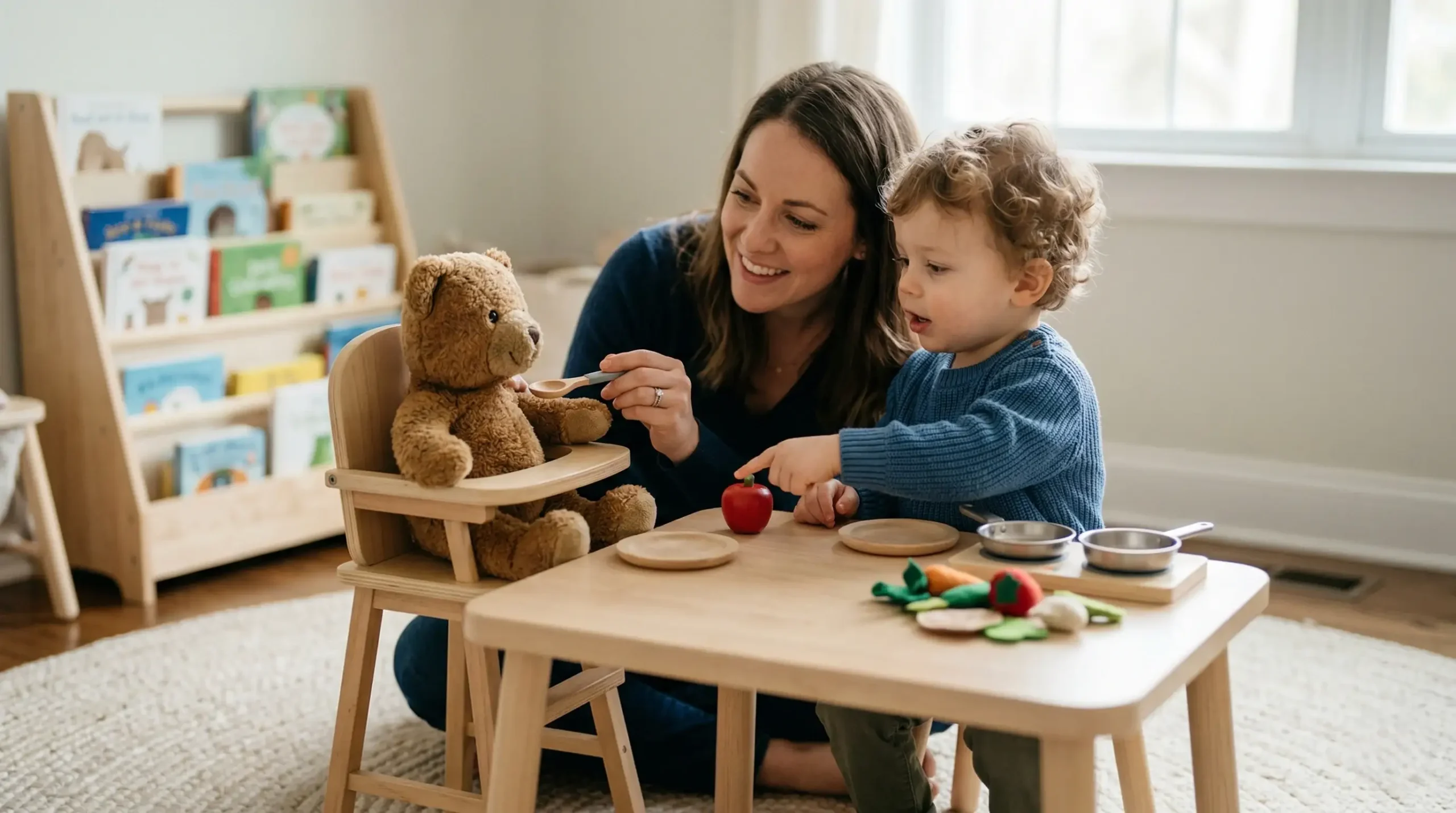
If your 2-year-old is not talking, the goal is to lower the “pressure” while increasing the “input.” Speech is a motor skill that requires a relaxed, engaged brain to develop. These activities encourage pointing, playing, and understanding—the foundations of language.
1. Pretend Play
Pretend play is one of the most powerful ways to encourage speech because it combines imagination, social interaction, and language. Using dolls, stuffed animals, or toy kitchens to act out simple stories helps toddlers connect words with actions.
Example: “The teddy is hungry—let’s feed him!”
Repetition and role‑play help toddlers connect words to actions, while encouraging pointing and choices builds communication.
2. Parallel Talk and Self-Talk
Think of yourself as a sports commentator for your child’s life.
- Self-Talk: Describe what you are doing. (“I am washing the blue plate. Scrub, scrub, scrub!”)
- Parallel Talk: Describe what your child is doing. (“You are building a tall tower! Up it goes.”)
This provides a constant stream of narrated vocabulary without the pressure of a “test” (like asking “What’s this?”).
3. Reduce the “Questioning”
Avoid asking “What’s this?” or “Say apple.” This can create performance anxiety. Instead, make statements. “Yum, yellow banana. Mommy is peeling the banana. Sweet banana!”
4. The Power of the Pause
After you speak or ask a simple question, wait 5 to 10 seconds. Toddlers often need a long “processing time” to formulate a sound. Silence is your best tool.
5. The Modeling Method: Connecting Sounds to Actions
Instead of demanding speech, show your child how words sound in real-life moments. By using repetition, rhythm, and excitement, you help their brain connect a sound to an action:
- 🟡 Ball… ball… ball (while rolling the ball slowly toward them)
- 🟤 Open… open… OPEN! (while opening a box or snack with excitement)
- 🟢 Bye… bye… bye (while waving gently and smiling)
- 🔵 More… more… MORE! (while giving food or toys in small portions)
Modeling words in context helps toddlers connect sounds with actions, making language feel natural and fun.
6. Talk throughout the day
Narrate what you’re doing (“Mommy is cooking rice,” “Daddy is opening the door”). This “sportscasting” maps words to real-time actions, strengthening the brain’s language connections.
7. Respond to gestures and sounds
Treat pointing, babbling, or eye contact as communication and respond warmly. This reinforces the idea that their attempts to connect are successful.
8. The “Plus One” Rule (Expansion)
When your child says one word, repeat it back and add one more.
- Child: “Car!”
- You: “Yes, blue car!” or “Car is fast!”
- Why it works: It meets them at their current level while showing them the very next step in sentence structure.
9. Limit screen time
Real conversations and play are far more effective for language growth than passive watching. High-quality human interaction is the primary driver of neurodevelopment.
10. Read together daily
Read to your child every day. Reading will help them learn new words. Point to the pictures as you read and discuss what is happening in the story. Picture books build vocabulary and spark interaction.
11. Be patient and positive
Try to be patient when communicating with your child. Give them time to respond, and don’t get frustrated if they don’t understand everything you are saying. Celebrate small steps—every sound, gesture, or attempt counts.
The Takeaway: Trust the Foundation, Not Just the Word Count
As a researcher, I encourage you to look at the whole child rather than just the number of words they say. Speech is only the final “output” of a complex neurological process.
If the foundation is strong—your child points, plays, understands instructions, and seeks your attention—the “neural bridge” for speech is likely just under construction.
If the foundation feels shaky—such as a lack of pointing, limited eye contact, poor response to name, or difficulty with joint attention—don’t “wait and see.” These are silent red flags worth noticing.
Early intervention is the clinical gold standard. It does not just “teach words”; it strengthens the brain’s ability to connect and communicate. If you have a gut feeling that something is being missed, trust your parental intuition and request a professional evaluation. Your proactive steps today are the best gift you can give your child’s future communication.
Frequently Asked Questions About a 2-Year Old’s Speech
Q1. What is normal speech for a 2‑year‑old?
By age two, many children use around 50 or more words, begin combining two words (like “more milk” or “mama come”), and understand simple instructions such as “bring the ball.” These are typical milestones, but every child develops at their own pace.
Q2. What are signs of delayed speech in a 2‑year‑old?
Signs include fewer than 20 words by age two, rarely combining words, limited gestures (pointing, waving, showing objects), difficulty following simple directions, lack of eye contact or response to name, and little progress over several months despite encouragement.
Q3. When should I worry about my toddler not talking?
If your 2‑year‑old is not using words, not pointing or gesturing, not responding to their name, or not understanding simple instructions, it’s important to seek professional advice early. Early support can significantly improve outcomes.
Q4. What are common reasons for delayed speech in children?
Delayed speech can be linked to hearing difficulties, limited exposure to spoken language, developmental differences such as autism spectrum disorder, oral‑motor challenges, or broader communication delays.
Q5. How can I help my 2‑year‑old with their speech?
You can model words in daily routines, read picture books together, play pretend games, respond warmly to gestures and sounds, and use the “Plus One” rule—expanding their words by adding one more. These strategies make language feel natural and fun.
Q6. At what age do late talkers usually start talking?
Many late talkers catch up between ages 3 and 4, especially with rich language input and play. Early support and professional guidance can make a big difference in long‑term communication skills.
Q7. How Do I Know if My Child is Just a Late Talker Or if It’s Something More?
Some toddlers are late talkers and catch up naturally, but if your child shows limited gestures, poor joint attention, difficulty understanding simple instructions, limited eye contact, or does not respond to their name, it may be more than just late talking. Consulting a pediatrician or speech‑language pathologist early can help determine whether extra support is needed.
References
📚 Click to view references
- Centers for Disease Control and Prevention (CDC). (2026). Developmental Milestones: 2 Years. View Source
- American Academy of Pediatrics. (2024). Developmental Milestones: 2-Year-Olds. View Source
- ResearchGate. (2012). Late Talkers: Do Good Predictors of Outcome Exist?: View Source
- Stinnett TJ, Reddy V, Zabel MK. (2023). Neuroanatomy, Broca Area. StatPearls Publishing. View Source
- ScienceDirect. (2011). Arcuate Fasciculus – Overview. View Source
- American Academy of Pediatrics. (2020). Promoting Optimal Development in Young Children. View Source
