
Written by:
MediHealth PRO Editorial Team
Scientifically Reviewed by:
Dr. Amit Pande, PhD
Molecular Biologist & Clinical Research Expert | Independent Scientific Reviewer, MediHealth PRO
Medically Reviewed by:
Dr. Arghyadeep Marik, MD
Specialist in Immunohematology & Blood Transfusion Medicine | Independent Medical Reviewer, MediHealth PRO
Key Takeaways:
- ADHD in toddlers is identified through behaviours that persist across home, daycare, and social settings rather than isolated situations.
- Core signs include hyperactivity, impulsivity, and inattention that are more intense than expected for age.
- Before age 4 to 5, high activity and short attention spans are still part of normal development. Age and context matter when interpreting behaviour.
- There is no single test for ADHD. Clinicians rely on reports, observation over time, and developmental history.
- Sleep issues, iron deficiency, hearing problems, and sensory differences can closely mimic ADHD and need to be assessed before drawing conclusions.
- Early assessment helps clarify the cause and guide appropriate support.
Recognising early signs of ADHD in toddlers is not always straightforward. Young children are naturally curious, energetic, and impulsive, which can make it difficult to separate normal development from early behavioural concerns.
However, when a child’s activity level begins to consistently affect safety, sleep, learning, or daily routines, parents often start to wonder whether this is expected for their age or something that needs closer attention.
Most high-energy behaviour in toddlers is still typical for this stage. The brain is rapidly maturing, especially the areas responsible for attention, impulse control, and emotional regulation.
ADHD, on the other hand, is a neurodevelopmental condition that affects how the brain manages focus, impulses, and behaviour over time.
This guide focuses on patterns over time rather than one-off behaviours, helping parents understand what truly matters.
Quick Answer: What are the early signs of ADHD in toddlers?
Early signs may include constant movement without clear purpose, difficulty staying engaged even in preferred activities, frequent impulsive actions, strong emotional reactions, and sleep difficulties or disrupted sleep patterns.
These concerns become more relevant when they are consistent over time and appear in multiple everyday settings such as home and preschool.
Toddler Development vs ADHD Symptoms: What Normal Actually Looks Like
A toddler’s brain is still developing rapidly, especially the areas responsible for attention, impulse control, and emotional regulation. Because of this, many behaviours that may look like ADHD are actually a normal part of early childhood.
Typical Toddler Development
In most young children, high activity and emotional expression are part of healthy development and usually have a clear purpose.
- Movement is goal-directed. A child runs to reach a toy, climbs to get something, or jumps because play calls for it.
- Impulsivity is present but often responsive. They may rush toward danger, but usually stop when told no with repetition over time.
- Attention span is short but developing. A three-year-old can typically focus for around six to eight minutes on a preferred task; a four-year-old often manages around eight to twelve minutes.
- Emotional reactions are strong but developmentally appropriate. Small frustrations trigger big responses because emotional processing develops faster than impulse regulation at this age.
- Transitions are difficult but manageable. Most four-year-olds can shift from play to meals with consistent routines and reminders in place.
When Behaviour May Need Closer Attention
Clinicians look more closely when patterns are persistent, unusually intense, and present across more than one setting.
Concerns may arise when:
- Behaviour does not improve over time despite guidance
- Difficulties are seen in more than one setting consistently
- Daily routines, learning, or safety begin to be affected
Feature Comparison: Typical Toddler vs ADHD Red Flags
| Feature | Typical Toddler | ADHD Red Flag |
|---|---|---|
| Movement | Moves with a clear purpose, usually linked to play or goals | Constant movement that continues without clear purpose, even in calm situations |
| Impulses | Usually responds to “stop” with reminders over time | Finds it difficult to stop and may repeat risky actions |
| Focus | Stays engaged briefly, especially in preferred activities | Gets easily distracted by small noises or environmental changes |
| Emotions | Gets upset but settles down relatively quickly | Emotional reactions are intense and take longer to calm |
| Bedtime | Naturally slows down when tired | Becomes more active or restless when overtired |
| Sleep | Generally stable and restful | Frequent waking or disrupted sleep patterns |
| Setting | Behaviour changes depending on situation | Similar behaviours appear across home, daycare, and social settings |
ADHD Symptoms Age by Age (2 to 5 Years)
Understanding how behaviour patterns shift as the brain develops makes it easier to recognise what warrants attention at each stage.
| Age | Typical Development | ADHD-Related Concerns |
|---|---|---|
| 2 Years | Explores and climbs with a clear goal or interest in mind. | Movement appears constant and less linked to a clear purpose or activity. |
| 3 Years | Can stay engaged with a preferred toy or activity for several minutes. | Frequently shifts between activities with very short attention span. |
| 4 Years | Usually responds to simple instructions with gradual improvement over time. | Finds it difficult to stop unsafe or disruptive actions even after repeated reminders. |
| 5 Years | Can sit briefly during structured group activities with support. | Has difficulty staying seated or following simple group instructions for expected age level. |
Signs of ADHD in 2 year olds
At age two, most children are highly active and exploratory. Many behaviours that look concerning at this stage are still developmentally normal.
However, it may be worth observing more closely when:
- Movement feels constant and is not clearly tied to play or purpose.
- Unsafe actions are repeated even after gentle correction.
- Tantrums are unusually long or difficult to calm compared to other toddlers.
Signs of ADHD in 3 year olds
By age three, children begin responding more to simple instructions and routines.
Possible concerns may include:
- Frequently switching activities without settling into any one task.
- Becoming easily distracted by sounds or movement that others ignore.
- Emotional reactions that take a long time to settle even after comfort.
Signs of ADHD in 4 year olds
At this stage, children usually show improving impulse control and more structured play.
Attention may be needed when:
- Behaviour appears less mature compared to peers of the same age.
- High activity levels continue across home, daycare, and play settings.
- Transitions remain very difficult even with clear routines and warnings.
Signs of ADHD in 5 year olds
Starting school increases the demands on attention, impulse control, and social regulation, which can make previously unnoticed patterns more visible.
Some patterns that may stand out include:
- Difficulty staying engaged in group activities such as circle time.
- Playing too roughly or disrupting peers more often than expected.
- Becoming more restless in the evening instead of gradually winding down.
7 Neurological ADHD Red Flags in Toddlers to Watch For
If several of these patterns appear consistently across different settings and over time, it is worth discussing them with a paediatrician.
1. Movement without direction or purpose
Children showing early ADHD traits often move continuously without a clear goal. This persists even during quiet activities like meals or story time, and continues long after the child appears physically tired.
2. Persistent inability to stop after clear guidance
All toddlers are impulsive, but a consistent pattern of being unable to stop despite repeated, calm correction is worth noting.
This may look like:
- Running into unsafe areas without hesitation.
- Repeating risky actions immediately after getting hurt.
- Finding it genuinely difficult to wait, even for a very short time.
3. Attention that fragments easily
The ability to filter out background noise and stay with a task develops more slowly in children with ADHD traits.
This may present as:
- Rapid switching between activities without engaging meaningfully with any.
- Strong sensitivity to background sounds that other children ignore.
- Difficulty staying with even preferred tasks through to completion.
4. Emotional reactions that are intense and slow to recover
Tantrums are developmentally normal, but patterns that warrant attention include:
- Reactions that are noticeably more intense than those of same-age peers.
- Meltdowns triggered by minor frustrations.
- Difficulty recovering even after the trigger is removed and comfort is offered.
5. Difficulty slowing down at night
Rather than winding down as tiredness increases, some children with ADHD traits become more active and harder to settle.
This can include talking continuously, fidgeting in bed, getting up repeatedly, or reacting strongly to small sounds or changes in the room.
Research has also documented delayed melatonin release in children with ADHD, which may shift sleep timing and make falling asleep harder even with a consistent bedtime routine.
6. Poor sleep affecting daytime behaviour
When sleep is consistently disrupted or insufficient, the effects show clearly during the day — increased restlessness, lower frustration tolerance, and difficulty sustaining attention. This can make existing ADHD traits more pronounced and harder to distinguish from other causes.
7. Behaviour that is consistent across all settings
ADHD traits do not appear only at home or only at daycare.
If the same patterns of hyperactivity, impulsivity, or inattention appear consistently at home, at preschool, and in social settings, that cross-setting consistency is one of the strongest indicators clinicians look for.
If a child is hyperactive only at home but calm and focused elsewhere, the cause is more likely environmental, routine-related, or sensory than neurological.
Related Post: Not sure if these signs are just a phase? Read our Side-by-Side Comparison: High Energy vs. ADHD.
Wait—Could it be something else? Conditions that can look like ADHD
Before confirming early signs of ADHD in toddlers, clinicians typically rule out other conditions that can produce similar behaviour patterns. Identifying these first ensures a child receives the right support rather than a premature diagnosis.
Thyroid Dysfunction
An overactive thyroid can cause restlessness, irritability, and difficulty settling — symptoms that closely resemble ADHD hyperactivity.1
Related Post: Is It ADHD or a Thyroid Condition? 7 Hidden Signs of Misdiagnosis in Children
Mineral Deficiencies
Iron, magnesium, and zinc play a direct role in dopamine production and regulation. When these levels are low, the brain may struggle to support focus, emotional balance, and self-regulation.2
Related Posts:
- Magnesium and ADHD in Children: What Parents Should Know
- Zinc and ADHD in Children: Hidden Link Parents Should Know
- Is It ADHD or Iron Deficiency in Children? 7 Hidden Signs to Avoid Misdiagnosis
Sensory Processing Issues
Some children need stronger physical input to feel settled. They may crash into things, jump constantly, or spin, not because of hyperactivity alone, but because their nervous system is seeking sensory feedback to feel regulated.3 This pattern can look like ADHD but has a different underlying cause, though both can occur together.
Sleep Apnea
Enlarged tonsils or disrupted breathing during sleep can significantly affect daytime behaviour, including restlessness and poor attention, in ways that closely resemble ADHD symptoms.4
Hearing or Language Delays
A child who cannot fully process spoken instructions may appear inattentive or unresponsive. Ruling out hearing difficulties is an important early step before any behavioural assessment.
The Science: What Makes an ADHD Brain Different?
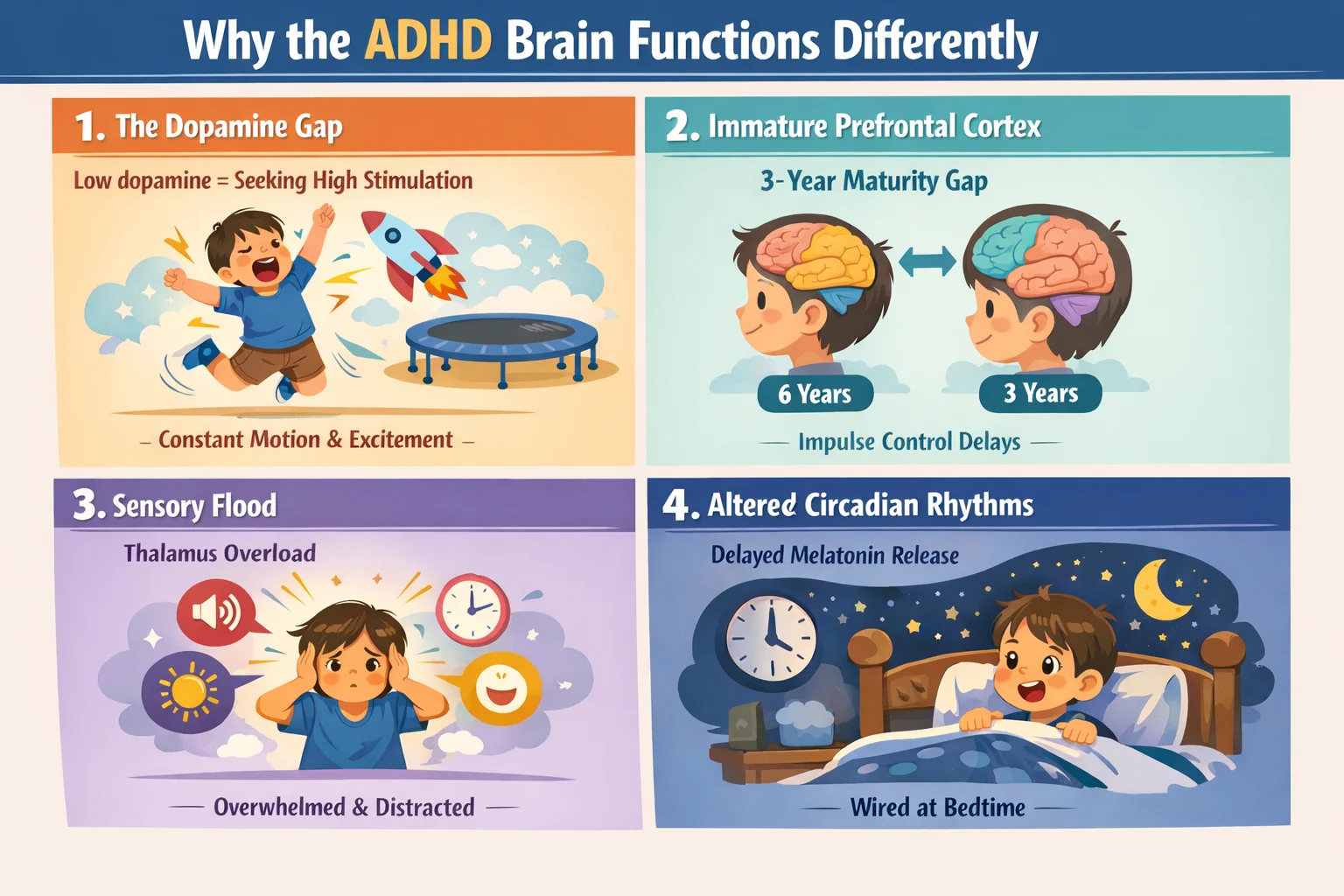
Understanding the biology behind these behaviours helps explain why ADHD traits are not linked to parenting style, discipline, or motivation. They reflect how certain brain systems develop and communicate over time.
Differences in brain development, dopamine regulation, sensory processing, and sleep–wake rhythm all contribute to how attention and behaviour are expressed in early childhood.
Research & Statistics on ADHD
Current research helps provide context on how ADHD presents in children and how frequently it is identified.
- 11.4% of children (3–17) have received an ADHD diagnosis. (CDC survey)
- 1.4% of toddlers (3–5) are diagnosed early, although diagnosis at this age remains uncommon. (JAMA Network)
- Boys are diagnosed at roughly twice the rate of girls (around 15% vs 8%). (CDC)
- Nearly 78% of children with ADHD have at least one co-occurring condition, most commonly anxiety (39%) or behavioural difficulties (44%). (CDC)
1. The Dopamine Gap: Why ADHD Toddlers Seek High Stimulation
Dopamine is a neurotransmitter involved in motivation, focus, reward, and attention.5 Research suggests that in children with ADHD-like patterns, dopamine signaling may work less efficiently.
Because of this, the brain often seeks stronger stimulation to stay engaged. That is why some toddlers constantly jump, climb, shout, run, or move rapidly from one activity to another.
These high-energy behaviors may actually be the brain’s way of trying to stay alert and focused.
2. The Maturity Gap: Big Emotions, Limited Self-Control
The emotional part of the brain (the limbic system) develops earlier than the prefrontal cortex — the area responsible for impulse control, planning, and self-regulation.6
In children with ADHD, the prefrontal cortex may mature more slowly, sometimes by several years.
This developmental mismatch can make behavior look younger than the child’s actual age.
For example, a highly energetic 4-year-old may still struggle with emotional regulation and impulse control in ways more typical of a younger toddler.
3. Sensory Overload: Why Everything Feels Distracting
Most brains automatically filter out unimportant background information, such as distant sounds or visual distractions. In children with ADHD-like traits, this filtering system may work less efficiently.7
As a result, sounds, movements, lights, and other sensory input may compete more equally for attention.
During play or conversation, a child may appear distracted or unable to listen. Not because they are ignoring their parents, but because their brain may be trying to process too much information at once.
4. Circadian Delay: The Bedtime “Second Wind”
Melatonin is the hormone that helps regulate the body’s sleep–wake cycle.8
Some children with hyperactive or ADHD-like patterns may release melatonin later than expected, shifting their internal body clock.
This may help explain why certain children suddenly seem more energetic, talkative, or restless at bedtime instead of becoming sleepy. Parents often describe it as a nighttime “second wind,” even after a very active day.
When to Talk to a Pediatrician
Because toddler brains are still developing rapidly, a formal ADHD diagnosis is rarely made before age four or five.
However, it is worth seeking an evaluation if you consistently notice any of the following:
1. Safety is a recurring concern
All toddlers take risks, but concern increases when impulsive behaviour repeatedly overrides correction.
If your child regularly runs into traffic, climbs dangerous heights, or touches hot surfaces despite consistent redirection, it may be time for an evaluation instead of waiting to see if they “grow out of it.”
2. Daily routines feel consistently unmanageable
Occasional difficult outings are normal during the toddler years. But if everyday activities like grocery shopping, mealtimes, daycare drop-offs, or family visits regularly feel overwhelming, it may be helpful to speak with a professional.
3. Social difficulties are persistent
Some difficulty with sharing and taking turns is completely normal at this age.
However, if your child regularly plays too roughly, struggles to join simple group activities, or is frequently excluded from daycare or playgroups, it may be worth discussing these concerns with a paediatrician.
4. Sleep problems are affecting the whole family
Some children with ADHD-related traits may have delayed melatonin release, which can affect sleep patterns.
If your child regularly struggles to fall asleep or stay asleep, and the exhaustion is impacting daytime behaviour or family functioning, further evaluation may help identify possible contributing factors.
Parent Note: Keeping short notes about your child’s behaviour across different settings for one to two weeks before the appointment can give your paediatrician a much clearer picture than a single office visit alone.
Conclusion
Recognising early signs of ADHD in toddlers is not about finding fault or reaching for a label. It is about understanding how a child’s brain is developing and ensuring appropriate support at the right time.
When behavioural patterns persist across different settings and continue over time, the most helpful next step is careful observation, documenting concerns, and consulting a paediatrician. This helps bring clarity for families and guides the right support for the child.
Frequently Asked Questions (FAQ)
Q1. What are the early signs of ADHD in toddlers?
Early signs include constant purposeless movement, high impulsivity, difficulty staying with any activity, and emotional reactions that are hard to settle. These patterns are more significant when they appear consistently across home, daycare, and play settings, rather than only during stressful or tiring days.
Q2. At what age do signs of ADHD usually start showing?
ADHD signs typically become more noticeable between ages 3 and 5, when structured expectations such as routines and group activities begin. Before this stage, high activity levels and impulsivity are often part of normal toddler development.
Q3. Can a toddler be diagnosed with ADHD?
A formal ADHD diagnosis before age 4 is uncommon. In most cases, clinicians prefer to observe behaviour over time and provide supportive strategies first, rather than making an early diagnostic label in very young children.
Q4. What is normal toddler behaviour vs ADHD symptoms?
Normal toddler behaviour is situational and improves gradually with routine, guidance, and age. ADHD-related patterns are more persistent, harder to redirect, and often interfere with sleep, safety, learning, or daily functioning across multiple environments.
Q5. What conditions can look like ADHD in toddlers?
Several conditions can mimic ADHD-like behaviour, including sleep disturbances, iron deficiency, hearing problems, language delays, sensory processing differences, and thyroid imbalance. These are usually assessed first to ensure an accurate clinical picture.
Q6. How do doctors diagnose ADHD in young children?
There is no single test for ADHD. Diagnosis is based on long-term behavioural patterns, reports from parents and caregivers, developmental history, and ruling out other medical or developmental conditions that may explain the symptoms.
Q7. When should I worry about my toddler’s behaviour?
It may be worth seeking professional advice if behaviour consistently affects safety, sleep, learning, or daily routines, especially when these concerns continue over time and are seen across more than one setting.
Q8. How can I tell normal hyperactivity from ADHD?
Normal hyperactivity is usually goal-directed and improves with structure and age. ADHD-related hyperactivity tends to feel more constant, less purposeful, and more difficult to redirect, even in calm and predictable environments.
References
📚 Click to view citations
- Chen G, Gao W, Xu Y, Chen H, Cai H. Serum TSH Levels are Associated with Hyperactivity Behaviors in Children with Attention Deficit/Hyperactivity Disorder. Neuropsychiatr Dis Treat. 2023 Mar 7;19:557-564. View on PubMed
- Robberecht H, Verlaet AAJ, Breynaert A, De Bruyne T, Hermans N. Magnesium, Iron, Zinc, Copper and Selenium Status in Attention-Deficit/Hyperactivity Disorder (ADHD). Molecules. 2020 Sep 27;25(19):4440. View on PubMed
- Maćkowiak I, Ciesielska J, Ruszczyk M, Opydo-Szymaczek N. Sensory Processing Disorder in Children-Description of the Phenomenon and Practical Procedures. J Clin Med. 2025 Jun 10;14(12):4105. View on PubMed
- Nguyen-Thi-Phuong M, Nguyen-Thi-Thanh M, Goldberg RJ, Nguyen HL, Dao-Thi-Minh A, Duong-Quy S. Obstructive Sleep Apnea and Sleep Disorders in Children with Attention Deficit Hyperactivity Disorder. Pulm Ther. 2025 Sep;11(3):423-441. View on PubMed
- Gold MS, Blum K, et al. Low dopamine function in ADHD: should genotyping signify early diagnosis? Postgrad Med. 2014. View on PubMed
- El-Baba RM, Schury MP. Neuroanatomy, Frontal Cortex. StatPearls [Internet]. 2023. View NCBI Bookshelf
- Batty MJ, et al. Morphological abnormalities in prefrontal surface area and thalamic volume in ADHD. Psychiatry Res. 2015. View PMC Article
- Luu B, Fabiano N. ADHD as a circadian rhythm disorder: evidence and implications for chronotherapy. Front Psychiatry. 2025. View PMC Full Text
