
Written by: MediHealth PRO Editorial Team
Scientifically Reviewed by: Dr. Amit Pande, PhD
Molecular Biologist & Independent Scientific Advisor
Key Takeaways:
- Early signs of ADHD in girls can include daydreaming, forgetfulness, disorganisation, emotional sensitivity, and difficulty completing tasks.
- These symptoms are often misinterpreted as laziness, lack of focus, or personality traits rather than a neurodevelopmental condition.
- Many girls develop masking behaviours such as perfectionism or over-effort, which can delay diagnosis.
- Girls with ADHD may also experience anxiety, depression, learning difficulties, autism spectrum disorder, or sleep issues, which can complicate diagnosis.
- Early recognition and timely support can significantly improve academic performance, confidence, and emotional health.
Attention-deficit/hyperactivity disorder (ADHD) is often harder to recognise in girls than in boys. Many girls with ADHD are not obviously hyperactive or disruptive in the classroom. Instead, they may daydream, appear forgetful, struggle with organisation, or fall behind in school and daily tasks.
Because these signs are not immediately apparent, the early signs of ADHD in girls are frequently missed or diagnosed late. Without the right support, ADHD can affect a girl’s academic progress, friendships, and sense of self in ways that persist well beyond childhood.
10 Early Signs of ADHD in Girls That Are Often Missed
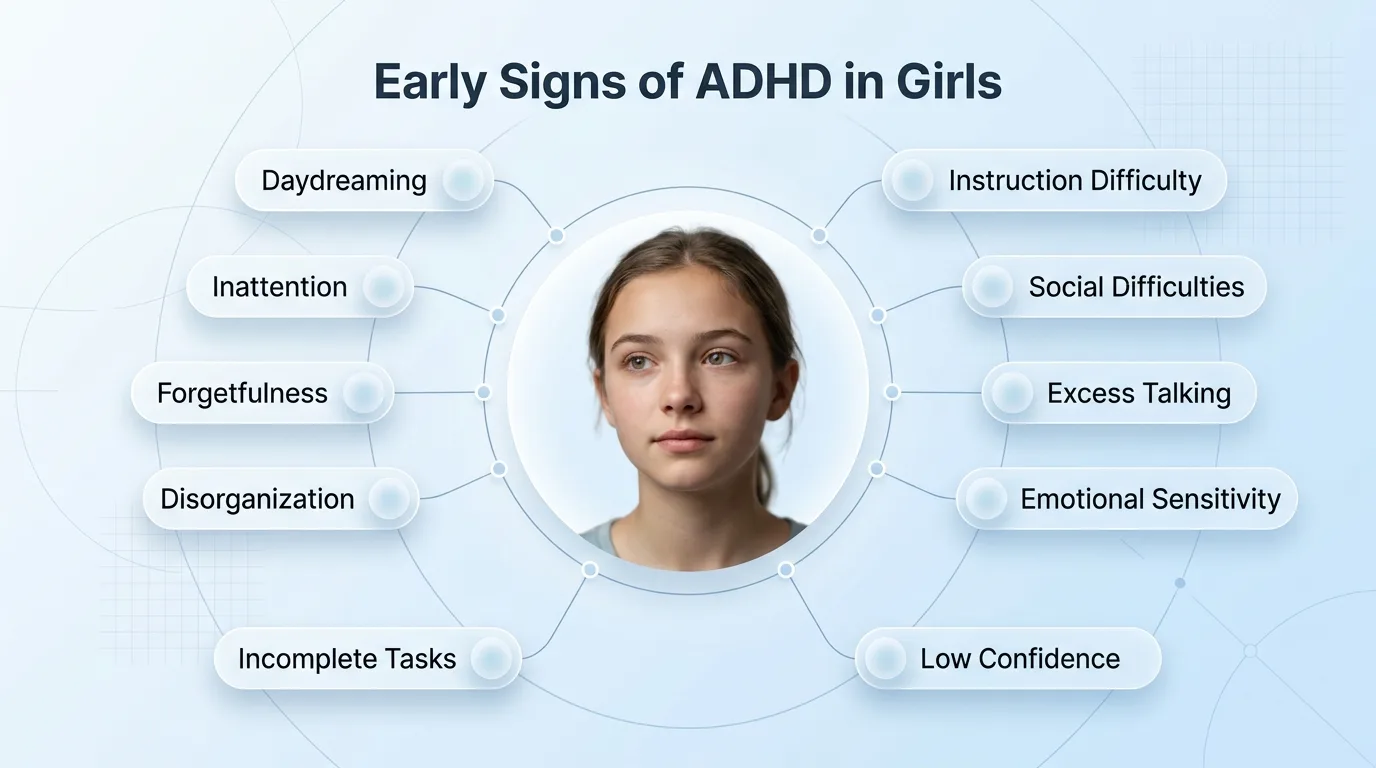
Many girls with ADHD are not obviously hyperactive or disruptive. Instead, they may struggle with attention, organisation, emotions, and friendships and remain undiagnosed for years. Early signs of ADHD in girls may include:
1. Frequent Daydreaming
Many girls with ADHD spend long periods lost in thought, particularly during lessons or structured activities. They may stare out of the window, seem mentally absent, or appear to be in their own world.
This is not laziness or disinterest. It reflects a genuine difficulty staying focused and engaged.
2. Difficulty Paying Attention
Girls with ADHD often struggle to maintain attention even when trying their best. They may miss important details, lose track of conversations, or become mentally disengaged during tasks.
Parents and teachers may assume they are not listening, but the real issue is an inability to sustain focus.
3. Extreme Forgetfulness and Losing Things
Frequently forgetting homework, misplacing school supplies, or losing personal belongings can be an early sign of ADHD. These problems happen again and again in different parts of daily life, not just once in a while like most children experience.
4. Trouble Staying Organised
A messy school bag, unfinished planners, and trouble keeping track of assignments are common in girls with ADHD. They may also find it hard to manage their time or decide what to do first, leading to missed deadlines and unnecessary stress.
These organisation problems are often linked to executive dysfunction, a set of mental skills that help with planning, prioritising, and finishing tasks. This difficulty is common in these girls and can make everyday tasks feel hard to manage.
5. Difficulty Finishing Tasks
Many girls with ADHD begin projects with enthusiasm but struggle to sustain effort through to completion.
Incomplete homework, abandoned hobbies, and frequently moving from one activity to another are common signs of this struggle.
6. Excessive Talking or Interrupting
Hyperactivity in girls frequently presents verbally rather than physically. Some girls talk excessively, interrupt conversations, or switch rapidly between topics.
Because these behaviours are easily mistaken for excitement or poor manners, they are not always recognised as symptoms of ADHD.
Learn more : Why children with ADHD talk so much and the brain mechanisms behind it.
7. Strong Emotional Sensitivity and Mood Swings
Girls with ADHD often experience emotions more intensely than their peers. Minor frustrations may trigger tears, anger, or a sense of overwhelm.
They may take criticism personally and need longer to recover from disappointments. These reactions are often mistaken for oversensitivity.
Some girls with ADHD also experience rejection sensitive dysphoria (RSD),3 an intense emotional response to criticism, rejection, or perceived failure. Even minor setbacks can feel distressing and affect self-esteem and daily functioning.
8. Difficulty Following Instructions
Multi-step instructions present a particular challenge. A girl may follow the first part of a task and lose track of the rest, or become distracted before completing it.
This is often mistaken for carelessness or defiance when it reflects difficulties with attention and working memory.
Many girls with ADHD also have challenges with working memory, the ability to hold and use information temporarily. Difficulties with working memory can make it harder to remember instructions and follow through on multi-step tasks.
9. Low Self-Esteem or Anxiety
Because their struggles often go unnoticed, many girls begin to believe they are lazy, careless, or less capable than their peers.
Repeated difficulties at school and in daily life can contribute to persistent self-criticism, low confidence, and anxiety over time.
10. Problems at School or With Friendships
Girls with ADHD may underperform academically despite having clear abilities.
Friendships can also be difficult to maintain. They may misread social cues, interrupt others, or withdraw from social situations because they feel socially out of place.
Normal Childhood Behaviour vs Possible ADHD
Many behaviours associated with ADHD are also common in children without the condition.
The difference is that ADHD symptoms are persistent, occur across multiple settings such as home and school, and interfere with learning, relationships, or daily life.
| Normal Childhood Behaviour | Possible ADHD |
|---|---|
| Occasionally daydreams during lessons | Frequently daydreams and misses important instructions |
| Sometimes forgets homework or belongings | Forgets homework, school supplies, or personal items despite frequent reminders |
| Has a messy room or school bag from time to time | Persistent disorganisation affecting schoolwork and daily routines |
| Occasionally becomes upset after disappointment | Frequent, intense emotional reactions she struggles to regulate |
| Needs occasional reminders to complete tasks | Starts tasks but rarely finishes without repeated prompting |
| Occasionally interrupts conversations | Frequently interrupts others or struggles to wait her turn |
| Finds some school subjects challenging | Attention and organisation difficulties affect learning across multiple subjects |
No single behaviour confirms ADHD. A healthcare professional diagnoses ADHD based on a persistent pattern of symptoms that has been present for at least six months, began before 12 years of age, and significantly affects daily functioning across multiple settings.
Why Is ADHD Often Missed in Girls?
ADHD is often missed in girls because their symptoms are less obvious than in boys. Many do not show the hyperactivity or disruptive behaviour that draws attention in classrooms.
Instead, they may appear quiet or shy, frequently daydream, forget assignments, struggle with organisation, or find it hard to manage emotions.
Many girls also develop masking behaviours to hide their difficulties.1
They may spend extra time completing work or imitate peers to fit in, rarely speaking about their struggles. Because they are not disruptive, their symptoms often go unnoticed by parents and teachers.
Hormonal changes during puberty can make symptoms more noticeable. Difficulties with attention, emotional regulation, and organisation may worsen during the teenage years, often leading to increased anxiety and lower self-confidence.
Girls who are perfectionists about their schoolwork or other areas of life can hide their ADHD even more. As a result, many are not diagnosed until their teenage years or adulthood, by which time anxiety, low confidence, and school difficulties may have already set in.
Types of ADHD in Girls
ADHD is not a single presentation. In girls, it can appear in three distinct forms, each with a different pattern of symptoms.
1. Predominantly Inattentive ADHD
Predominantly inattentive ADHD is the most common presentation seen in girls.
Symptoms include difficulty paying attention, forgetfulness, losing belongings, poor organisation, and frequent daydreaming. Because these behaviours are not disruptive, inattentive ADHD in girls is often overlooked.
2. Hyperactive-Impulsive ADHD
Some girls experience hyperactive-impulsive ADHD. Instead of physical hyperactivity, they may appear constantly busy, excessively talkative, emotionally impulsive, or internally restless.
3. Combined Type ADHD
Combined-type ADHD includes symptoms of both inattention and hyperactivity-impulsivity. Girls with this presentation may experience difficulties across school, daily functioning, and emotional regulation.
How Common Is ADHD in Girls?
ADHD is less frequently diagnosed in girls than in boys.
According to the CDC, approximately 8% of girls and 16% of boys receive an ADHD diagnosis during childhood.2 However, population-based research indicates that the true difference in prevalence between girls and boys is much smaller than diagnosis rates suggest.
The gap appears to lie not in how common ADHD is, but in how often it is recognised.
Girls are more likely to have symptoms that are quieter and less disruptive, making them easier to overlook. As a result, many girls remain undiagnosed or receive a diagnosis significantly later than boys.
How ADHD Symptoms Change as Girls Get Older
The way ADHD presents in girls shifts considerably as they grow, often becoming harder to spot even as the underlying difficulties persist.
Preschool Years (Ages 3–5)
During the preschool years, girls with ADHD may have difficulty sitting still or waiting for their turn. Frequent emotional outbursts, trouble following simple instructions, constant talking or interrupting, and an inability to settle on one activity are also common.
If your daughter is 5 years old, read our guide on ADHD Signs in a 5-Year-Old Girl: Is It ADHD or Just Normal Behaviour?
Primary School Years (Ages 6–12)
As academic demands increase, ADHD symptoms often become quieter but more disruptive to daily functioning. Girls may daydream frequently, forget homework or school supplies, struggle to stay organised and complete tasks, become easily distracted during lessons, and fall behind despite making a genuine effort.
Teenage Years (Ages 13–18)
Hormonal changes and increasing independence can make ADHD symptoms more noticeable. Common challenges include poor time management and planning, increasing academic stress, anxiety, low self-esteem, difficulty maintaining friendships, and heightened emotional sensitivity.
As girls get older, hyperactivity often becomes less prominent, while difficulties with attention, organisation, and emotional regulation become more pronounced.
Learn more: How ADHD affects growth and development in children.
ADHD in Girls vs ADHD in Boys: What’s the Difference?
Although ADHD can affect both boys and girls, the symptoms often look different.
Girls are more likely to have subtle, internalised symptoms that go unnoticed, while boys tend to show more obvious hyperactive and disruptive behaviours.
| Feature | Girls with ADHD | Boys with ADHD |
|---|---|---|
| Hyperactivity | Often verbal, internally restless, or constantly busy in their mind | More physical, such as running, climbing, fidgeting, or difficulty sitting still |
| Inattention | Quiet daydreaming, appearing “spaced out,” and drifting inwardly | More overtly distracted and likely to draw attention in the classroom |
| Impulsivity | Emotional reactions, interrupting conversations, or making hasty social decisions | Calling out answers, acting without thinking, and disruptive behaviour |
| Emotional Presentation | More likely to internalise struggles, leading to anxiety, low self-esteem, and self-criticism | More likely to externalise emotions through frustration, defiance, or aggression |
| Masking Symptoms | Common; many girls use perfectionism, social imitation, or extra effort to hide their difficulties | Less common |
| Age at Diagnosis | Often diagnosed during adolescence or adulthood | More commonly diagnosed during the primary school years |
| Common Co-occurring Conditions | Anxiety, depression, and eating disorders | Conduct disorder and oppositional defiant disorder |
Common Myths About ADHD in Girls
Misunderstandings about ADHD can delay diagnosis and prevent girls from receiving the support they need.
Myth: Girls with ADHD are always hyperactive.
Fact: Many girls have predominantly inattentive ADHD. They may appear quiet, daydream frequently, or struggle with organisation rather than showing obvious hyperactivity.
Myth: Good grades mean a girl cannot have ADHD.
Fact: Some girls achieve good grades by putting in far more time and effort than their peers. They may mask their difficulties yet continue to struggle with attention, organisation, or emotional regulation.
Myth: ADHD is caused by poor parenting.
Fact: ADHD is a neurodevelopmental condition with strong genetic and biological influences. Parenting does not cause ADHD, though supportive strategies can help children manage their symptoms.
Myth: Children simply outgrow ADHD.
Fact: ADHD is a lifelong condition. Symptoms often change with age, yet many girls continue to experience challenges with attention, organisation, and emotional regulation into adolescence and adulthood.
Common Co-occurring Conditions in Girls With ADHD
Girls with ADHD frequently have one or more co-occurring conditions, which can complicate diagnosis and delay appropriate support.
In some cases, the co-occurring condition is identified first, while the underlying ADHD remains unrecognised for years.
1. Anxiety
Anxiety is one of the most common conditions seen alongside ADHD in girls. The ongoing effort to keep up with school demands, mask difficulties, and meet expectations can lead to significant anxiety over time.
Because anxiety is often more noticeable than inattention, it may be treated while ADHD remains unrecognised.
2. Depression
Girls who struggle for years without understanding why everyday tasks feel harder for them may be at increased risk of depression. Low self-esteem, academic difficulties, and social challenges can all contribute.
3. Learning Difficulties
Dyslexia, dyscalculia, and other learning difficulties occur more frequently in children with ADHD than in the general population.
These conditions can make school more challenging and make it harder to determine which difficulties are related to ADHD and which stem from a separate learning disorder.
4. Autism Spectrum Disorder
ADHD and autism spectrum disorder (ASD) can occur together and share several overlapping features, including difficulties with social communication, emotional regulation, and sensory sensitivities.
Distinguishing between the two conditions requires a careful clinical assessment.
5. Sleep Disorders
Difficulty falling asleep, staying asleep, or waking up feeling unrefreshed is common in girls with ADHD.
Poor sleep can worsen attention, emotional regulation, and behaviour, creating a cycle that may be difficult to break without appropriate support.
How Is ADHD Diagnosed in Girls?
ADHD in girls is diagnosed through a comprehensive assessment of a child’s symptoms, behaviour, and developmental history. There is no single blood test, brain scan, or laboratory test that can diagnose ADHD.
A healthcare professional will usually gather information from multiple sources, including parents, teachers, and the child herself.
Behaviour rating scales, school reports, and a review of medical, developmental, and family history all form part of the assessment.
The clinician will also look for other conditions that can mimic or occur alongside ADHD, including anxiety, depression, sleep problems, learning disorders, and autism spectrum disorder.
To meet diagnostic criteria, symptoms must have been present before the age of 12 years, persisted for at least six months, and caused difficulties in more than one setting, typically both at home and at school.4
Who Can Diagnose ADHD in Girls?
ADHD may be diagnosed by a paediatrician, psychiatrist, psychologist, or another qualified healthcare professional with expertise in neurodevelopmental or mental health conditions.
ADHD Assessment Questionnaires
Healthcare professionals commonly use standardised behaviour rating scales completed by parents, teachers, and sometimes the child to evaluate symptoms across different settings and compare them with age-appropriate expectations.
DSM-5 Diagnostic Criteria
Healthcare professionals diagnose ADHD using the criteria in the Diagnostic and Statistical Manual of Mental Disorders (DSM-5). These guidelines help ensure that symptoms are persistent, began in childhood, affect daily functioning, and cannot be better explained by another condition.
Can ADHD in Girls Be Treated?
Yes, ADHD in girls is treatable. While there is no cure, a combined approach involving medication, behavioural therapy, and practical support can help manage symptoms and improve daily functioning.
The aim of treatment is not to alter a child’s personality but to help her manage her symptoms, build organisational skills, and function more effectively in daily life.
1. Medication
Stimulant and non-stimulant medications can improve attention, impulse control, and executive functioning in many children with ADHD.
Many parents have concerns about the long-term effects of ADHD medication on growth and puberty. If you have concerns, read our evidence-based guide on whether ADHD medication affects physical growth or puberty.
2. Behavioural Therapy
Behavioural therapy helps children develop practical skills for managing attention, emotions, and behaviour. It can also provide parents with strategies to support routines, organisation, and positive behaviour at home.
3. School Accommodations
Many girls benefit from classroom accommodations such as extra time for assignments, organisational support, clear instructions, and scheduled movement or sensory breaks.
Working closely with teachers can improve both academic performance and self-confidence.
4. Parent Support Strategies
Parents can help by using visual schedules, creating predictable routines, and breaking large tasks into smaller, manageable steps.
Does ADHD in Girls Go Away With Age?
ADHD is a lifelong neurodevelopmental condition. It does not simply disappear with age.
Hyperactivity often becomes less prominent, but difficulties with attention, organisation, and emotional regulation frequently persist into adolescence and adulthood.
Longitudinal research indicates that approximately 60% to 77% of girls diagnosed with ADHD continue to experience persistent symptoms into adulthood.5, 6
Some girls with ADHD may also appear less emotionally mature than their peers because executive functioning skills often develop more slowly.
This developmental lag can affect emotional regulation, planning, and social development. In some cases, these differences contribute to the feeling that girls with ADHD are younger than their chronological age.
Learn more: Why children with ADHD sometimes act younger than their age and what it means for development.
When Should Parents Seek Help for ADHD in Girls?
Occasional forgetfulness, daydreaming, or emotional outbursts are a normal part of childhood. However, professional advice is worth seeking when these behaviours are persistent, occur across multiple settings, and begin to interfere with daily functioning.
Consider speaking with your child’s doctor if your daughter frequently struggles to pay attention or complete tasks. The same applies if she has ongoing difficulties with organisation and forgetfulness, or is falling behind at school despite genuine effort.
Significant anxiety, low self-esteem, or difficulty making and maintaining friendships are also worth raising with a doctor, as are any symptoms that are affecting family life or everyday activities.
What Parents Can Do Right Now
1. Keep a Record of Symptoms
Write down the behaviours you have noticed, when they occur, how often they happen, and whether they affect home, school, or social situations. Specific, dated observations can be valuable during an ADHD assessment.
2. Speak With Her Teacher
Ask whether your daughter’s teacher has noticed difficulties with attention, organisation, task completion, or peer interaction.
Request that observations be put in writing where possible, as school feedback is a standard part of the assessment process.
3. Schedule a Medical Appointment
See your paediatrician if symptoms are persistent and affecting daily life. Bring your written observations and any school feedback, and be specific about how long difficulties have been present.
4. Ask Questions About the Assessment Process
Find out what the evaluation involves, which professionals will be consulted, and whether other conditions such as anxiety, learning disorders, sleep difficulties, or autism spectrum disorder will be considered alongside ADHD.
5. Request Support at School
If ADHD is suspected or diagnosed, speak with your daughter’s school about strategies that may help her succeed.
Organisational support, clear instructions, extra time for assignments, and regular communication between home and school can help her succeed at school.
Conclusion
ADHD in girls is more common than many people realise. The symptoms are real and identifiable, but they often do not look the way most people expect.
A girl who daydreams through lessons, forgets instructions, struggles to finish tasks, or becomes overwhelmed by small setbacks is not lazy, oversensitive, or difficult. She may be living with ADHD that has simply gone unrecognised.
When ADHD goes unrecognised, it can affect confidence, academic performance, and mental health. Recognising the early signs of ADHD in girls and seeking appropriate support can lead to better outcomes at school, in relationships, and in everyday life.
If your daughter is showing persistent symptoms that interfere with daily life, speaking with a healthcare professional is an important first step towards understanding her difficulties and accessing the right support.
Frequently Asked Questions About ADHD in Girls
Q1. What are the early signs of ADHD in girls?
Early signs of ADHD in girls can include frequent daydreaming, forgetfulness, difficulty following instructions, disorganisation, trouble finishing tasks, emotional sensitivity, and poor time management. Many girls do not show obvious hyperactivity, which can make the condition harder to recognise.
Q2. Why is ADHD often missed in girls?
ADHD is often missed in girls because their symptoms tend to be quieter and less disruptive than those seen in boys. Girls are also more likely to mask their difficulties by working harder, staying organised through extra effort, or hiding their struggles.
Q3. At what age is ADHD usually diagnosed in girls?
Although ADHD symptoms typically begin in childhood, many girls are not diagnosed until adolescence or even adulthood because their symptoms are frequently overlooked or misinterpreted.
Q4. Can a girl have ADHD without being hyperactive?
Yes. Many girls have predominantly inattentive ADHD, which is characterised by difficulties with attention, organisation, and memory rather than obvious hyperactivity or impulsive behaviour.
Q5. Can ADHD in girls get worse during puberty?
Yes. Hormonal changes during puberty can make ADHD symptoms more noticeable. Difficulties with attention, emotional regulation, and organisation may become more challenging during the teenage years.
Q6. What happens if ADHD in girls goes undiagnosed?
Undiagnosed ADHD can affect self-confidence, academic performance, and mental health. Some girls may develop anxiety, depression, or ongoing difficulties with organisation and emotional regulation.
Q7. Can girls with ADHD do well in school and later in life?
Yes. With early recognition, appropriate support, and effective coping strategies, many girls with ADHD perform well academically, build strong relationships, and succeed in higher education and their careers.
Q8. What is the hardest age for girls with ADHD?
Many girls find the teenage years particularly challenging. Hormonal changes during puberty, increasing school demands, and more complex friendships can make symptoms such as inattention, emotional sensitivity, and disorganisation more noticeable.
Q9. What can make ADHD symptoms worse in girls?
Several factors can worsen ADHD symptoms, including poor sleep, stress, anxiety, changes in routine, excessive distractions, increasing academic pressures, and hormonal changes during puberty. These factors do not cause ADHD, but they can make symptoms harder to manage.
Q10. Can girls with ADHD be successful?
Yes. With an accurate diagnosis and appropriate support, many girls with ADHD perform well academically, maintain strong relationships, and build successful careers. ADHD does not determine what a girl is capable of achieving.
