
Written by: MediHealth PRO Editorial Team
Scientifically Reviewed by: Dr. Amit Pande, PhD
Molecular Biologist & Clinical Research Expert | Independent Scientific Reviewer, MediHealth PRO
Key Takeaways
- Children with ADHD may be two to three years behind peers in brain development and self-regulation.
- The ADHD brain matures more gradually, especially in areas tied to self-control and executive function.
- This development can continue into the 20s.
- A child can be bright and intelligent yet still struggle with emotional control, patience, and frustration.
- A 9-year-old with ADHD may regulate emotions more like a younger child in certain situations.
- Routines, reminders, and visual schedules can help bridge the gap while these skills continue to develop.
A child with ADHD can solve a puzzle, hold a conversation, and surprise you with what they know. Yet waiting their turn, managing frustration, or moving through a daily routine can feel genuinely hard for them.
This is not inconsistency in the child. It reflects how the ADHD brain develops. The brain regions responsible for self-control, attention, and emotional regulation grow more slowly in children with ADHD, a pattern researchers call ADHD maturity delay. Studies show this gap averages two to three years, and in some children reaches up to five years.1
These challenges are not caused by poor parenting or lack of effort. They have a clear neurological basis.
Below, you will find the science behind this gap in plain terms, a simple way to think about your child’s Executive Age, and practical strategies that fit how their brain actually grows.
Why Children with ADHD May Seem Younger Than Their Age (Quick Answer)
ADHD maturity delay refers to the slower development of brain regions involved in self-control, emotional regulation, planning, and impulse control. In some children, this gap can run two to three years behind their peers.
This does not reflect intelligence. The delay mainly affects executive functions such as self-control, planning, and managing emotions, not a child’s ability to learn or think.
Brain Development in ADHD
Children with ADHD often experience slower development of the prefrontal cortex, the region responsible for focus, impulse control, decision-making, and emotional regulation.2
Why the Prefrontal Cortex Matters
The prefrontal cortex coordinates executive functions — the mental skills children need to:
- Focus and shift attention
- Pause before acting
- Regulate big emotions
- Plan and organize tasks
- Start and complete work
In all children, the prefrontal cortex is the last brain region to fully mature, often developing into the mid-twenties. In children with ADHD, this process follows the same path but on a shifted timeline.3
Research shows children with ADHD may experience a two to three year developmental lag in these executive function skills.4,1,5,6
Executive Function in ADHD
Executive functions are the brain’s self-management skills that help children regulate behavior and organize daily life. Key executive functions include:
- Self-control
- Working memory
- Emotional regulation
- Planning and organization
In ADHD, these skills develop more slowly due to delayed maturation of brain networks involved in self-regulation, meaning children with ADHD acquire them over a longer timeline than their peers.
Related Post:
For a deeper understanding of ADHD, explore our detailed guide on: ADHD in Children (Ages 2–12): Early Signs, Brain Development & Treatment
Signs of ADHD Brain Maturity Delay in Daily Life
Children with ADHD may show signs of brain maturity delay across several areas of daily life, such as:
- Emotional regulation: Frequent meltdowns or difficulty calming down under stress.
- Impulse control: Acting before thinking, blurting out, or struggling to wait their turn.
- Executive function: Forgetting school materials, losing items, or trouble following multi-step instructions.
- Transition challenges: Difficulty switching tasks or resisting changes in routine. For a deeper look, see ADHD Transition Difficulties in Kids.
- Social preferences: Often preferring younger children whose pace feels more natural.
- Delayed internal dialogue: Limited ability to talk themselves through problems silently.
Recognizing these patterns helps parents and teachers support skills like planning, self-control, and emotional resilience.
Why IQ and Behavior Do Not Match in ADHD
A common question parents ask is: My child is so smart, why can they not act their age?
The answer lies in how the brain is organized. Intelligence and emotional self-control develop through different brain systems. This is why a child with ADHD may think at one level but react emotionally at another.
Children with ADHD follow the same developmental journey as their peers, but their timeline runs later.7,8,9 Full maturity still happens, but it arrives after a longer developmental window.
This explains why a child may be intellectually bright yet struggle with the everyday maturity expected of their age.
For example, a child may be a gifted reader or strong in math (their IQ), yet still forget their school bag every single day (their executive age). This gap is where many families feel stuck.
What Is Executive Age? The Rule of Two-Thirds Explained
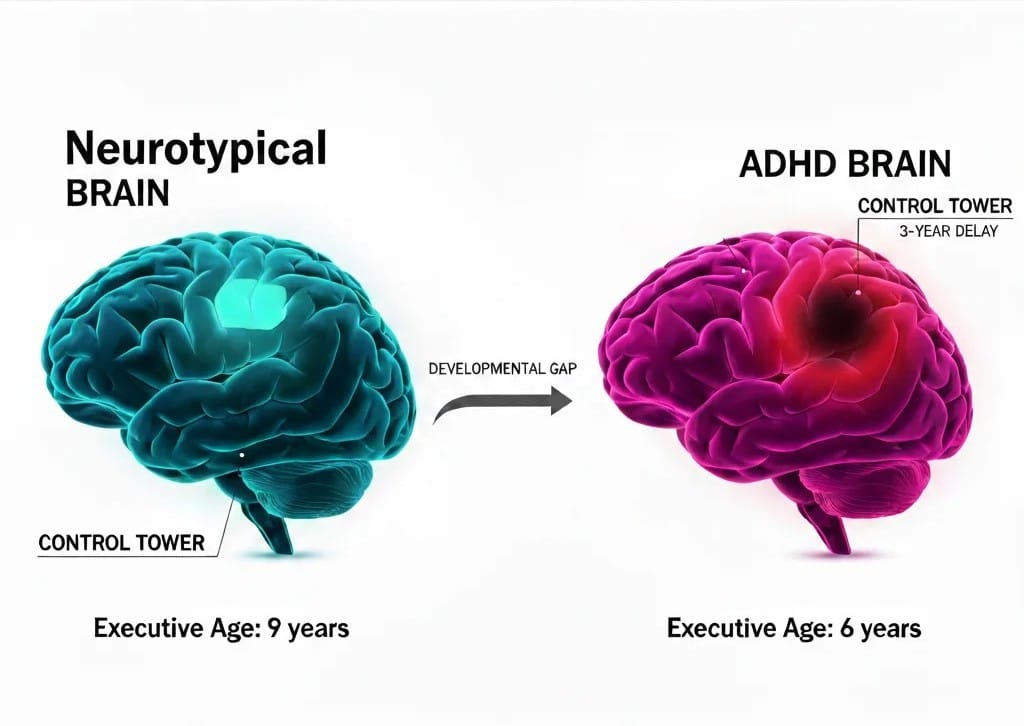
To help parents translate this delay into everyday life, experts such as Dr. Russell Barkley describe the ADHD 30% Rule, often referred to as the Rule of Two-Thirds.10
To estimate your child’s Executive Age, multiply their chronological age by 0.67.
- 9 years × 0.67 = 6 years
- 12 years × 0.67 = 8 years
- 15 years × 0.67 = 10 years
A 9-year-old with ADHD may function closer to age 6 in impulse control, planning, and self-regulation. This does not reflect their intelligence. It reflects that their self-management skills are still developing.
ADHD Development Gap Examples
| Chronological Age | Estimated Executive Age | What You Might Notice |
|---|---|---|
| 6 years | 4 years | Difficulty waiting turns, frequent emotional outbursts |
| 9 years | 6 years | Needs help starting homework, forgets instructions |
| 12 years | 8 years | Struggles with organization and time management |
| 15 years | 10 years | Impulsive decisions, inconsistent self-control |
Note: This table is a guide, not a strict rule. Every child is different.
How ADHD Brain Maturity Delay Affects Daily Life
If you expect a nine-year-old with ADHD to behave like a typical nine-year-old in emotional control, you may feel constant frustration. If you understand their executive skills are closer to age six, your approach naturally shifts. You may:
- Give shorter instructions
- Provide more reminders
- Break tasks into smaller steps
- Offer structured routines
- Stay calmer during emotional outbursts
This approach is not about lowering expectations—it’s about matching support to your child’s real abilities, making daily challenges easier and fostering confidence.
Is ADHD Developmental Delay Permanent?
A common fear for parents is: “Will my child always be behind?” The short answer is no.
While ADHD is a lifelong neurological condition, the developmental gap is a temporary timing issue.
The ADHD brain is not broken or developing the wrong way. It simply matures more gradually. The brain’s communication systems continue strengthening over a longer period, especially in areas linked to planning, self-control, and emotional regulation.
Research shows the ADHD brain reaches full structural maturity by the mid-to-late twenties.8 At this stage, while traits like distractibility may remain, the maturity gap narrows significantly.
This does not mean ADHD disappears. It means the brain eventually catches up to where it was always headed.
How ADHD Brain Maturity Changes Across Different Life Stages
As the brain matures, the gap often gets smaller. But it looks different at each stage of life.
In the Teen Years
This is usually when the gap feels the biggest. Other teenagers are becoming more independent, but a teen with ADHD still needs a lot of support with organisation, planning, and impulse control.
They may want the same freedom as their peers but not yet have the self-control skills to manage it. This is the stage where routines and structure matter most.
In the Mid-Twenties
Many young adults start to find things easier around their mid-twenties.
The brain is reaching closer to full maturity, and skills like organisation and emotional control begin to improve.
Many start building their own strategies, such as using reminders, planners, and set routines, to stay on track.
By Ages 28 to 30
By the time the brain fully matures, the developmental gap usually settles.
Some traits like distractibility may stay, but the maturity gap narrows considerably.
Many adults with ADHD find ways to work with how their brain functions rather than against it.
How to Support Children with ADHD: 8 Practical Strategies
When we understand that a 12-year-old with ADHD may have an Executive Age closer to 8, the approach to parenting changes. Instead of expecting the 12-year-old, we begin supporting the 8-year-old within them.
Here are eight practical strategies based on the Rule of Two-Thirds.
1. Match Expectations to Executive Age
A 10-year-old with ADHD may plan and organise more like a 7-year-old. Meet them there.
Supervise homework rather than leaving them to manage alone. Pack school bags together. Give one instruction at a time instead of a full list.
This is not lowering the bar. It is giving the right level of support for where their brain is right now.
2. Use External Structure Generously
Children with ADHD find it hard to stay organised without help. External tools do the job their brain is not yet doing on its own.
Try a simple visual schedule on the wall, a checklist for the morning routine, and a timer for tasks. Keep the routine the same each day. Consistency reduces stress and makes behaviour easier to manage.
3. Break Tasks Into Smaller Steps
Large instructions like “Clean your room” can feel overwhelming for children with ADHD.
Instead of giving one big instruction, break it into smaller steps. For example, ask them to put the books on the shelf first, then place clothes in the laundry basket, and finally make the bed.
Smaller steps feel easier to manage and can reduce frustration and resistance.
4. Teach Skills, Do Not Assume Them
Children with ADHD do not pick up organisation and self-control naturally. These skills need to be shown, practised, and repeated.
Sit with them and show how to write tasks in a planner.
Practise taking a breath before reacting. After a mistake, ask together: what could we do differently next time?
Teach these during calm moments, not in the middle of a meltdown.
5. Stay Calm During Emotional Storms
When a child with ADHD loses control, it is usually delayed regulation, not defiance.
Lower your voice instead of raising it. Say something simple like: “I can see you are upset. That is okay.” Then give them a short break to calm down. Your calm response is the most powerful tool in that moment.
6. Use Scaffolding, Then Step Back
Scaffolding means giving support while a skill is still developing, then slowly pulling back as the child grows more capable.
Start by sitting beside them during homework. Remind them of routines each day. Help organise their bag. Over time, do less and let them try. The goal is independence, reached gradually.
7. Protect Sleep, Movement, and Nutrition
Children with ADHD often do better when sleep, physical activity, and daily routines are consistent.
Try to keep bedtimes regular, encourage active play or movement every day, and offer balanced meals. Limiting screens late at night can also help improve sleep and emotional regulation.
When these basics are stable, many everyday challenges become easier to handle.
8. Reinforce Effort, Not Just Outcome
Children with ADHD often hear a lot of correction. Make sure they also hear what they are doing right.
Celebrate effort when your child starts a task on their own, pauses before reacting, or remembers one step without being reminded.
Small wins noticed consistently can build confidence over time.
When parents prioritize these routines, children feel calmer, stay more focused, and handle daily challenges with greater confidence.
Conclusion
ADHD maturity delay does not mean a child is lazy or incapable. It means the brain is developing more gradually, especially in areas related to self-control, attention, and emotional regulation.
Understanding your child’s Executive Age can help shift the focus from frustration to understanding and support.
With time, support, and consistent routines, many children gradually build better emotional control, organization, and independence.
You are not just managing behavior. You are helping your child build skills for long-term growth and confidence.
Frequently Asked Questions (FAQ)
These answers are based on current neurodevelopmental research and clinical ADHD guidelines
Q1: What is ADHD brain maturity delay?
ADHD brain maturity delay means some brain areas involved in self-control, attention, and emotional regulation develop more slowly than expected for age. This can make a child seem emotionally younger than peers the same age.
Q2: Does ADHD brain maturity delay mean my child is less intelligent?
No. ADHD affects executive function and self-regulation, not intelligence. A child may be academically bright yet still struggle with organization, patience, or emotional control.
Q3: How can I calculate my child’s “executive age”?
“Executive Age” is a simple way to describe how a child’s self-regulation skills may function below their chronological age. Experts often estimate executive skills in ADHD at about two-thirds of a child’s actual age.
Q4: Is ADHD brain maturity delay permanent?
No. ADHD reflects a slower developmental timeline, not a lack of ability. Many executive function skills continue improving into early adulthood.
Q5: How can parents support a child with ADHD brain maturity delay?
Parents can help by using visual schedules, breaking tasks into smaller steps, keeping routines consistent, and offering calm reminders and support.
Q6: Why does my child seem smart but act younger than their age?
Children with ADHD may have strong intelligence but slower development of self-control and emotional regulation. This can make them appear younger in everyday behavior despite normal or advanced learning ability.
Q7: Can ADHD brain maturity delay improve with support?
Yes. Consistent routines, positive reinforcement, emotional support, and practical coping strategies can help children gradually strengthen self-regulation and independence over time.
References
📚 Click to view references
- National Institute of Health (NIH). (2014, September). Focusing ADHD: How the Brain Manages Attention. View Source (NIH)
- Deshmukh MP, Khemchandani M, Thakur PM. Exploring role of prefrontal cortex region of brain in children having ADHD with machine learning: Implications and insights. Appl Neuropsychol Child. 2026 Jan-Mar;15(1):71-83. View Source (PubMed)
- Shaw P, Eckstrand K, Sharp W, et al. Attention-deficit/hyperactivity disorder is characterized by a delay in cortical maturation. Proc Natl Acad Sci U S A. 2007 Dec 4;104(49):19649-54. View Source (PMC)
- Hoogman M, Bralten J, Hibar DP, et al. Subcortical brain volume differences in participants with ADHD in children and adults: a cross-sectional mega-analysis. Lancet Psychiatry. 2017 Apr;4(4):310-319. View Source (PMC)
- Shaw et al. (2007). Attention‑deficit/hyperactivity disorder is characterized by a delay in cortical maturation. View Source (PubMed)
- Sadozai, A.K., Sun, C., Demetriou, E.A. et al. Executive function in children with neurodevelopmental conditions: a systematic review and meta-analysis. Nat Hum Behav 8, 2357–2366 (2024). View Source (Nature)
- Fujita S, Hagiwara A, Hori M, et al. 3D quantitative synthetic MRI-derived cortical thickness and subcortical brain volumes. J Magn Reson Imaging. 2019 Dec;50(6):1834-1842. View Source (PubMed)
- Berger I, Slobodin O, Aboud M, et al. Maturational delay in ADHD: evidence from CPT. Front Hum Neurosci. 2013 Oct 25;7:691. View Source (PMC)
- National Institute of Mental Health. (2007). Brain matures a few years late in ADHD, but follows normal pattern. View Source (NIMH)
- Barkley, R. A. (2012). This is how you treat ADHD based on science. Keynote lecture at the 2012 Burnett Seminar. Watch Video (YouTube)
