
Written by: MediHealth PRO Editorial Team
Scientifically Reviewed by: Dr. Amit Pande, PhD
Molecular Biologist & Clinical Research Expert | Independent Scientific Reviewer, MediHealth PRO
Medically Reviewed by: Dr. Arghyadeep Marik, MD
Independent Medical Reviewer, MediHealth PRO
If your child is constantly racing around the house or jumping on the bed, many parents start wondering what is normal at this age.
High energy is a normal and healthy part of toddler development. But when it comes to ADHD vs toddler high energy, the real question is not how much energy a child has, but how well the brain manages it.
This confusion is common because many ADHD symptoms overlap with normal developmental milestones. The key difference is not the amount of energy, but how consistently the brain regulates attention, movement, impulses, and emotions when self-control is needed.
This post covers five neurological signs that distinguish ADHD from normal toddler high energy and what to watch for over time.
What ADHD Is Not: Clearing Up Common Misconceptions
Many parents feel guilt or self-blame when ADHD enters the conversation. Before looking at the signs, it helps to understand what current research actually shows.
- Not a parenting failure. ADHD is a neurological condition linked to brain chemistry and structure. It is not caused by poor discipline, screen time, or inconsistent boundaries.
- Not a measure of intelligence. Children with ADHD are often bright and creative. As neuropsychologist Russell Barkley explains, the challenge lies in performance, not ability.
- Not a behaviour choice. When a child struggles to sit still, it is not defiance. Their nervous system is often seeking stimulation to stay alert.
- Not a deficiency. ADHD involves differences in dopamine regulation and prefrontal cortex development. It reflects variation in brain function, not a broken brain.
Understanding this is the first step toward responding to your child with clarity rather than frustration.
Toddler High Energy vs ADHD: The Core Difference
Toddlers are naturally built for movement and exploration. At this age, impulsivity is part of normal brain development. Their internal self-control systems are still developing, which is why bursts of energy are expected.
ADHD, however, is a neurodevelopmental condition that affects how the brain regulates attention, impulses, movement, and emotions. In ADHD, these regulatory systems develop differently, making it harder for children to slow down, pause, or redirect behaviour in everyday situations.
Why some behaviours look younger than expected
Beyond energy levels, one of the most consistent patterns in children with ADHD traits is a gap between their age and their self-regulation ability.
Executive functions develop more slowly in children with ADHD than in their peers. Dr. Russell Barkley describes this as roughly a 30% delay, meaning a six-year-old with ADHD may understand the rules as well as their classmates but struggle with impulse control closer to the level of a four-year-old.
This does not reflect intelligence. It reflects the pace at which self-regulation develops, which is why everyday tasks like waiting, sharing, or sitting still can require significantly more effort than parents or caregivers typically expect for that age.
5 Early Neurological Signs of ADHD vs Toddler High Energy
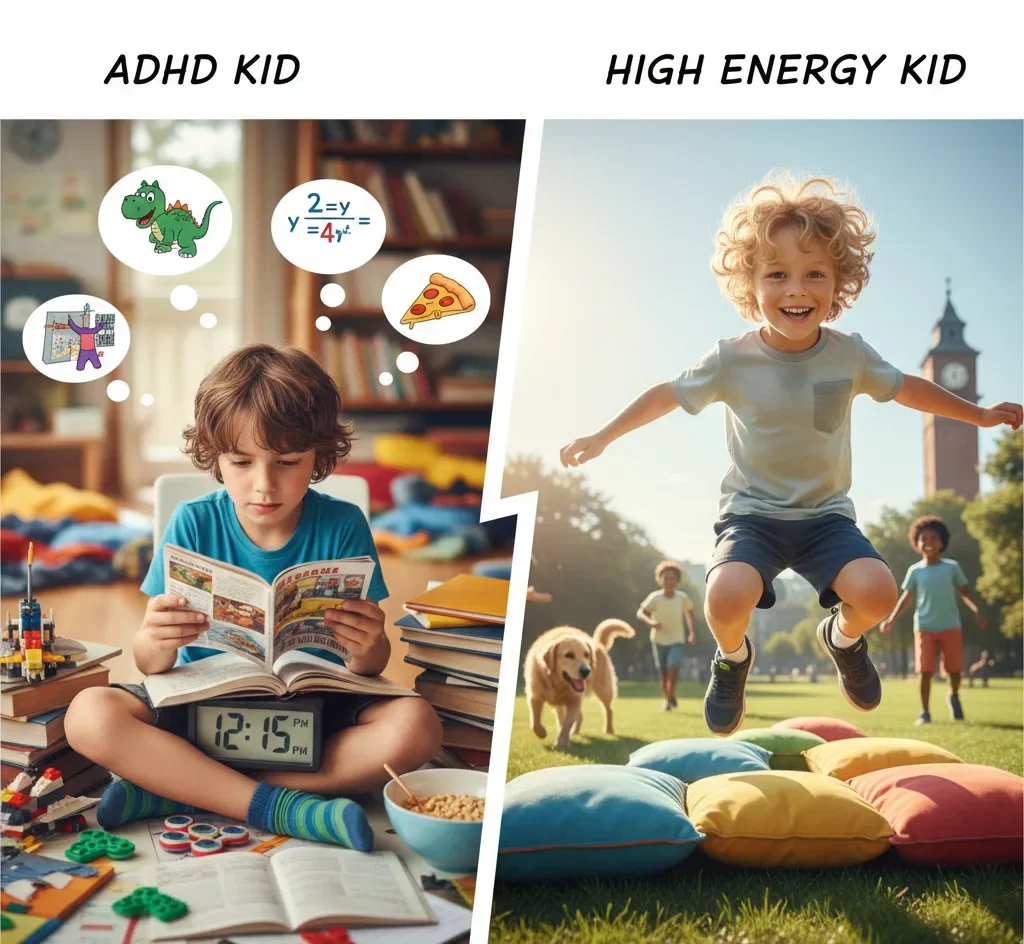
Here are five neurological signs that help distinguish ADHD from typical toddler high energy.
Typical Toddler Energy vs ADHD Traits: Key Differences at a Glance
Sign 1: Movement with purpose vs movement without direction
One of the clearest differences is why a child is moving, not how much they move.
Typical high-energy toddlers usually move toward something. They run to grab a toy, climb to reach something, or jump during play. Once the goal is done, they naturally pause or shift to something else.
In children showing ADHD traits, movement often has no clear goal. They may move from one place to another without purpose, keep fidgeting even during meals or story time, and continue long after they seem tired.
What research suggests: Dopamine, a brain chemical, plays a key role in movement and attention regulation.1 When this system is less efficient, the brain may use movement as a way to stay alert rather than respond to intention.
Sign 2: Impulse control — the gap between urge and action
All toddlers are impulsive. The difference lies in how quickly they can respond to limits.
Most toddlers may rush into things, but over time they begin to pause when they hear “stop.” That learning slowly improves with repetition.
In ADHD traits, there is very little pause between feeling an urge and acting on it. A child may repeat unsafe actions, find it hard to wait, or act before fully understanding instructions..
What research suggests: The prefrontal cortex is responsible for controlling impulsive behaviour.2 In ADHD, this system develops more slowly,3 making self-regulation harder in daily situations.
Sign 3: Attention quality, not attention span
Attention in toddlers is always short — but the quality of attention is what matters.
Typical toddlers can stay with an activity they enjoy for a few minutes and return to it when redirected.
In ADHD traits, attention feels scattered. Even simple background sounds can pull focus away, and tasks are often left unfinished even when the child enjoys them.
What research suggests: Research has identified structural differences in the thalamus in children with ADHD,4 meaning the brain’s ability to filter competing sensory input may be less efficient. Multiple signals reach attention at similar intensities, making it harder to focus on one thing at a time.
Sign 4: Tantrums vs emotional regulation difficulty
Tantrums are normal in early childhood. The difference is in recovery.
Typical toddlers calm down relatively quickly once the trigger is removed or they are comforted.
In ADHD traits, emotional reactions can feel stronger and last longer. Even small frustrations may lead to intense reactions, and the brain takes longer to bring an emotional response back down even after reassurance.
What research suggests: The prefrontal cortex sends signals to calm the amygdala, the brain’s emotion-processing centre.5 In children with ADHD, this connection is less efficient, which is why emotional responses can feel intense and take longer to settle.
Sign 5: Bedtime and the ability to slow down
Sleep patterns often reveal how well a child’s nervous system can downshift.
Typical toddlers resist bedtime but eventually become sleepy once the environment is calm.
In ADHD traits, tiredness can actually increase activity. Children may become more restless, talkative, or physically active even at night.
What research suggests: Some children with ADHD show delayed melatonin release (the hormone that signals the brain it is time to sleep),6 which can shift their internal clock and make sleep onset harder.
Parent Note: No single sign confirms ADHD. What matters is pattern, consistency, and impact across daily life. If several of these signs appear regularly in different settings, it may be helpful to observe over time and discuss concerns with a paediatrician.
How to Calm a High‑Energy Child or ADHD Toddlers
These strategies can help whether your child is naturally high-energy or showing early signs of ADHD.
- Keep routines predictable. A consistent schedule for meals, play, and sleep helps children feel secure and reduces impulsive behaviour.
- Use active play before quiet time. Let them run, jump, or climb first. Physical activity beforehand makes the shift to calmer activities easier.
- Create a calm corner. A cozy spot with soft toys, books, or gentle music gives your child a place to settle.
- Give short, one-step instructions. Simple directions are easier for young children to follow without getting frustrated.
- Limit screens before bed. Fast-paced content close to bedtime can increase restlessness and delay sleep.
- Build a bedtime routine. Reading, dim lights, and calm physical contact help signal that it is time to slow down.
- Try simple calming techniques. Slow breathing games, gentle stretching, or rhythmic rocking can help regulate energy and emotion.
- Encourage outdoor play. Time outside, especially in open or natural spaces, has a noticeable calming effect on children who are easily overstimulated.
If hyperactivity, impulsivity, or emotional outbursts are significantly affecting daily life, behavioural therapy is often the most effective first-line support for young children (before 6) with ADHD traits.7 Parent-based behaviour therapy helps children build routines, emotional regulation, and self-control skills in a structured and supportive way.
Related: ADHD Toddler Activities, Routines and Symptom Log
When Should Parents Talk to a Paediatrician?
Because a toddler’s brain is still developing rapidly, a formal ADHD diagnosis is usually not made before age four because behaviour patterns are still evolving.8
However, it is worth speaking to a paediatrician or developmental specialist if you consistently notice any of the following:
- Safety is a recurring concern. Impulsive behaviour leads to frequent injuries, or your child regularly puts themselves in danger despite repeated correction.
- Daily routines are significantly disrupted. Everyday activities such as grocery shopping, eating out, or visiting others feel consistently unmanageable because of your child’s behaviour.
- Social difficulties persist. Your child regularly struggles to play with peers, is too rough, cannot share, or finds it hard to follow simple group rules.
- Sleep is consistently poor. Ongoing difficulty falling or staying asleep affects your child’s mood and your family’s daily functioning.
Before pursuing a diagnosis, a paediatrician will typically rule out other conditions that can present similarly, including thyroid disorders, iron, magnesium or zinc deficiency, sleep apnoea, sensory processing differences, and hearing or vision problems.
Ruling these out ensures your child receives the right support rather than a premature diagnosis.
The Takeaway
In the ADHD vs toddler high energy conversation, energy level alone is not the defining factor.
Toddlers are naturally active. What distinguishes ADHD is how consistently the brain struggles to regulate that energy, attention, and emotions across different settings and over time.
If you are unsure, keep notes on your child’s behaviour across different situations for a few weeks. Patterns observed over time give a paediatrician the most accurate picture to work from.
FAQs: ADHD or Toddler High Energy
Q1. Is constant movement always a sign of ADHD?
No. Many toddlers are naturally active as they explore and develop coordination. The difference is in pattern and purpose. ADHD-related movement often continues across settings like home, playground, and clinics, and may persist even when the child is tired or has no clear goal.
Q2. Can ADHD be diagnosed in toddlers under 4?
A formal diagnosis is usually made between ages 4 and 7, since early childhood development changes quickly. However, early behavioural patterns can still be observed. If concerns like impulsivity, distractibility, or sleep issues continue over time, a paediatric evaluation can help with monitoring and early support.
Q3. What is the difference between curiosity and ADHD hyperactivity?
Curiosity is goal-driven. A child explores, learns, and often pauses once interest is satisfied. ADHD-related hyperactivity is less structured and more continuous, where movement continues even without a clear goal or stopping point.
Q4. Does discipline fix ADHD behaviour?
No. ADHD is not caused by parenting style or lack of discipline. While structure, routines, and boundaries are helpful, they do not change how the brain regulates attention and impulses. Support strategies and professional guidance are more effective.
Q5. Can diet affect a toddler’s energy levels?
Yes, but usually in short-term ways. For example, sugary foods may cause a temporary spike in energy followed by a drop, which can look like irritability or low focus. This is different from the consistent patterns seen in ADHD.
Related: Does Sugar Make Kids Hyperactive? The Truth About the Sugar High
Q6. Is there a link between screen time and ADHD in toddlers?
Screen time does not cause ADHD, but it can make symptoms like restlessness and distractibility more noticeable. Fast-paced content may make slower real-world tasks feel harder to engage with, especially in children who are already sensitive to stimulation.
Q7. Does high energy mean my child is gifted?
Not necessarily. Some gifted children and children with ADHD both show high energy and curiosity. The difference is that gifted children can usually focus deeply on areas of interest, while children with ADHD may struggle with sustained attention even when highly interested.
Q8. How do doctors assess ADHD in young children?
Doctors rely on behavioural history, parent reports, and structured rating tools such as Vanderbilt or Conners scales. They compare behaviour patterns with age expectations and rule out other conditions like iron deficiency or thyroid imbalance that may mimic similar symptoms.
Related: 7 Essential Blood Tests for ADHD in Children: Rule Out Mimics Before Starting Medication
Q9. Can a child outgrow ADHD?
ADHD is a lifelong neurodevelopmental difference, but its expression changes over time. With early support and coping strategies, many children learn to manage symptoms effectively, reducing daily impact significantly.
Q10. Why does behaviour seem worse in the evening?
By evening, a child’s ability to regulate impulses and attention is often depleted. This “mental fatigue” can lead to more restlessness, emotional reactions, and difficulty settling down before bedtime.
References
📚 Click to view references
- Gold MS, Blum K, Oscar-Berman M, Braverman ER. Low dopamine function in attention deficit/hyperactivity disorder: should genotyping signify early diagnosis in children? Postgrad Med. 2014 Jan;126(1):153-77. Available from: https://pubmed.ncbi.nlm.nih.gov/24393762/
- El-Baba RM, Schury MP. Neuroanatomy, Frontal Cortex. [Updated 2023 May 29]. In: StatPearls [Internet]. Treasure Island (FL): StatPearls Publishing; 2025 Jan-. Available from: https://www.ncbi.nlm.nih.gov/books/NBK554483/
- Arnsten AF. The Emerging Neurobiology of Attention Deficit Hyperactivity Disorder: The Key Role of the Prefrontal Association Cortex. J Pediatr. 2009 May 1;154(5):I-S43. Available from: https://pmc.ncbi.nlm.nih.gov/articles/PMC2894421/
- Batty MJ, Palaniyappan L, Scerif G, Groom MJ, Liddle EB, Liddle PF, Hollis C. Morphological abnormalities in prefrontal surface area and thalamic volume in attention deficit/hyperactivity disorder. Psychiatry Res. 2015 Aug 30;233(2):225-32. Available from: https://pmc.ncbi.nlm.nih.gov/articles/PMC4834461/
- Kenwood MM, Kalin NH, Barbas H. The prefrontal cortex, pathological anxiety, and anxiety disorders. Neuropsychopharmacology. 2022 Jan;47(1):260-275. doi: 10.1038/s41386-021-01109-z. Epub 2021 Aug 16. Erratum in: Neuropsychopharmacology. 2022 Apr;47(5):1141. Available from: https://pmc.ncbi.nlm.nih.gov/articles/PMC8617307/
- Feybesse C, Chokron S, Tordjman S. Melatonin in Neurodevelopmental Disorders: A Critical Literature Review. Antioxidants (Basel). 2023 Nov 20;12(11):2017. Available from: https://pmc.ncbi.nlm.nih.gov/articles/PMC10669594/
- Centers for Disease Control and Prevention (CDC). Behavior Therapy First for Young Children with ADHD. Available from: https://www.cdc.gov/adhd/articles/behavior-therapy-first-young-children.html
- American Academy of Pediatrics. Diagnosing ADHD in Children: Guidelines and Information for Parents. HealthyChildren.org. Available from: https://www.healthychildren.org/English/health-issues/conditions/adhd/Pages/Diagnosing-ADHD-in-Children-Guidelines-Information-for-Parents.aspx
