

Written by: MediHealth PRO Editorial Team
Scientifically Reviewed by: Dr. Amit Pande, PhD
Molecular Biologist & Independent Scientific Reviewer
Key Takeaways
- The 4-month sleep regression is a normal stage of brain development as your baby’s sleep cycles mature.
- It usually begins between 3 and 5 months and lasts about 2 to 6 weeks.
- Frequent night wakings, shorter naps, and difficulty settling are common signs.
- Following age-appropriate wake windows (1.5 to 2 hours), maintaining a consistent bedtime routine, and creating a sleep-friendly environment can help reduce sleep disruptions.
- Most babies settle into longer, more consolidated sleep as their sleep patterns mature over the following weeks.
Has your 4-month-old baby, who used to sleep fairly well, suddenly started waking every hour, taking short naps, or needing to be soothed back to sleep? If so, you may be dealing with the 4-month sleep regression.
Many parents first describe these changes simply as baby sleep problems, but they are often part of the normal sleep regression.
This is not a sign that something is wrong. It is a normal developmental milestone as your baby’s brain matures and sleep patterns shift from the simple newborn pattern to more adult-like sleep cycles.
In this guide, you will learn the signs, causes, how long it typically lasts, and practical, evidence-based strategies to help your baby sleep better again.
Is the 4-Month Sleep Regression Real?
Yes. The 4-month sleep regression is not an official medical diagnosis, but it is a widely recognized pattern that describes real developmental changes affecting infant sleep around this age.
Pediatricians and sleep researchers recognize that temporary sleep disruption around this age is a normal part of infant development, even though “sleep regression” itself is parenting terminology rather than a formal clinical term.
What Is the 4-Month Sleep Regression?
The 4-month sleep regression is a developmental stage when babies transition from newborn sleep patterns to more mature sleep cycles.1, 2, 3 This normal change often becomes noticeable between 3 and 5 months of age and can temporarily disrupt sleep.
As babies begin developing more adult-like sleep cycles and circadian rhythms, they spend more time in lighter stages of sleep and briefly wake between sleep cycles more often.4
These changes can lead to temporary sleep problems, including frequent night wakings, shorter naps, and difficulty settling back to sleep without help.
Once the 4-month sleep regression is over, you may encounter the 6-month sleep regression (due to rolling/sitting), the 8-month sleep regression (due to crawling), or the 12-month sleep regression (due to walking). For a full overview of every stage, see our complete Sleep Regression Symptoms by Age guide.
Signs of the 4-Month Sleep Regression (Common Baby Sleep Problems)
Every baby experiences the 4-month sleep regression differently. These temporary sleep problems may develop gradually or seem to appear almost overnight. Some babies have only mild sleep changes, while others experience frequent night wakings, shorter naps, and difficulty settling.
Changes in Sleep Itself
- Frequent night wakings, often every 1 to 2 hours instead of longer stretches.
- Naps that shrink from 1 to 2 hours down to 30 to 45 minutes.
- More time spent in light sleep, making your baby easier to wake.
Changes in Behavior
- Increased fussiness, especially in the evening.
- More reliance on feeding or rocking to fall back asleep.
- Resistance at bedtime or waking soon after being put down.
Not every baby shows all six signs. A few disrupted nights and shorter naps are enough to signal the regression is underway, even without every symptom on the list.
Is It the 4-Month Sleep Regression or Another Sleep Problem?
Not every sleep change at 4 months is caused by a sleep regression. Teething, illness, hunger, or discomfort can also affect your baby’s sleep. Looking at the overall pattern can help you understand what is most likely happening.
| More Likely the 4-Month Sleep Regression | May Be Another Cause |
|---|---|
| Frequent night waking after previously sleeping for longer stretches | Fever, cough, congestion, or other signs of illness |
| Short naps (about 30–45 minutes) | Ongoing discomfort from teething or an ear infection |
| Bedtime suddenly becomes more difficult | Hunger or feeding difficulties |
| Waking between sleep cycles and needing help to settle | Reflux, pain, or another medical condition |
If your baby has a fever, breathing difficulties, poor feeding, poor weight gain, persistent vomiting, or seems unusually sleepy or difficult to wake, contact your pediatrician instead of assuming it is the 4-month sleep regression.
Why Does the 4-Month Sleep Regression Happen?
Around 4 months of age, your baby’s brain and sleep patterns go through important developmental changes. Two normal changes are mainly responsible for the extra night waking.
1. Sleep Cycles Become More Mature
Around 4 months, babies transition from the simple newborn sleep pattern to more mature sleep cycles with light sleep, deep sleep, and REM (dream) sleep.4 Each infant sleep cycle lasts about 45 to 50 minutes, compared to roughly 90 minutes in adults
Between cycles, babies briefly wake. Some fall back asleep on their own, while others need the same comfort they had at bedtime, such as feeding, rocking, or being held. This often leads to more frequent night wakings and shorter naps.
2. The Internal Body Clock Develops
Around 3 to 4 months, your baby’s circadian rhythm, or internal body clock, also becomes more established. Three natural signals begin working together to regulate sleep:
- Adenosine builds up during wake time, creating sleep pressure.5
- Melatonin rises in the evening as it gets dark, helping prepare the body for sleep.6
- Cortisol naturally peaks in the morning, promoting wakefulness.7
Why Overtiredness Makes Sleep Worse
If babies stay awake longer than their ideal wake window, they can become overtired. Many pediatric sleep experts believe this makes it harder to settle and move smoothly between sleep cycles, although the exact biological mechanism is still being studied. In practice, overtired babies often have more fragmented sleep, frequent night wakings, and shorter naps.
Signs and their common contributing factors:
| Sign | Commonly Linked To |
|---|---|
| Frequent night waking | Maturing sleep cycles and lighter sleep stages |
| Shorter naps | Increased time spent in light sleep |
| Increased fussiness | Overtiredness or missed wake windows |
| Bedtime resistance | Difficulty transitioning between sleep cycles |
4-Month vs Newborn Sleep
Understanding what actually changes at this age can make the regression easier to make sense of. The table below compares newborn sleep patterns with the more mature sleep cycles that develop around 4 months.
| Before 4 Months | After 4 Months |
|---|---|
| Newborn sleep pattern | More mature sleep cycles |
| Sleeps more deeply overall | More time spent in light sleep |
| Brief awakenings often go unnoticed | Brief awakenings become more noticeable |
| Easier to transfer while asleep | More likely to wake fully between cycles |
How Long Does the 4-Month Sleep Regression Last?
Most pediatric sleep resources report that the 4-month sleep regression typically lasts 2 to 6 weeks, although every baby develops at their own pace. Some babies adjust within a couple of weeks, while others need a little longer as their sleep cycles mature.
The regression itself is temporary, but the change in your baby’s sleep pattern is permanent. Unlike newborn sleep, mature sleep cycles remain as your child grows. This means your baby may continue to wake briefly between sleep cycles but will get better at settling back to sleep with time.
Several factors can influence how long the regression lasts, including:
- Your baby’s temperament and overall development.
- Consistent bedtime and nap routines.
- Age-appropriate wake windows.
- Whether your baby is learning to fall asleep independently.
Typical Timeline
| Time | What You May Notice |
|---|---|
| First few days | Frequent night wakings and shorter naps |
| Weeks 1–3 | Sleep becomes lighter, with more brief awakenings |
| Weeks 3–6 | Most babies settle into more mature sleep patterns |
If sleep disruptions continue for more than 6 weeks, are getting worse instead of better, or your baby has poor weight gain, feeding difficulties, breathing problems during sleep, or other concerning symptoms, speak with your pediatrician to rule out an underlying medical cause.
How to Help Your Baby Sleep Better During the 4-Month Sleep Regression
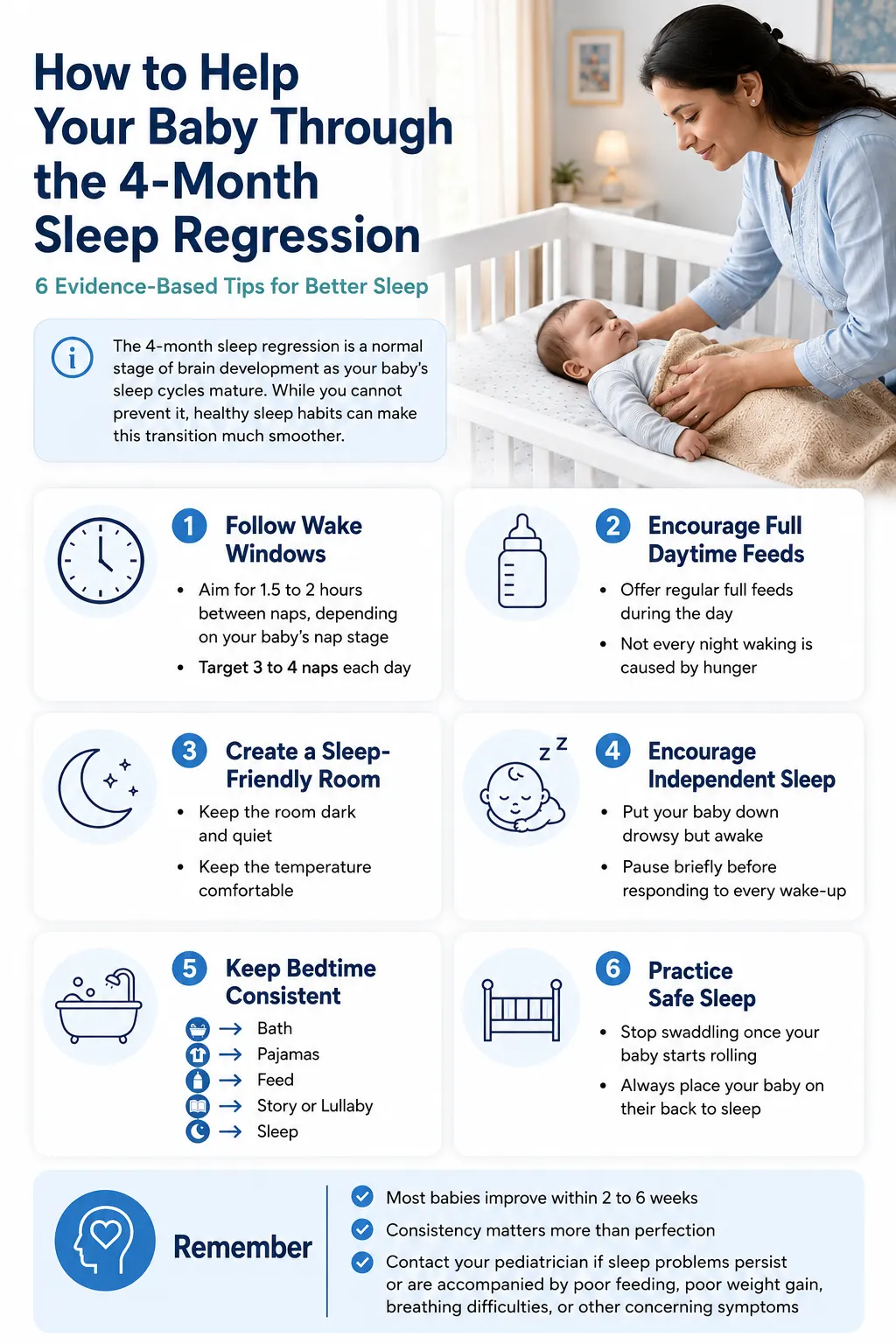
You cannot stop the 4-month sleep regression, but these simple strategies can help reduce common sleep problems while your baby’s sleep cycles continue to mature.
The goal is not to eliminate every night waking. It is to support healthy sleep habits while your baby’s sleep cycles continue developing.
1. Follow Age-Appropriate Wake Windows
At around 4 months, most babies do best with 1.5 to 2 hours of awake time between naps and 3 to 4 naps each day. Staying awake for too long can lead to overtiredness, making it harder for your baby to settle and stay asleep.
Tip: If your baby consistently refuses the last nap or has long periods of wakefulness during the night, they may be ready to transition from four naps to three. See our 4-to-3 nap transition guide for signs and how to manage the switch.
2. Encourage Full Daytime Feedings
Offer regular, full feeds during the day so your baby gets most of their calories while awake. This may help reduce hunger-related night wakings, although some babies still need nighttime feeds at this age.
3. Create a Sleep-Friendly Environment
Keep the room dark and quiet to support better sleep, and keep the temperature comfortable.8 If you use white noise, place the machine away from the crib and keep the volume at a safe level.
4. Encourage Independent Sleep
Whenever possible, place your baby in the crib drowsy but awake. If they wake between sleep cycles, pause briefly before responding to see whether they can settle themselves. Many babies build this skill over time with consistency.
5. Keep Bedtime Predictable
A simple bedtime routine helps signal that it is time to sleep. Try following the same calming sequence each night, such as:
Bath → Pajamas → Feeding → Story or Lullaby → Bed
Consistency is more important than having a long routine.
6. Follow Safe Sleep Practices
Transition to an arms-free sleep sack as soon as you see signs of rolling. This keeps your baby safe while allowing free movement of their arms and legs.8, 9 Always place your baby on their back to sleep on a firm, flat mattress with no pillows, blankets, bumpers, or toys in the crib.
Sample 4-Month-Old Sleep Schedule
Every baby develops at their own pace, so use these schedules as a flexible guide, not a strict routine. Some 4-month-olds still take 4 naps, while others may be ready to transition to 3 naps.
If Your Baby Is Still Taking 4 Naps
| Time | Activity |
|---|---|
| 7:00 AM | Wake and feed |
| 8:30–9:15 AM | Nap 1 |
| 9:15 AM | Feed and play |
| 11:00–11:45 AM | Nap 2 |
| 11:45 AM | Feed and play |
| 1:30–2:15 PM | Nap 3 |
| 2:15 PM | Feed and play |
| 4:00–4:45 PM | Nap 4 (Short Catnap) |
| 4:45 PM | Feed and play |
| 6:45–7:15 PM | Bedtime routine and sleep |
If Your Baby Has Transitioned to 3 Naps
| Time | Activity |
|---|---|
| 7:00 AM | Wake and feed |
| 9:00–10:00 AM | Nap 1 |
| 10:00 AM | Feed and play |
| 12:00–1:00 PM | Nap 2 |
| 1:00 PM | Feed and play |
| 3:30–4:30 PM | Nap 3 |
| 4:30 PM | Feed and play |
| 6:45–7:15 PM | Bedtime routine and sleep |
Note: These are sample schedules, not strict rules. Follow your baby’s sleep cues and adjust nap times or bedtime as needed. During the transition from 4 naps to 3 naps, some flexibility is completely normal.
Not sure which schedule fits your baby? Read our 4-to-3 nap transition guide to learn when your baby is ready to drop the fourth nap and how to make the transition smoothly.
What If Your Baby’s Sleep Problems Do Not Improve?
If you have followed the sleep strategies consistently for 2 to 3 weeks and your baby is still waking every hour, look for these common roadblocks:
- Wake windows are too long. Most 4-month-olds do best with wake windows of about 1.5 hours on a 4-nap schedule and 1.75 to 2 hours on a 3-nap schedule. Overtiredness is a common cause of persistent night wakings.
- Your baby relies on a sleep association. If your baby usually falls asleep while feeding, rocking, or being held, they may expect the same help each time they wake between sleep cycles.
- The sleep environment is not ideal. A dark, quiet room with minimal stimulation supports more consolidated sleep than a bright or noisy one.
If your baby’s sleep problems are not improving after making these adjustments, or night wakings remain frequent after 2 to 3 weeks, a more structured, gentle approach to building independent sleep skills may help.
Next step: Read our TRUST Method for Sleep Regression guide to learn a connection-based approach for reducing night wakings from 4 months to 4 years.
What to Avoid During the 4-Month Sleep Regression
Some common habits can unintentionally make sleep more difficult:
- Changing bedtime or nap times frequently, making it harder for your baby to develop a consistent sleep rhythm.
- Immediately feeding or rocking your baby back to sleep every time they wake, which can reinforce sleep associations for some babies.
- Overstimulating your baby before bedtime with active play, bright lights, or screens.
- Skipping naps to tire your baby out, which often leads to overtiredness and more frequent night wakings instead of better sleep.
Could Something Else Be Causing the Night Wakings?
Sometimes, yes. Ear infections, reflux, eczema, constipation, and other illnesses can also disrupt a baby’s sleep and may be mistaken for the 4-month sleep regression. Signs that may point to another cause include a fever, persistent pain or discomfort, breathing difficulties, poor feeding, a rash that does not improve, or sleep problems that continue for more than several weeks despite a consistent routine. If you notice any of these, contact your pediatrician to rule out an underlying cause.
Final Thought
The 4-month sleep regression is a real adjustment, but it is temporary. Rather than a problem to fix, it is a sign that your baby’s sleep is maturing. Consistent wake windows, a predictable bedtime routine, and a calm, sleep-friendly environment can help your baby adapt to this developmental milestone.
If your baby’s sleep problems persist beyond the expected timeline or are accompanied by any of the warning signs discussed earlier, contact your pediatrician.
Frequently Asked Questions About the 4-Month Sleep Regression
Does the 4-month sleep regression happen exactly at 4 months?
Not always. Although it is called the 4-month sleep regression, it can begin anytime between 3 and 5 months. Every baby develops at a different pace, and factors such as adjusted age in premature babies may influence when it starts.
Does every baby go through the 4-month sleep regression?
Most babies experience changes in their sleep around 4 months as their sleep cycles mature. However, the severity varies. Some babies have only mild sleep disruptions, while others wake much more frequently for several weeks.
What are the first signs of the 4-month sleep regression?
Common signs include:
- More frequent night wakings.
- Shorter daytime naps.
- Increased fussiness before sleep.
- Difficulty settling at bedtime.
- Waking shortly after being put down.
These changes usually coincide with your baby’s developing sleep cycles.
How long does the 4-month sleep regression last?
For most babies, the 4-month sleep regression lasts 2 to 6 weeks. The exact duration varies depending on your baby’s development, sleep habits, and overall health.
Can I prevent the 4-month sleep regression?
No. The 4-month sleep regression is a normal developmental milestone caused by maturing sleep cycles and cannot be prevented. However, consistent bedtime routines, age-appropriate wake windows, and healthy sleep habits may make the transition smoother.
Should I feed my baby every time they wake up?
Not necessarily. Some 4-month-olds still need night feeds, while others wake mainly because they are moving between sleep cycles. If your baby is growing well and feeding regularly during the day, not every night waking is caused by hunger. If you are unsure whether your baby still needs nighttime feeds, discuss it with your pediatrician.
Can overtiredness make the 4-month sleep regression worse?
Yes. Babies who stay awake longer than their age-appropriate wake windows often become overtired, making it harder to fall asleep and settle between sleep cycles. Keeping wake windows around 1.5 to 2 hours can help support better sleep.
Can the 4-Month Sleep Regression Come Back?
No. The 4-month sleep regression does not come back because it marks a permanent change in your baby’s sleep cycles. However, your child may experience new sleep regressions later, such as around 6 months, 8 to 10 months, 12 months, 18 months, and 2 years, as new developmental milestones affect sleep.
When should I contact my pediatrician about my baby’s sleep problems?
Contact your pediatrician if your baby’s sleep problems last longer than 6 weeks, continue to worsen, or are accompanied by poor feeding, poor weight gain, breathing problems during sleep, fever, or other concerning symptoms.
References
📚 Click to view references
- Galland BC, Taylor BJ, Elder DE, Herbison P. Normal sleep patterns in infants and children: A systematic review of observational studies.
https://pubmed.ncbi.nlm.nih.gov/21784676/ - Sadeh A. Infant sleep problems and interventions: A review.
https://pubmed.ncbi.nlm.nih.gov/28334578/ - Longitudinal study on self-regulated infant sleep.
https://pmc.ncbi.nlm.nih.gov/articles/PMC7667498/ - Problems in the Development of the Sleep–Wake Rhythm Influence Neurodevelopmental Disorders in Children.
https://www.ncbi.nlm.nih.gov/pmc/articles/PMC10252355/ - Adenosine and sleep pressure.
https://pmc.ncbi.nlm.nih.gov/articles/PMC4810168/ - Melatonin and sleep onset.
https://pmc.ncbi.nlm.nih.gov/articles/PMC9109407/ - Brum MCB, Senger MB, Schnorr CC, Ehlert LR, Rodrigues TDC. Effect of Night-Shift Work on Cortisol Circadian Rhythm and Melatonin Levels. Sleep Science. 2022;15(2).
https://pmc.ncbi.nlm.nih.gov/articles/PMC9210564/ - CDC. Safe Sleep for Babies.
https://www.cdc.gov/sudden-infant-death/sleep-safely/index.html - The Effect of Swaddling on Infant Sleep and Arousal: A Systematic Review and Narrative Synthesis.
https://pmc.ncbi.nlm.nih.gov/articles/PMC9748185/
