

Crawling is one of the most exciting milestones in your baby’s first year. It signals that their muscles, balance, and brain functions are starting to work together in a synchronized way. Despite crawling being a natural progression, the transition is not always as smooth as it looks. I have read a number of articles and found that for some babies, the coordination simply takes a little longer to fall into place—and that is perfectly normal.
If your little one is still “stuck” in one spot while other babies are moving right on schedule, it’s natural to feel anxious. Many parents begin to wonder, when do babies start crawling, and whether their child is reaching motor milestones within the expected timeframe.
While every child follows their own path, there is a typical window when neurology and physical strength align to support movement. If your baby is not crawling by 10 months, it is a perfect time to evaluate the developmental “why” behind the delay and ensure the right systems are in place.
In This Guide, We Cover:
- The Baby Crawling Timeline: Developmental expectations and age ranges.
- Physical Milestones: Early indicators that your baby is ready to move.
- The Neurology of Movement: Understanding the “brain-body” connection.
- Red Flags: When to consult a pediatrician about mobility delays.
- Expert Strategies: 6 Brain-Based Exercises to support a baby who is not moving by 10 months.
📖 Quick Summary: Crawling Milestones at a Glance
Most babies begin crawling between 7–10 months. It requires a synchronized “system check” of balance, planning, and body awareness. If your baby is not moving yet, it is often a sign the neurological wiring is still maturing.
How to Support Your Baby:
- Foundation: Prioritize Daily Tummy Time and varied floor surfaces (rugs/grass) to improve sensory feedback and core strength.
- Movement: Use Hands-and-Knees Rocking and Strategic Toy Placement to encourage the brain to plan forward and diagonal movement.
- Environment: Reduce “Container” Time (swings/seats) to give the motor cortex the freedom to practice independent exploration.
🚩 Key Red Flags (At 10 Months):
Seek professional guidance if your baby shows no attempt to move (no scooting or rolling), can not bear weight on limbs, or consistently uses only one side of the body.
When Do Babies Usually Crawl? A Developmental Timeline
Most babies begin to crawl between 7 and 10 months of age1. However, this is a broad window; some “early movers” start at 6 months, while others wait until closer to their first birthday.
Development typically follows this sequence:
- 6–7 Months: Pushing up and rocking on hands and knees.
- 8–9 Months: Beginning independent movement (army or classic).
- 10 Months+: Becoming an “Expert Explorer,” moving efficiently between sitting and crawling.
The 2022 CDC Milestone Update: Why Crawling Was Removed
In 2022, the CDC removed crawling as an official developmental milestone2. This decision was based on research showing that the age at which 75% of babies crawl varies too widely to establish a reliable benchmark. Because it didn’t meet the CDC’s criteria for a standardized “deadline,” it was removed from the formal tracking system.
However, this change does not mean movement is unimportant. In fact, since official tracking has shifted, parents now play a more active role in monitoring the neurology of crawling to recognize when a child may need additional support or targeted floor-time activities.
🚀 Expert Tip:
If your little one is still mastering the basics, you may want to review our guide on When Do Babies Roll Over? to ensure their foundational movements are on track.
6 Early Signs Your Baby Is Ready to Crawl
Before your baby takes their first “step” on all fours, they will hit several mini-milestones. These are signs that the neurological wiring is almost complete:
- Enjoys Tummy Time: Your baby pushes up on their arms comfortably, showing upper body strength.
- Pivoting (The “Clock” Move): Your baby spins in a circle on their tummy like the hands of a clock to reach a toy.
- Moves in and out of sitting: This transition reflects strong core muscles and good body awareness, both needed for stable crawling.
- Reaching Across the Body: This indicates cross-body coordination, a key skill for crawling.
- Crawling Backward: This is a positive sign! It means they are testing movement and building the necessary strength to eventually push forward.
- Supports Weight on All Fours: Holding the position without collapsing shows the body is physically ready.
Common Crawling Styles and Patterns
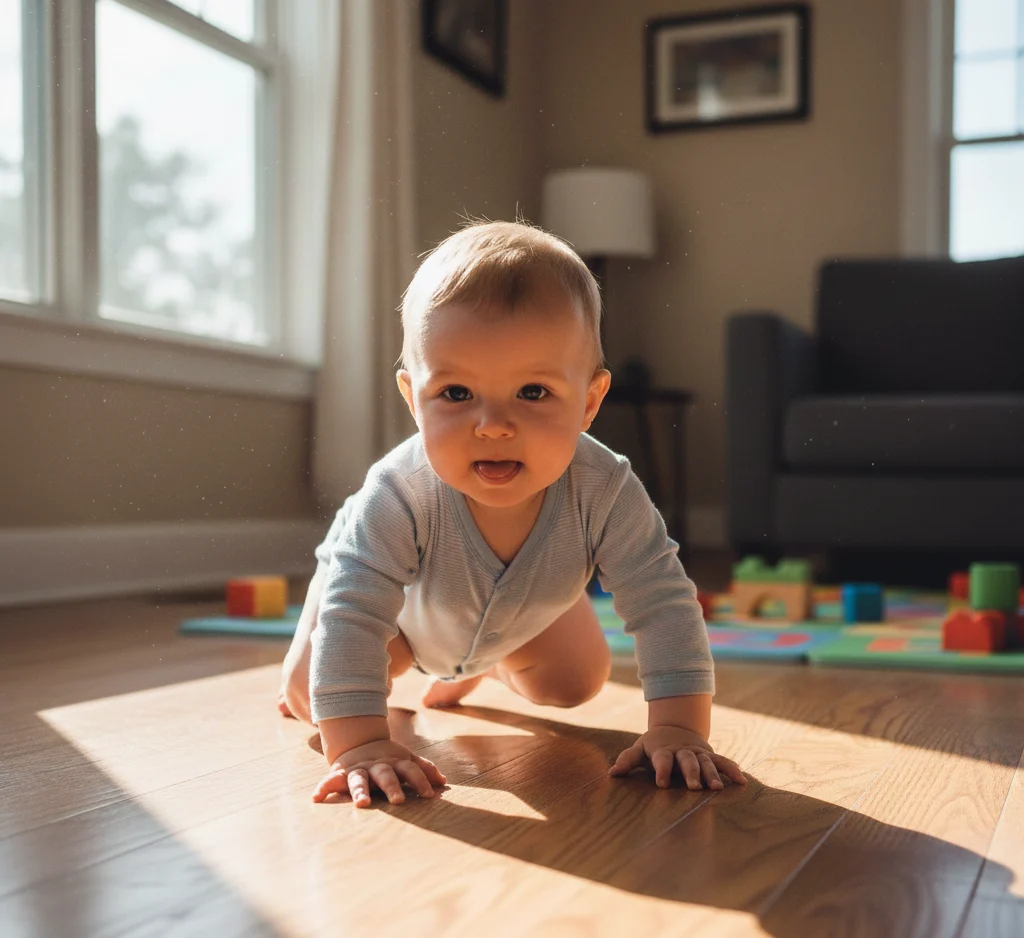
Here are the most common ways babies choose to move:
- The “Classic Crawl” (Hands-and-Knees): The “gold standard” of movement. In this type of crawling babies lift their belly off the floor and move opposite arms and legs together in a cross-lateral pattern.
- The “Rock and Roll”: Babies may push up onto hands and knees and rock back and forth. This is a vital physical rehearsal for the balance and weight-shifting required for forward movement.
- The “Army Crawl” (Commando Crawling): Many babies begin by pulling themselves forward using their arms while their belly stays on the floor. This is often called an army crawl and is a normal early pattern.
- The “Bum Shuffle or Scoot”: Some babies stay in a sitting position and use their legs or arms to scoot along.
👉 Expert Note:
It is important to remember that some babies skip the “classic” crawl entirely. They may “bum shuffle” (scoot on their bottom) or go straight to pulling themselves up to stand. As long as they use both sides of their body to move and explore, they are usually right on track.
Is It Normal If My Baby Is Not Crawling at 9 or 10 Months?
The short answer is: Yes, in many cases, it is perfectly normal. Developmental milestones are not “deadlines”; they are windows. Many babies prioritize different skills during these months:
- The “Static” Specialist: Some babies prefer to sit upright and master fine motor skills, such as picking up small objects with their fingers.
- The “Vertical” Mover: Some babies skip crawling and instead focus on pulling themselves up to stand or moving along the sofa for support.
- The Alternative Mover: Others are perfectly happy reaching their goals by rolling or scooting.
⚠️ When to Look Deeper:
While a delay is often just a matter of personality or preference, we look closer if a baby is not crawling by 10 months and also shows limited attempts to move, rotate, or explore the floor. At this point, the concern is not just strength but neurological readiness.
Clinical Red Flags: When to See a Pediatrician
If your baby has not started crawling by 10 months and shows one or more of the following signs, it’s a good idea to speak with your doctor or a pediatric physical therapist.
- No attempt to move forward by 10 months: This includes a lack of crawling, scooting, rolling to reach objects, or pivoting on the tummy to explore the room.
- Poor weight bearing on arms or legs: Your baby avoids pushing up on their hands, keeps their elbows “locked,” or collapses immediately when placed on their hands and knees.
- Persistent asymmetry: This means always using one side of the body, dragging one arm or leg, or consistently turning in only one direction. This is a key indicator that the brain’s hemispheres aren’t communicating equally.
- Unusual muscle tone: The body may feel unusually “floppy” (low tone) or, in contrast, very tight, stiff, and rigid (high tone) during movement.
- Limited head and trunk control: Your baby has significant difficulty lifting their head during tummy time or cannot maintain a stable, upright posture while sitting without falling over.
- Strong distress with floor play: Your baby shows extreme discomfort, fear, or persistent crying when placed on their tummy or on hands and knees, going well beyond typical “fussiness.”
Why Is My Baby Not Crawling Yet? (Internal vs. External Factors)
The delay usually falls into one of two categories: Environmental Factors or Neurological Readiness.
1. Environmental and Physical Factors (The “External” Factors)
Before looking at neurology, it’s important to review your baby’s environment and physical build. Sometimes, a baby is physically capable but lacks the “motivation” or opportunity to move:
- Temperament: Some babies are natural “observers.” They are happy to sit, watch, and play with what’s nearby. Others are “movers” who feel driven to reach everything in sight. As a result, observer babies may crawl later simply because they feel content where they are.
- Physical proportions: Babies with slightly larger heads or shorter arms and legs may need extra time to find balance on all fours. Crawling requires good weight shifting, and for some body types, that balance takes longer to develop.
- The container effect: Extended time in baby gear such as swings, bouncers, walkers, or seats limits floor time. As a result, babies miss chances to strengthen the core, shoulders, and hips that crawling depends on.
- Floor surface matters: I have noticed that slippery hardwood or tile floors can often be the hidden culprit behind crawling delays. Babies need traction to push forward, so try some barefoot time on a rug or foam mat.
2. The Neurology of the Crawl (The “Internal” Factors)
- The Vestibular System (Balance): This system, found in the inner ear, helps your baby understand body position and balance. If it is not developed, lifting the belly off the floor may feel confusing or uncomfortable.3
- The Cerebellum (Postural Control): The cerebellum is a part of the brain that helps control posture and balance. It works like a processor, making small, constant adjustments in the core and ankles to keep the body steady. If it is not fully developed, a baby may not feel stable or secure enough to stay upright for long.4
- Proprioception (Body Awareness): Proprioception is the body’s way of sensing itself. Nerves in the skin, muscles, and joints constantly send feedback to the brain about pressure and position. This helps your baby learn how much force to push with their knees and hands to move forward without looking at their legs. If proprioception is not developed, the baby may struggle to coordinate movements and crawl efficiently.5
- Left and Right Side Coordination (Crossing the Midline): This is the “big one.” Crawling requires the left and right sides of the brain to talk to each other so the baby can move opposite limbs (right arm, left leg) at the same time. If this skill is not developed, coordinated crawling can be difficult, and other milestones like writing may come later.6
💡 Note:
If your baby is not crawling at 10 months, it is often because the neurological “wiring” is still maturing. Strength alone is not enough. The brain must be ready to lead the dance.
Crawling and Sleep Regressions: Why Movement Disrupts Rest
Mastering this major motor skill requires intense brain activity, physical effort, and emotional excitement.
The brain continues working overtime, even at night, to organize and solidify the new skill. As a result, many babies go through a short phase often called a 8-month sleep regression.
During this time, they may wake more frequently, practice crawling movements in their crib, or struggle to settle back to sleep.
🚀 Expert Tip:
If your baby’s new movement milestones are creating a “sleep storm,” check out our 8-Month Sleep Regression Guide for a specialized strategy to restore your family’s sleep.
How to Help a Baby Crawl: 6 Brain-Based Exercises
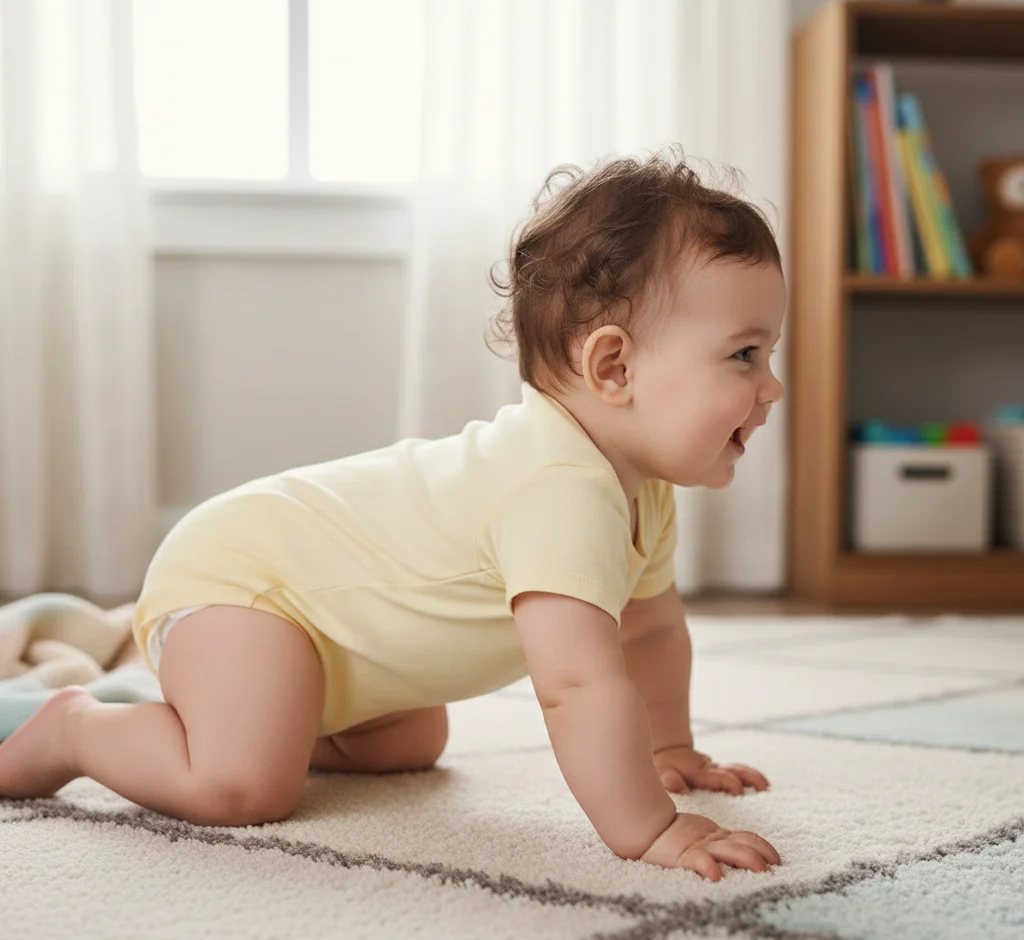
If your baby is not crawling yet, the goal is not to force crawling. Instead, focus on strengthening the brain and body systems that support movement. These crawling activities are especially helpful if your baby is not crawling by 10 months, and they support healthy motor development in a natural way.
1. Daily Tummy Time: Building the Physical Foundation
Tummy time is the essential starting point for strengthening the neck, shoulders, and core. It also helps prevent plagiocephaly (flat head syndrome). The American Academy of Pediatrics (AAP) recommends7 starting supervised tummy time as soon as you come home from the hospital, building up to 15–30 minutes total per day by 3 months.
- The Goal: Place a toy just out of reach to encourage reaching and gentle weight shifting. Keep sessions short and frequent throughout the day. This helps your baby build strength without getting too frustrated.
2. Hands-and-Knees Rocking: Activating the Vestibular System
Gently place your baby in a hands-and-knees position and slowly rock them forward and backward. This movement helps the body experience balance while staying supported.
- The Goal: This activity stimulates the vestibular system, which controls balance and spatial awareness. This simple move teaches the brain how it feels to stay stable in the crawling position, making forward movement easier when your baby is ready.
3. Assisted Cross-Body Movement: Teaching the Diagonal Pattern
While your baby is on their tummy, gently guide one arm forward while bringing the opposite knee under the body. Move slowly and stop if your baby resists.
- The Goal: This activity supports crossing the midline, meaning the ability to move one side of the body across the center line. As a result, it helps the brain learn the diagonal pattern needed for crawling, without forcing independent movement before your baby is ready.
4. Floor Play on Different Surfaces: Improving Proprioception
Let your baby spend time exploring a variety of safe floor surfaces, such as a play mat, carpet, or foam mat. Supervised floor play encourages natural movement and curiosity.
- The Goal: Different textures increase sensory input and improve proprioception, which is the body’s sense of position and movement. This gives the brain a better ‘map’ of where the body is, making coordination much easier.
5. Strategic Toy Placement: Encouraging Rotation and Pivoting
Place toys slightly to one side rather than directly in front of your baby. This simple adjustment naturally invites movement without pressure.
- The Goal: Side placement encourages gentle twisting and pivoting, which activate the core muscles. As a result, these movements build the strength and coordination needed to transition smoothly from sitting to crawling.
6. Reducing “Container” Time: Prioritizing Unrestricted Movement
Reduce prolonged use of swings, bouncers, and car seat carriers when your baby is awake and at home. While these tools are helpful for short periods, they should not replace active floor time.
- The Goal: Unrestricted floor play gives the brain and body the freedom to explore movement naturally. As a result, this free movement becomes one of the most important drivers of healthy motor development.
👉 Expert Note:
I have observed that when a baby gets on all fours and rocks back and forth, it’s a positive sign. This rocking acts as a “neurological system check” for balance and coordination, showing the motor cortex is nearly ready for crawling. Usually, after this stage, babies are just 2–4 weeks away from moving forward on their hands and knees.
What NOT to Do: Common Mistakes to Avoid When Your Baby Is Learning to Crawl
- Do not force the crawling position: Pushing your baby into crawling before their brain is ready can create stress and resistance. Crawling emerges naturally when neurological systems are mature enough.
- Avoid comparing your baby to others: Babies develop at different speeds. Constant comparison can increase parental anxiety without benefiting your baby’s development.
- Limit overuse of walkers and activity centers: These devices reduce floor time, which is where essential brain-body connections are built. As a result, motor skills may develop more slowly.
- Do not skip tummy time: Avoiding tummy time because your baby dislikes it can delay strength and coordination. Instead, offer shorter, more frequent sessions.
- Do not rely only on leg strength exercises: Crawling is not about strong legs alone. Balance, sensory feedback, and brain coordination matter just as much.
- Avoid intervening too quickly: If your baby struggles briefly, allow them time to problem-solve. This effort helps the brain learn how to adjust movements effectively.
Takeaway: Trust the Process
Crawling is an exciting milestone that reflects the healthy teamwork between your baby’s brain and body. However, this skill does not appear overnight. For many babies, neurological coordination takes time to mature, and a short delay does not automatically mean something is wrong.
Most babies crawl between 7 and 10 months, though some follow alternative paths like scooting. What truly matters is steady progress and a balanced use of both sides of the body.
If your baby is not crawling at 10 months, it is a signal to pause and look closer—not to panic. Supporting brain-based development through floor play and tummy time can make a meaningful difference. However, if clinical red flags are present, early guidance from a professional can help build a strong developmental foundation for your child’s future. By focusing on the quality of movement today, you ensure their brain and body are ready for the adventures of tomorrow.
💡Your Role as a Facilitator:
Crawling can not be forced. Pushing a baby into a position they aren’t ready for can lead to frustration and “floor aversion.” Your role is to create the right environment—safe surfaces, minimal “containers,” and plenty of motivation—and then support your baby with patience and confidence.
🌱 The Bottom Line:
When the brain is ready, the body will follow automatically. Focus on the journey, and the movement will come.
Frequently Asked Questions (FAQ) for Crawling
Q1. Is it normal if my baby is sitting but not crawling at 10 months?
Yes. Some babies focus on “static” milestones (sitting) or “fine motor” skills (picking up Cheerios) before focusing on locomotion. However, you should still encourage floor play to build the necessary core strength.
Q2. What if my baby skips crawling and goes straight to walking?
While some babies skip crawling, the cross-lateral movement of crawling is highly beneficial for brain development. Even if your baby starts walking, encouraging them to crawl through tunnels or over pillows can still provide those neurological benefits.
Q3. Does crawling affect sleep?
Often, yes! When a baby is on the verge of crawling, their brain is so active that it can cause a sleep regression. They may even try to practice rocking in their sleep!
Q4. My baby is rocking on hands and knees but not moving forward. Is this crawling?
This is often called the “pre-crawl” or “rocking phase.” It is a fantastic sign! It means your baby has the strength to hold their weight and is currently training their vestibular system (balance) and motor cortex (planning). Most babies begin moving forward within 2–4 weeks of starting this rocking behavior.
Q5. Is “Army Crawling” or “Commando Crawling” considered a real milestone?
Yes! Army crawling (moving with the belly on the floor) is a valid form of independent locomotion. It shows that your baby has the “will” to move and is building shoulder strength. While we eventually want to see the belly lift for the classic crawl to improve core stability, army crawling is a successful developmental step.
Q6. When should I be worried about my baby not crawling?
The “window” for crawling is wide, but you should consult a professional if your baby is 10 months or older and shows no interest in moving (scooting, rolling, or pivoting), or if they only move using one side of their body. Early intervention with a pediatric physical therapist can often resolve these delays quickly by focusing on brain-body coordination.
Q7. I have heard that if a baby skips crawling, they may have trouble reading later. Is this true?
No. There is no medical evidence linking skipping crawling to reading or learning disabilities. While crawling is great for brain coordination, the American Academy of Pediatrics (AAP)8 notes that as long as your baby is meeting other milestones and exploring their environment, the method they use to move is less important than the movement itself.
References
📚 Click to view references
- American Academy of Pediatrics. (2021). Movement: Babies 8 to 12 Months. Available from: https://www.healthychildren.org/English/ages-stages/baby/Pages/Movement-8-to-12-Months.aspx
- Center for Disease Control and Prevention. (2022). Important Milestones: Your Baby By Nine Months. Available from: https://www.cdc.gov/act-early/milestones/9-months.html
- Duarte DSB, Cabral AML, Britto DBLA. Vestibular assessment in children aged zero to twelve years: an integrative review. Braz J Otorhinolaryngol. 2022 Nov-Dec;88 Suppl 3(Suppl 3):S212-S224. Available from: https://pmc.ncbi.nlm.nih.gov/articles/PMC9761112/
- Blumberg MS, Adolph KE. Protracted development of motor cortex constrains rich interpretations of infant cognition. Trends Cogn Sci. 2023 Mar;27(3):233-245. Available from: https://pmc.ncbi.nlm.nih.gov/articles/PMC9957955/
- Bahrick LE. Body perception: intersensory origins of self and other perception in newborns. Curr Biol. 2013 Dec 2;23(23):R1039-41. doi: 10.1016/j.cub.2013.10.060. Available from: https://pmc.ncbi.nlm.nih.gov/articles/PMC3971536/
- Begum Ali J, Charman T, Johnson MH, Jones EJH; and the BASIS/STAARS Team. Early Motor Differences in Infants at Elevated Likelihood of Autism Spectrum Disorder and/or Attention Deficit Hyperactivity Disorder. J Autism Dev Disord. 2020 Dec;50(12):4367-4384. Available from: https://pmc.ncbi.nlm.nih.gov/articles/PMC7677154/
- American Academy of Pediatrics. (2022). Back to Sleep, Tummy to Play. Available from: https://www.healthychildren.org/English/ages-stages/baby/sleep/Pages/Back-to-Sleep-Tummy-to-Play.aspx
- American Academy of Pediatrics. (2021). I’ve heard that if a baby skips crawling, they may have trouble reading later. Is this true? Available from: https://www.healthychildren.org/English/tips-tools/ask-the-pediatrician/Pages/if-a-baby-skips-crawling-trouble-reading.aspx
