

Watching your baby transition from lying flat to sitting tall is a major developmental shift. It’s the first time they see the world from a vertical perspective, which fundamentally changes how they learn.
However, sitting is not just about “propping” a baby up. It is a complex neurological process that involves core strength, the inner ear, and the brain’s ability to understand gravity and balance. Therefore, the transition is not always as smooth as it looks. For some babies, this coordination takes a little longer to come together.
If your little one is still “wobbly” or “slumping” while other babies seem to be sitting upright, it is natural to feel concerned. But do not panic—there is often a logical reason for the delay.
In This Guide, We Cover:
- The Sitting Timeline: A month-by-month breakdown from the first “prop” at 4 months to independent, hands-free play.
- The Neurology of Movement: Why sitting is a brain-based milestone and what’s happening inside the vestibular (balance) system.
- The 2022 CDC Update: Why the “9-Month Rule” from the Centers for Disease Control and Prevention (CDC) changed the way doctors look at sitting milestones.
- Expert Exercises: 7 brain-based, physical therapist-approved ways to support a baby who is struggling to stay upright.
📖 Quick Summary: Sitting Milestones
The 9-Month Rule: As per the 2022 CDC update, independent sitting is now officially a 9-month milestone. If your 6 or 7-month-old still uses their hands for balance, this is normal development.
How to Support Your Baby:
- Practice: Use Hip-Supported Sitting (holding the waist, not the armpits) to force the trunk muscles to engage and balance the body.
- Neurology: Increase Floor Play and Side-Lying to help the brain map out gravity and strengthen the oblique muscles.
- Environment: Minimize “Container” Time in seats or swings to allow the motor cortex the freedom to wobble, fall, and learn.
🚩 Key Red Flags (At 9 Months):
Consult your pediatrician if your baby cannot sit with support, feels consistently floppy or very stiff, or shows persistent leaning to one side only.
When Do Babies Start Sitting Up on their own?: Baby Sitting Timeline
Most babies are able to sit up on their own between 7 and 9 months. However, this is a broad window; some “early sitters” start at 4 months, while others wait until closer to 9 months.
Development typically follows this sequence:
[table id=35 /]
A Closer Look at the Timeline
4 Months (The Prop)
- Physical Ability: Your baby can hold their head steady but still “slumps” at the waist. If you prop them up with a nursing pillow or hold them, they can stay there for a few seconds.
- Neurology: At this stage, the brain is primarily focusing on head control and stabilizing the gaze. They are learning how to keep their eyes level even when their body moves.
5–6 Months (The Tripod)

- Physical Ability: This is the “hands-on-floor” phase. They place their hands on the floor in front of them. This “tripod” position provides a wide base of support while the brain learns to balance.
- Neurology: The inner ear (vestibular system) is waking up! The brain is learning that if the body tilts, the arms need to reach out as a safety net to prevent a fall.
7–8 Months (Independent Sitting)
- Physical Ability: The “hands-free” stage. The baby sits with a straight spine. Their hands are now free to reach for toys, clap, or explore finger foods.1
- Neurology: The “Righting Reflex” is now fully active. Their brain now makes tiny, automatic muscle adjustments in their core to keep them balanced without them having to think about it.
9 Months (The Transition Specialist)
- Physical Ability: The biggest shift! They no longer need you to “place” them in a sitting position. They can move from crawling or lying on their tummy into a sit on their own.
- Neurology: This is a major win for Motor Planning. The brain can now coordinate a complex sequence of movements to change the body’s position in space.2, 3
The 2022 CDC Baby Milestone Update: The “9-Month Rule”
In 2022, the Centers for Disease Control and Prevention (CDC) updated their developmental standards to reflect what 75% of babies (the majority) can do, rather than just the average (50%). This shift was designed to reduce “wait and see” approaches and identify delays earlier.
The New Standards for Sitting
- At 6 months: Babies are expected to lean on their hands for support while sitting. Hands-free sitting is not the goal yet.4
- At 9 months: Babies should sit without support and be able to get into a sitting position on their own.5
What This Means for You
If your 7-month-old still uses their hands like “kickstands” to stay balanced, this is considered normal. The updated medical guidelines now recognize 9 months as the standard age for independent sitting. This gives your baby more time to develop the brain-body connection naturally.
👉 Key Message:
The “9-Month Rule” means it’s not just about sitting still; it’s about a baby being able to get into a sitting position on their own. If your baby is not sitting independently by 9 months, the CDC recommends “Acting Early” by speaking with your pediatrician.
Early Signs Your Baby Is Ready to Sit Independently
Before your baby starts sitting independently, they go through several small “practice” milestones. These early signs show that the brain, balance system, and core muscles are almost ready to work together:
- Good head control: Your baby holds their head steady without wobbling when upright.
- Pushes up during tummy time: They lift their chest using their arms, showing stronger neck and core muscles.
- Rolls easily: Your baby rolls from tummy to back and back again without much effort. Is your baby still working on this? Read our guide on How to Help Your Baby Roll Over.
- Plays with hands in the middle: They bring hands together, grab feet, or reach for toys in front of them.
- Likes sitting with support: When you help them sit, they stay upright and look around instead of slumping.
- Leans forward on hands (tripod sitting): This is normal and helps your baby learn balance.
- Reaches for toys while sitting: Your baby tries to grab toys even if they wobble a little.
💡 Pro-Tip: Guide from the Hips
When helping your baby practice, always guide the movement from their hips or outer thighs. Avoid pulling them by their hands or arms; guiding from the lower body encourages their core muscles to engage and teaches their brain how to initiate the “big flip” independently.
Baby Not Sitting at 6, 7, or 9 Months: When Should You Worry?
If your baby is not hitting these milestones, it’s rarely a cause for panic, but it is a signal to pay closer attention.
1. The 6-Month Mark: Focus on Support
At six months, independent sitting is not the goal. Instead, the focus is on head control and stability.
- The Goal: Your baby should be able to sit with support (in your lap or propped) without their head wobbling.
- The Concern: If they feel significantly “floppy” or cannot hold their head steady, mention it at your next check-up.
2. The 7–8 Month Window: The Tripod Phase
By this age, most babies are actively using the “Tripod Sit” (leaning forward on their hands).
- The Goal: Staying upright with hands on the floor for at least a few seconds.
- The Strategy: If your baby cannot stay upright even with their hands on the floor for support, they may need more floor-based play. This is a great time to increase tummy time and side-lying play to strengthen their core.
3. The 9-Month “Cutoff” and Clinical Red Flags
This is the developmental “cutoff.” If your baby is not sitting independently by 9 months and shows one or more of the following signs, consider speaking with your doctor or a pediatric physical therapist:
- Failure to Sit Unsupported: They still collapse, slump significantly, or require constant propping to avoid falling.
- Poor Head and Neck Stability: Their head still drops back or wobbles when you move them or pick them up.
- Persistent Asymmetry or Leaning: Always leaning to one side, using only one hand for support, or sitting with a curved, uneven spine.
- Unusual Muscle Tone: Their body feels extremely stiff (hypertonia) or very limp/floppy (hypotonia), interfering with their ability to hold a frame.
- Persistent use of one side: Mostly using one side of the body to reach or turn, which can signal uneven muscle development.
💡 Important to Remember:
Every baby develops differently. However, if sitting is not emerging by 6 months or not independent by 8 to 9 months, an early developmental check can be very helpful. Early support often leads to faster progress and better outcomes.
Why Is My Baby Not Sitting Yet? Brain vs. Body
Delayed sitting is rarely caused by just one issue. Sitting is a “whole-body” event. If a baby is struggling, it’s rarely just about weak muscles; it’s usually a combination of:
1. Neurological & Sensory Factors (The “Wiring”)
- The Vestibular System (Balance): Located in the inner ear, this system tells the brain where the body is in space. If this system is still maturing, the baby may feel “dizzy” or unsafe when upright, leading them to slump back down to the floor.
- Retained Primitive Reflexes: If a baby has not integrated certain early reflexes, their body may still want to “curl up” or “extend out” involuntarily, making a neutral sitting posture difficult.
- Sensory Feedback & Proprioception: Nerves in the skin and joints send information to the brain about body position. If these signals are still organizing, your baby may struggle to adjust their posture or keep their trunk upright.
2. Physical & Environmental Factors (The “Building Blocks”)
- Low Muscle Tone (Hypotonia): Some babies have “floppier” muscles, requiring more effort to hold their frame against gravity.
- Lack of Tummy Time: Without sufficient floor play, the extensors (back muscles) and neck muscles don’t develop the “stiffness” needed to stay upright.
- Limited Floor Play: Too much time in baby seats, swings, or carriers (often called “container time”) can limit the opportunities a baby needs to practice natural movement..
- Movement Caution: Some babies prefer stability and take longer to experiment with new positions.
Why Sitting Milestones Cause 6-Month Sleep Regressions
Mastering a major motor skill like sitting requires intense brain activity, physical effort, and emotional excitement. The brain continues working overtime, even at night, to organize and solidify the new skill. As a result, many babies go through a short phase often called a motor-driven sleep regression, also known as 6-month sleep regression.
Key Factors Behind the Disruption
- The “Stuck” Factor: They often pop up in their sleep but haven’t learned how to lay back down yet, causing them to cry for help.
- Brain Overdrive: Their nervous system is working overtime to master balance, making it harder to stay in deep sleep.
Common Signs to Watch For
During this phase, you may notice temporary changes such as:
- More frequent night wakings.
- Shorter naps or skipped naps.
- Difficulty settling back to sleep after a wake-up.
- Rocking, rolling, or attempting to sit in the crib during sleep hours.
🚀 Expert Tip:
If your baby’s new movement milestones are creating a “sleep storm,” check out our 6-Month Sleep Regression Roadmap: Step By Step Plan to Stop Night Wakings for a specialized strategy to restore your family’s sleep.
How to Help a Baby Sit-Up: 7 Brain-Based Exercises
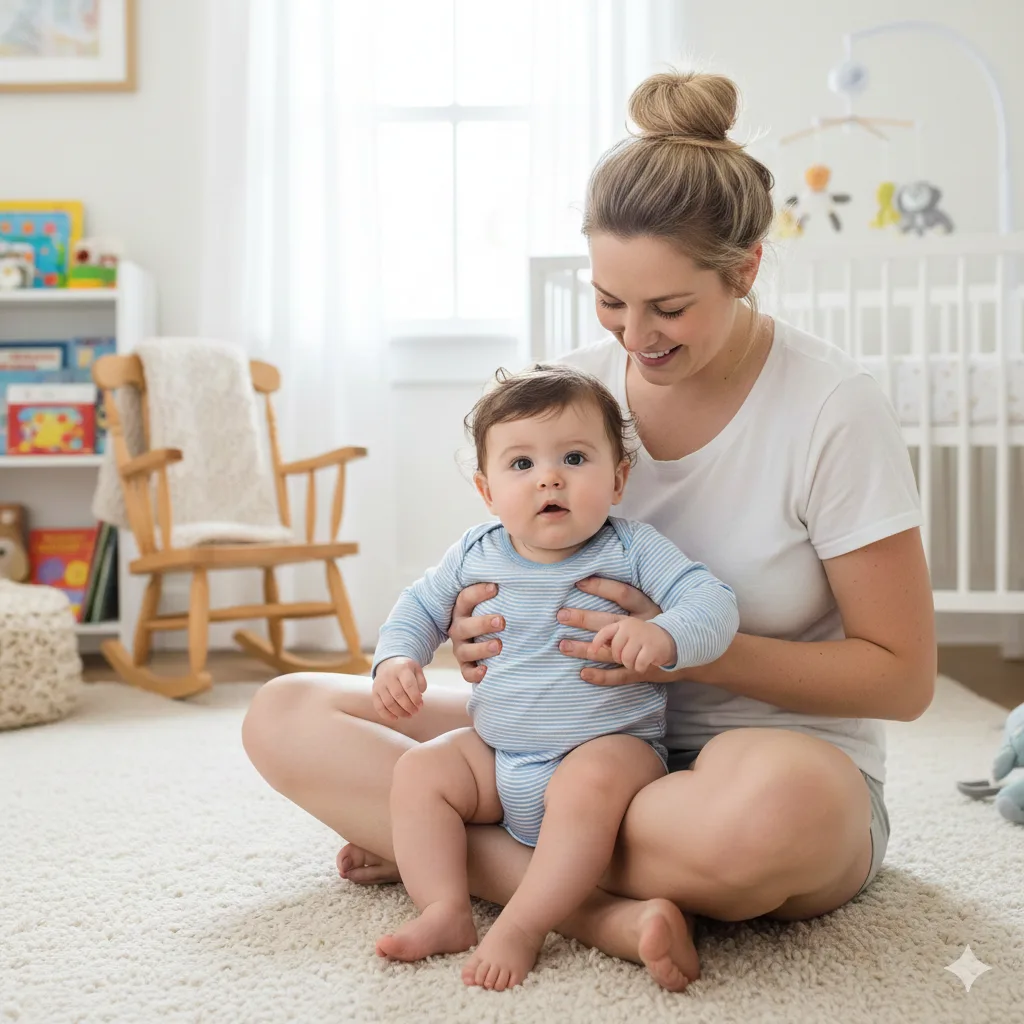
Many parents believe learning to sit is purely about “building muscle.” While strength is important, sitting is actually a complex neurological milestone. It requires the brain to integrate the vestibular system (balance) with proprioceptive input (understanding where the body is in space).
If you are wondering how to help your baby reach this milestone, these six brain-based exercises offer gentle support for your baby’s development while keeping playtime both engaging and safe.
1. Hip-Supported Sitting
- The Exercise: Place your baby on your lap, facing away from you, and hold them firmly but gently at the hips. By supporting the base rather than the chest, you force their upper body to do the “work” of balancing.
- The Goal: To encourage independent trunk control and postural stability.
- Expert Tip: Use “active sitting.” If they lean to the left, gently tilt your own leg to the right, encouraging their brain to recognize the shift and pull back to the middle. Keep sessions short and fun, about 1–2 minutes at first, and gradually increase as your baby strengthens.
2. Tummy Time
- The Exercise: Encourage your baby to push up onto their hands. Start with short sessions several times a day and gradually increase the duration.
- The Goal: It strengthens the neck, back, and core muscles needed for sitting.
- Expert Tip: Use colorful toys, a shatterproof mirror, or your face to make tummy time fun. Try different surfaces like a firm blanket on the floor to vary sensory experience.
3. Reach-and-Grab Play
- The Exercise: While your baby is sitting with support, place toys slightly out of reach. Encourage them to reach, twist, and grasp.
- The Goal: Develop upper body strength, coordination, and balance while sitting.
- Expert Tip: Use high-contrast toys or those that make a “crinkle” sound to engage the auditory and visual cortex, providing more motivation for the brain to move the body.
4. Rolling Games
- The Exercise: Gently encourage rolling from tummy to back and back to tummy by leading with a toy or moving their leg across their body.
- The Goal: To build diagonal muscle strength (the connection between the shoulder and opposite hip).
- Expert Tip: Roll slowly and avoid rushing the movement. Rolling helps your baby learn how to control their core, which is an important step toward sitting.
5. Side Sitting Practice
- The Exercise: Prop your baby up so they are sitting on one hip with their legs tucked to the side (like a “mermaid” pose), using one hand on the floor for support.
- The Goal: To engage the obliques and lateral core muscles for side-to-side stability.
- Expert Tip: Always Practice on both sides during playtime. This helps prevent favoring one side and supports balanced muscle development.
6. Interactive Floor Play
- The Exercise: Use mirrors, soft blocks, or textured toys on the floor. Encourage your baby to twist their torso to see things behind or beside them.
- The Goal: To integrate vestibular (balance) and visual systems.
- Expert Tip: Placing a mirror in front of them is highly effective; babies are socially motivated to “interact” with the “other baby” in the reflection, which keeps them upright longer.
7. Minimize “Container” Time
- The Strategy: Reduce the amount of time your baby spends in “containers” like baby seats, swings, or bouncers.
- The Goal: To allow the motor cortex the freedom to wobble, fall, and learn.
- Expert Tip: While containers are convenient, the brain only learns balance through “micro-corrections.” When a baby wobbles on a flat floor, their brain is firing neurons to figure out how to stay upright—a process that is “switched off” when they are strapped into a seat.
👉 Parent Note:
Consistency is key. Short, frequent sessions are more effective than long, tiring ones. Always supervise your baby during these exercises and celebrate small milestones—they add up quickly!
Common Mistakes to Avoid
- Do not force the sitting position: Pushing your baby to sit before they have enough core strength can create frustration and resistance. Sitting develops naturally as muscles and neurological systems mature.
- Avoid comparing your baby to others: Every baby learns to sit at their own pace. Constant comparison can increase parental stress without helping your baby’s development.
- Limit overuse of pillows or props: Relying heavily on cushions or chairs can reduce the need for your baby to use their own muscles, slowing natural balance and strength development.
- Do not skip tummy time: Skipping tummy time limits neck, back, and core strength, which are essential for sitting. Offer short, frequent sessions to build these muscles gradually.
- Do not rely only on toys to motivate sitting: While toys help, sitting requires balance, coordination, and core strength. Encourage natural movement and reaching, not just playing with objects.
- Avoid intervening too quickly: If your baby wobbles or falls briefly, give them a chance to self-correct. This problem-solving helps the brain learn balance and control effectively.
Takeaway: The Journey to Independent Sitting
- Respect the Timeline: Each baby follows their own timeline: some may start sitting with support around 4–6 months, use the “tripod” position at 5–6 months, and achieve independent sitting by 7–9 months.
- Support the Hips, Not the Chest: When practicing, use Hip-Supported Sitting. By holding their waist instead of their armpits, you force their upper body to do the “work” of balancing, which builds real strength.
- The 9-Month Rule (CDC): This is the developmental “cutoff.” If your baby is not sitting unsupported by 9 months, or if you notice persistent leaning, stiffness, or “floppiness,” consult your pediatrician for a quick developmental check.
- Prioritize the Floor: The floor is your baby’s best teacher. Limit time in “containers” (swings, bouncers, or seats) and let them work through the “wobble” on a flat surface—that is where the most important neurological learning happens.
🌱 The Bottom Line:
Sitting is not just a physical act—it’s a confidence-building exercise. Stay consistent with floor play, celebrate the “wobbles” as signs of learning, and enjoy this new vertical view of the world!
Frequently Asked Questions (FAQ): Baby Sitting Milestones
Q1: Is it normal for a 6-month-old to not sit up?
Yes, it is perfectly normal. While some babies begin to sit with support at 6 months, many are still developing the core strength and vestibular balance needed to sit independently. At this age, “tripod sitting” (leaning forward on hands) is the standard milestone, not hands-free sitting.
Q2: When should I worry if my baby is not sitting?
Most pediatricians look for independent sitting by 9 months. If your baby reaches 9 months and can not sit unsupported or shows signs of extreme “floppiness” or stiffness, it is recommended to seek a developmental evaluation. This ensures your baby gets any extra support they might need early on.
Q3: How can I help my baby sit up?
The best way to help is to focus on “Hip-Supported Sitting.” By holding your baby at the waist rather than the armpits, you force their core muscles to do the work of balancing. In addition, plenty of tummy time and “reach-and-grab” play are essential for strengthening the back muscles required for an upright posture.
Q4. Is it okay to sit my baby up early (at 3 or 4 months)?
It is generally too early to sit, even with support. At this age, a baby’s spine is still C-shaped and they lack the trunk strength to hold their weight. Forcing a sit too early can lead to significant ‘slumping,’ which may put them in a position that restricts their breathing. Focus on tummy time instead to build the neck strength they will need later.
Q5. When should I start training my baby to sit?
You do not need to “train” a baby so much as provide the opportunity. You can start practicing supported sitting around 4 to 5 months, once your baby has solid head control. Start by sitting them in your lap or using your hands at their hips. However, the best “training” is simply floor play, which allows them to naturally discover the muscles needed to stay upright.
Q6. Can I put my 4-month-old in a sitting chair?
It is best to wait. If you do use a baby chair, limit it to 10–15 minutes a day. If your baby’s chin drops to their chest or they slump to the side, they are not ready for the chair yet. Their muscles are still too weak for that position. The best place for a 4-month-old to get strong is flat on the floor.
Q7. What are the red flags for a baby not sitting?
The primary clinical red flag is a baby who cannot sit unsupported by 9 months. Other signs to watch for include persistent “floppiness” (low muscle tone), extreme stiffness in the legs when trying to sit, or always leaning to one specific side.
Q8: My baby keeps falling backward. Is that normal?
Yes! Falling backward is actually a sign that the brain is learning. It happens because the “backwards protective reflex” is the last one to develop. To help, place a nursing pillow (like a Boppy) behind them or practice on a soft play mat so they can “wobble” safely.
Q9: Is “W-Sitting” bad for my baby?
It is fine if your baby moves in and out of a “W” position while playing. However, if they only sit that way and can not sit with their legs straight or tucked, it can make their core muscles lazy. Encourage other positions like “side-sitting” to keep their hips and core healthy.
References
📚 Click to view references
- American Academy of Pediatrics (AAP) via HealthyChildren.org: Movement: Babies 8 to 12 Months — Source for the progression from toppling to hands-free sitting.
- World Health Organization (WHO): Motor Development Milestones – Windows of Achievement — Source for the international 4–9 month “window” of developmental achievement.
- National Institutes of Health (NIH) / PMC: Analysis of 2022 Milestone Updates — Scientific breakdown of why the CDC shifted milestones to the 75th percentile.
- CDC (Centers for Disease Control and Prevention): Milestones by 9 Months: Learn the Signs. Act Early. — Source for the “9-Month Rule” and independent sitting standards.
- CDC (Centers for Disease Control and Prevention): Milestones by 6 Months: Learn the Signs. Act Early. — Source for the “Tripod Sit” and leaned support at 6 months.
