

One of the most exciting milestones in parenting is watching your baby take their first shaky, independent steps. But when do babies start walking, and what is actually considered normal?
If your baby is not walking yet, do not worry. While the “classic” expectation is the 12-month mark, this number is only an average. In reality, walking is a complex neurological milestone that depends on brain maturity, balance, and coordination—all of which develop at different speeds in every child.
In this guide, you will discover:
- The typical walking timeline (9 to 18 months).
- The “neurological software update” behind balance and movement.
- Red flags that may signal a medical concern.
- 7 exercises to support your child’s first steps.
📖 Quick Summary
Most infants walk between 9–18 months. Around 12 months is average. But some take their first steps even earlier or much later — and that’s perfectly OK.
This transition is like a sophisticated “neurological software update” where the brain’s vestibular system (balance), motor cortex (movement), and proprioceptive system (body awareness) learn to work together to stabilize the body against gravity.
How to Support Your Baby
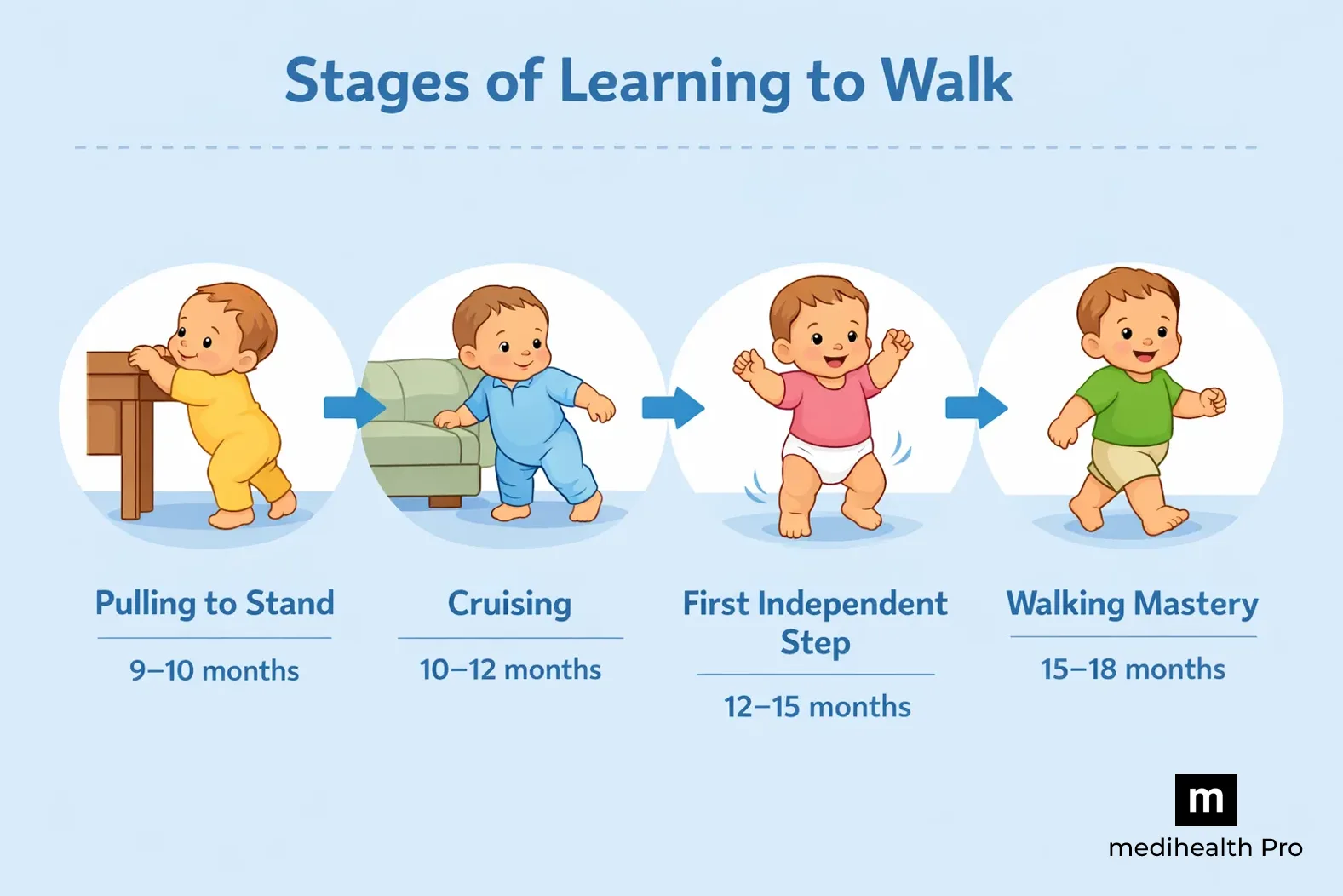
- The Timeline: Expect pulling-to-stand at 9-10 months, cruising at 10–12 months, independent standing near 12-15 months, and walking mastery by 15–18 months.
- Support the Hips, Not the Hands: When practicing, hold your baby at the pelvis or hips, not by their hands, to encourage them to find their own center of gravity.
- Master “The Plop”: Teach your baby how to sit down safely from a standing position to build confidence and independence.
- Prioritize Barefoot Practice: Being shoeless provides superior sensory feedback, helping the brain “wire” balance pathways faster..
- Safety: Avoid seated baby walkers; opt for sturdy push-toys that require the baby to bear their own weight.
Key Red Flags (The 18-Month Rule)
Consult your pediatrician if your baby is:
- Not bearing weight by 10 months
- Not standing independently by 15 months.
- Not walking independently by 18 months.
(See the full “Red Flags” section below for more details).
When Do Babies Start Walking? The Complete Baby Walking Timeline
Walking is not just a physical feat—it is a gradual calibration of the nervous system. While media highlights the “first birthday” step, the developmental window is much wider than most parents realize.
Before reaching this stage, your baby has likely already mastered key foundations such as rolling over and sitting up. These early milestones build the strength, balance, and coordination needed for confident first steps.
🔍 If your baby is struggling with walking, revisit earlier skills like When Do Babies Roll Over? and When Do Babies Start Sitting Up?. These early skills build the strength, balance, and coordination needed for confident first steps.
Baby Walking Milestones at a Glance
[table id=42 /]
9–10 months: Pulling-to-Stand
- Overview: During this window, babies transition from floor-play to the vertical world.
- Key Milestones: Babies begin pulling to stand (walking sideways while holding furniture), and bear full weight through their legs.
🔍 For more on the mobility that leads up to this, see When Do Babies Start Crawling?
10–12 Months: Cruising Phase
- Overview: This is the critical “sideways walking” phase. Most babies spend at least 2 months perfecting this before letting go.
- Key Milestones: Babies begin cruising along furniture (walking sideways while holding onto support) and shift weight from one leg to the other.
🔍 If your baby is struggling to reach this stage, you may want to review When Do Babies Start Standing?
12–15 months: First Independent Steps
- Overview: Most babies take their first independent steps during this window.
- Key Milestones: Walking with legs apart and arms raised for balance.
- The Role of Falling: Frequent falls are natural and help the brain learn to recover balance and adjust the body’s center of gravity.
15–18 months: Mastery and Mobility
- Overview: By 18 months, confident walking typically emerges as the nervous system matures.
- Refined Movement: Core stability improves, with legs moving closer together and arms lowering into a natural walking posture. This results in smoother, more coordinated walking.
- Advanced Exploration: Babies are now ready to progress into running, climbing, and jumping.
📝 Parent Note:
Developmental research consistently indicates that independent walking occurs within a 9–18 month window. Variability within this range is expected and generally not a cause for concern. Clinical evaluation is recommended only if walking has not commenced by 18 months or if additional developmental red flags are present.
💡 Myth vs. Reality: Common Baby Walking Concerns
👟 Myth 1: Babies need stiff shoes for ankle support.
Reality: Barefoot (without shoes) is best! High-top shoes can actually restrict the natural range of motion needed for balance. Shoeless exploration allows thousands of nerve endings in the feet to “feel” the floor, strengthening the arches naturally.
🦵 Myth 2: Bow‑leggedness is a sign of a walking problem.
Reality: Most infants are naturally bow-legged (physiologic genu varum) due to their position in the womb. The legs typically straighten naturally by age two as they bear weight and build muscle.
Early Signs Your Baby Is Ready to Walk: Pre-Walking Milestones (9–12 Months)
Many parents ask: “When will my baby start walking?” According to the Centers for Disease Control and Prevention (CDC)1, most walking‑related milestones are achieved by a baby’s first birthday. Still, every child develops differently, and spotting early signs of walking readiness can help you support your baby’s first steps with confidence.
Pre‑Walking Milestones to Watch For:
- Pulling up to stand: Babies begin using furniture to pull themselves upright. This shows growing leg strength and balance.
- Cruising along furniture: Babies shuffle sideways while holding onto couches or tables. This step builds coordination and confidence.
- Standing without support: Even brief moments of independent standing signal readiness for walking.
- Improved balance and core strength: Sitting steadily, squatting to pick up toys, and shifting weight between legs are key precursors.
- Stepping with support: Babies may walk while holding your hands or pushing a sturdy toy cart.
- Increased curiosity and mobility: Crawlers who constantly pull up, reach higher, and explore upright positions are preparing for independent steps.
Reasons for Late Walking in Babies: Neurological Causes of Delay
At Medihealth PRO, developmental research shows that walking is far more than a physical milestone; it is a neurological breakthrough requiring the brain and body to work in perfect harmony.
Before a child can move from crawling to confident steps, three important systems must develop and coordinate:
The Three Systems Behind the “Walking”
- Vestibular System: Provides balance and spatial orientation, helping babies stay upright and steady.2, 3
- Motor Cortex: Controls voluntary muscle movements, coordinating the legs, arms, and core for walking.4
- Proprioceptive System: Delivers internal body awareness, allowing babies to sense limb positioning and adjust movements in real time.5
When a baby takes a step, the brain sends signals to the legs, the inner ear maintains balance, the eyes help judge distance, and proprioception provides body awareness. If these systems are still developing, walking may take a little longer — and that’s usually a normal part of growth.
📝 Parent Note:
Research published in Nature (2025) shows that brain connections mature at different speeds for every child.6 This explains why some babies walk early, while others first focus on skills like language or fine motor coordination before turning their energy toward walking.
When to worry: Red Flags to Watch For
Most babies walk between 10–18 months. The CDC recommends1 talking to your child’s pediatrician if they are not walking independently by 18 months, or show signs like stiff/floppy muscles, persistent toe-walking, or loss of motor skills—it may be a red flag for walking delay and should prompt a pediatric evaluation.
Key Red Flags for Walking Delay
- Not bearing weight by 10 months: Babies should be able to stand with support and put weight on their legs.
- Not standing independently by 15 months: A child should have the core strength and balance to stand for a few seconds without holding onto furniture or a parent.
- Not walking independently by 18 months: Walking later than this is considered delayed and should prompt an immediate consultation with a pediatrician or physical therapist.
- Persistent toe-walking: Occasional toe-walking is normal, but constant toe-walking may signal neurological or muscular issues.
- Stiff or floppy muscle tone: Hypertonia (too stiff) or hypotonia (too floppy) can interfere with walking.
- Loss of previously acquired motor skills: Regression is always concerning and requires urgent evaluation.
- Asymmetry in movement: Dragging one leg, favoring one side, or uneven strength may indicate hip or neurological problems.
- Associated delays in other areas: Speech, social interaction, or fine motor delays alongside walking delay suggest broader developmental concerns.
📝 Parent Note:
A 2022 study suggested that early motor delays could be a risk factor for later communication challenges in children already at higher risk for autism (family history).7 However, for children with a low risk of autism, parents should not assume that motor delays automatically signal future communication problems.
How to Support Your Baby: 7 Exercises to Help Baby Walk Independently👣
If you are wondering how to help your baby walk faster or what exercises encourage walking, these tried‑and‑tested activities will strengthen muscles, improve balance, and build confidence.
1. Supported Standing
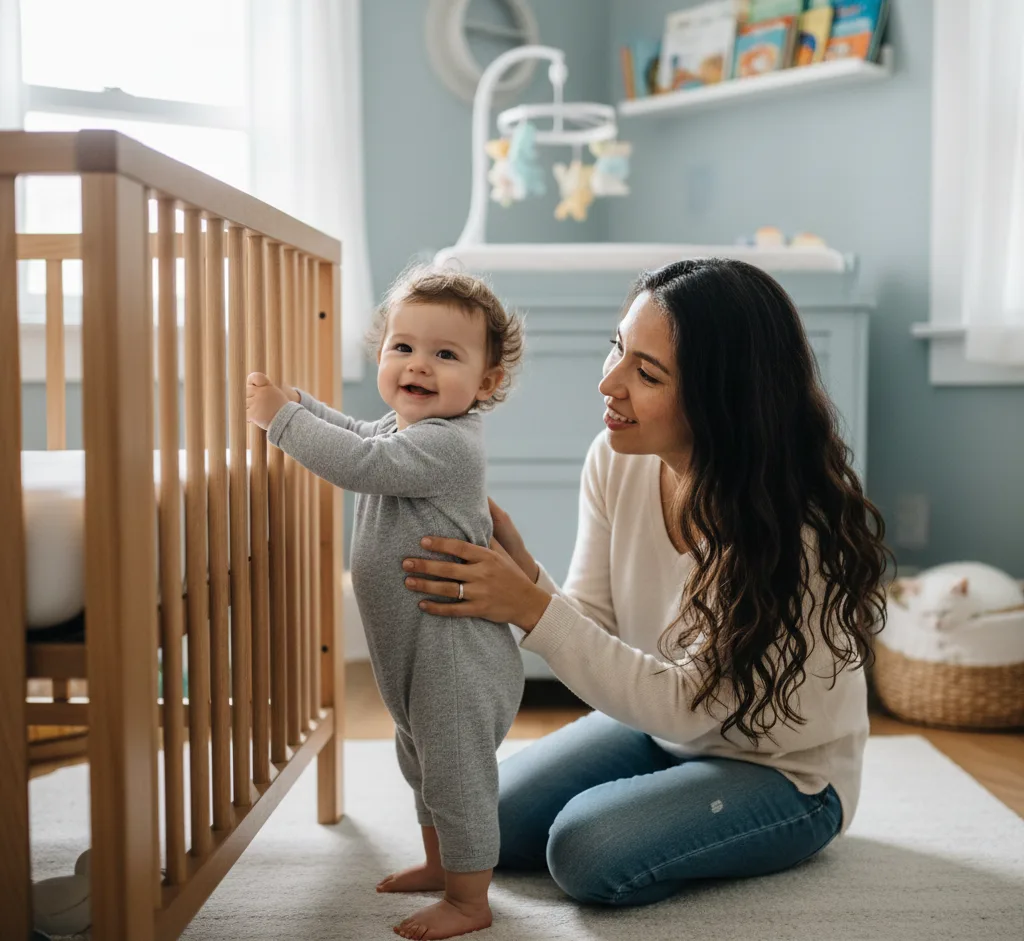
- The Exercise: Encourage your baby to stand while holding onto furniture or your hands.
- The Goal: Builds leg strength and trains the vestibular system (inner ear) to manage an upright center of gravity.
- Expert Tip: While hand-holding is fun, prioritizing furniture support is better for development. It forces the baby to find their own balance rather than relying on your pull.
2. Cruising Along Furniture
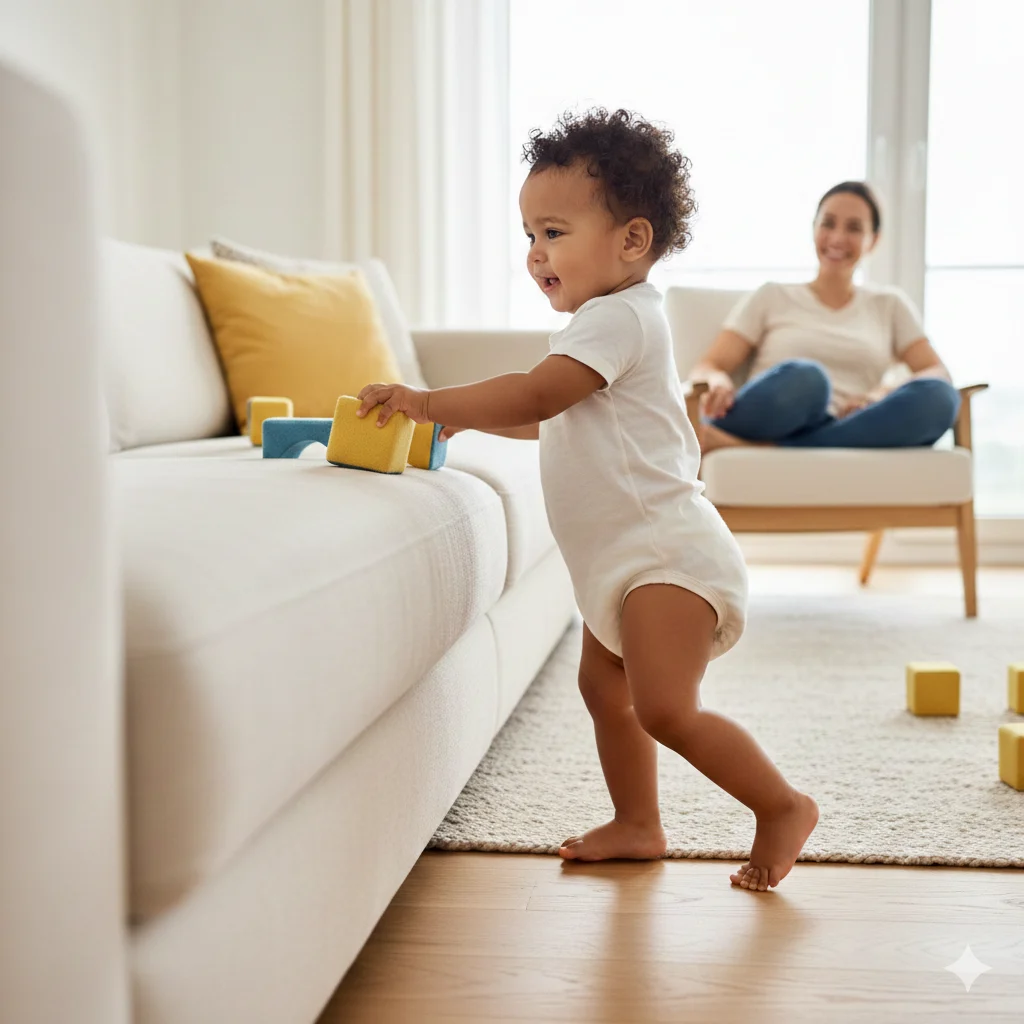
- The Exercise: Place favorite toys along the edge of a sofa or table. Encourage your baby to move sideways while holding on to reach the toys.
- The Goal: Teaches lateral weight shifting. This is the “bridge” between standing still and moving forward.
- Expert Tip: Use a long sofa so they can take multiple steps in one direction, which builds muscle endurance in the hips.
3. Push‑Toy Walking
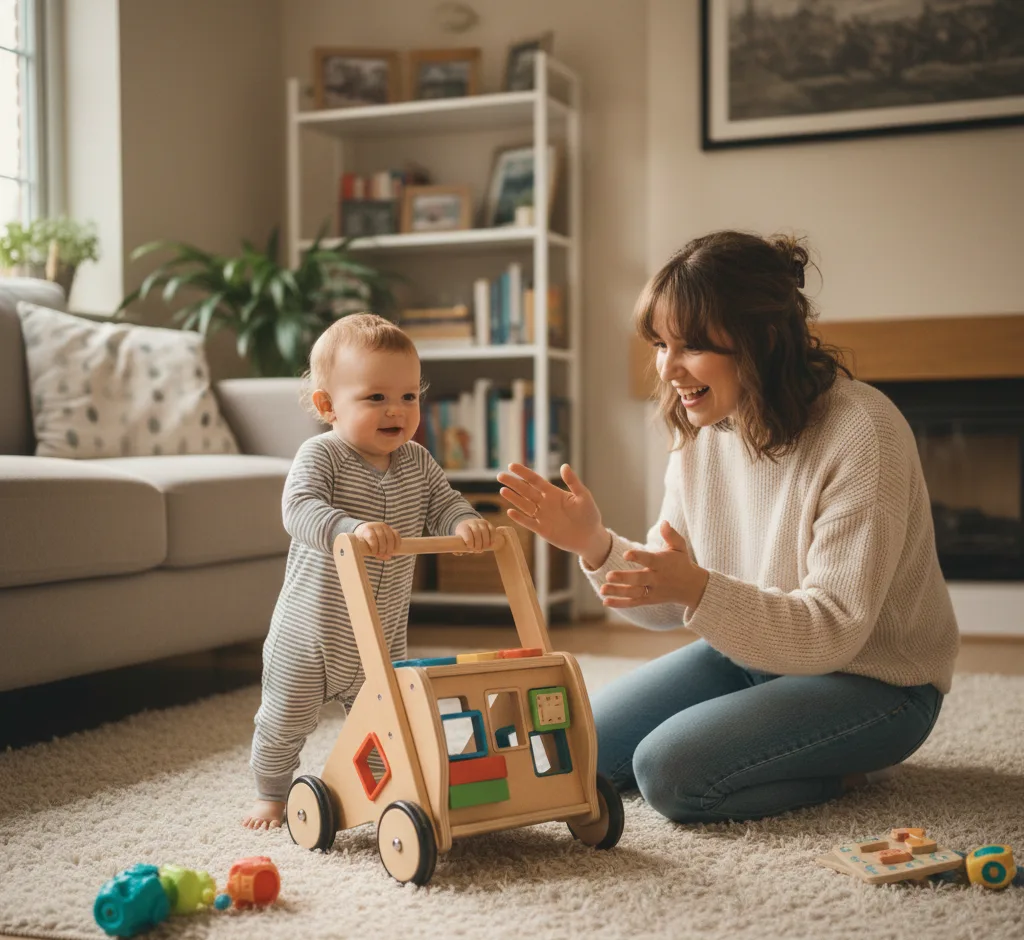
- The Exercise: Offer a sturdy push toy or walker cart. Let your baby push it forward while stepping.
- The Goal: Encourages forward walking patterns with safe support. Builds confidence in independent movement.
- Expert Tip: Avoid seated “baby walkers.” Our research analysis shows they can actually delay walking. Instead, use a push-toy that requires the baby to support their own weight.
4. Squat‑to‑Stand Games
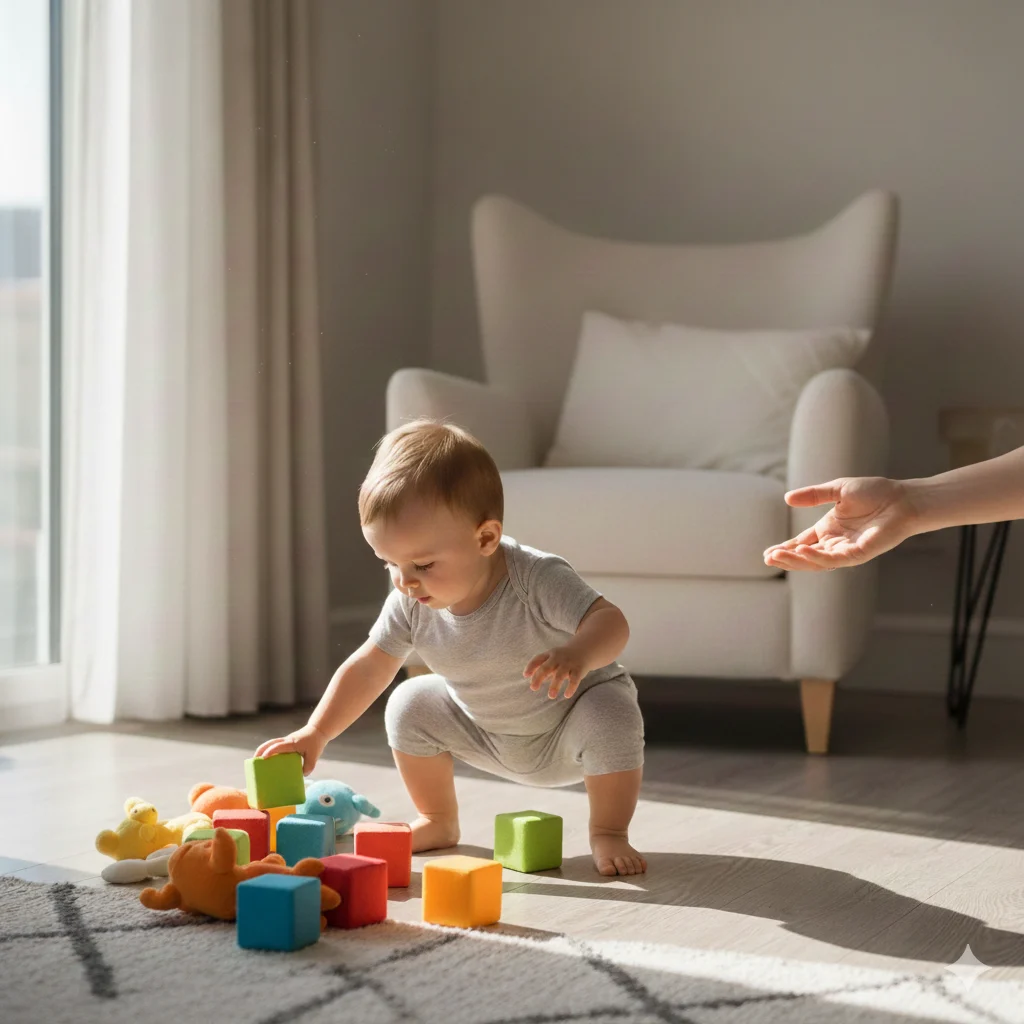
- The Exercise: Scatter toys on the floor and encourage your baby to squat down and stand back up to pick them up.
- The Goal: This is the ultimate “power move.” It strengthens the quadriceps and core while teaching the brain how to control a descent.
5. Barefoot Balance Practice
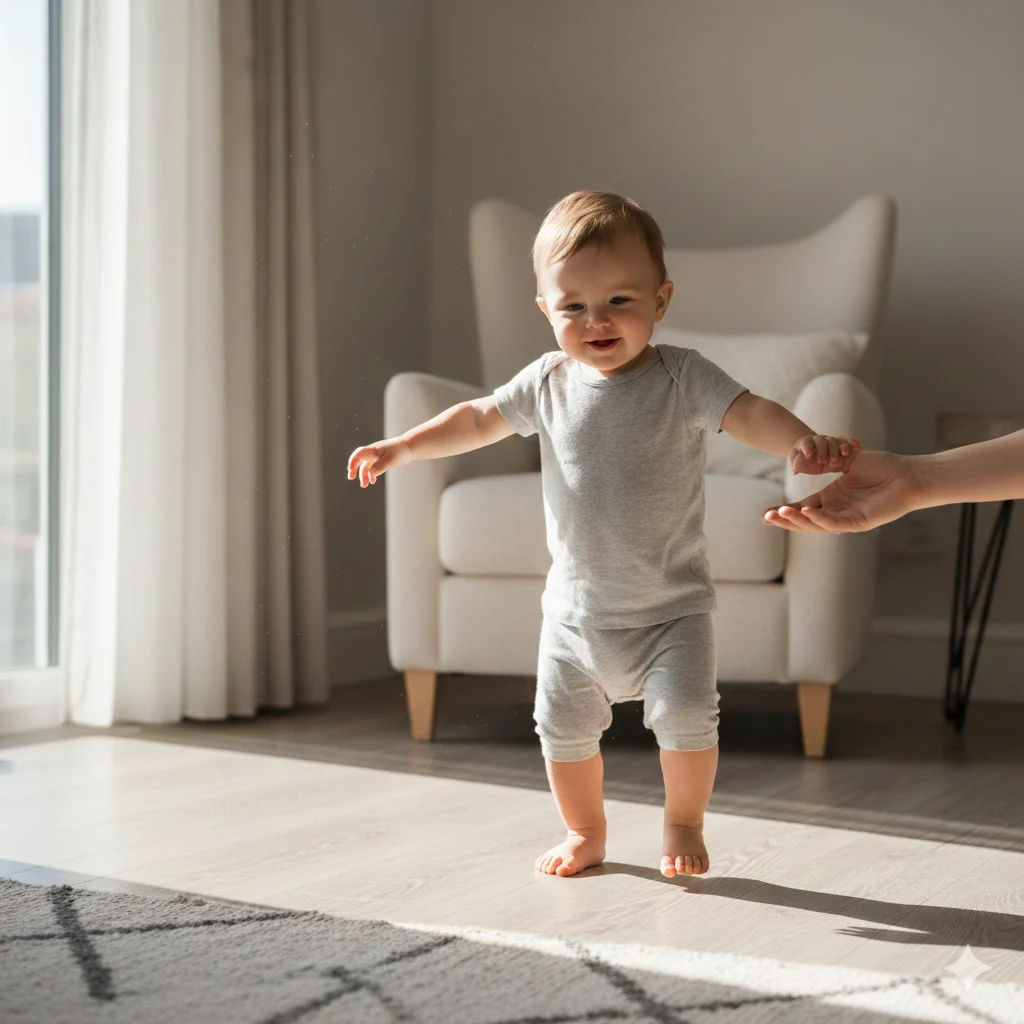
- The Exercise: Allow your baby to walk barefoot (without shoes) indoors on safe and clean surfaces.
- The Goal: Improves proprioceptive feedback. The thousands of nerve endings in the feet send “data” to the brain about the floor’s texture and tilt, helping the brain “wire” balance faster.
- Expert Tip: Avoid socks on slippery floors—bare feet give the best grip and stability.
6. Hand‑Holding Walks
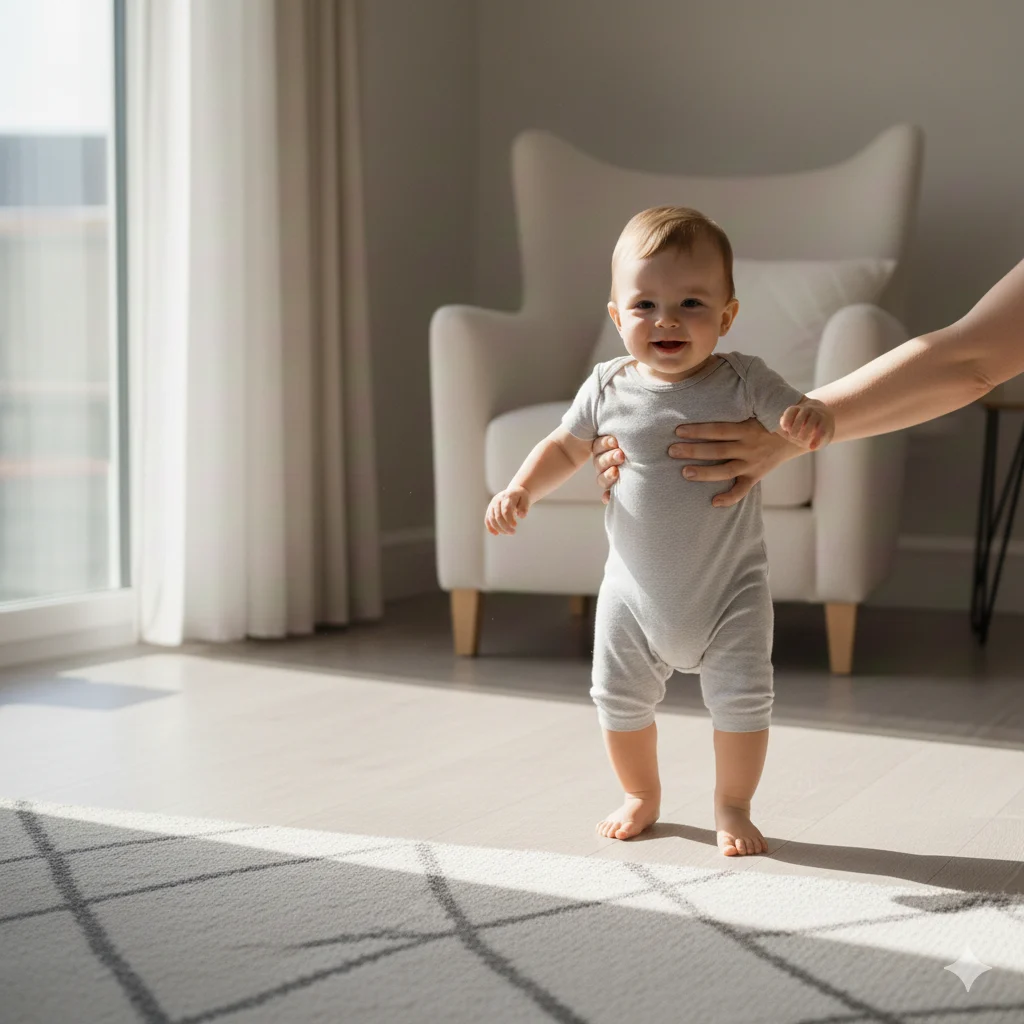
- The Exercise: Instead of holding your baby’s hands high above their head, try holding them at the trunk or hips.
- The Goal: Builds confidence and helps your baby trust their own balance.
- Expert Tip: When you hold hands high, the baby often “leans” into you. Supporting the hips forces their core muscles to do the work.
7. Obstacle Play

- The Exercise: Create a soft path with pillows or toys to step over and around.
- The Goal: Enhances spatial awareness and problem-solving. The brain must plan the movement (motor planning) before the body executes it.
- Expert Tip: Keep obstacles low and safe. Celebrate each successful step with claps or cheers to reinforce confidence.
⚠️ A Note on Seated Baby Walkers
While push‑toys are excellent, seated baby walkers can actually delay walking. These devices prevent the brain from learning how to balance the body’s center of gravity and may encourage unsafe tip‑toe patterns. Stick to push‑toys that promote natural, upright walking.
Key Baby Safety Checks for walking Milestones
As your baby reaches important walking milestones, safety becomes a top priority. Ensure these safety steps are in place:
- Cover sharp corners: Use corner guards on tables and furniture to protect your baby during falls.
- Secure heavy furniture: Fix TVs, shelves, and cabinets to the wall so they do not tip over.
- Clear low surfaces: Remove hot drinks, heavy items, and small objects from tables your baby can reach.
- Cover electrical outlets: Place outlet covers on all reachable sockets.
- Block dangerous areas: Use safety gates near stairs, kitchens, and balconies.
- Keep floors safe: Dry floors and remove loose rugs to prevent slipping and tripping.
- Lock cabinets and drawers: Store medicines, cleaners, and sharp items behind childproof locks.
- Prioritize Bare Feet or Grip: Encourage barefoot walking or non-slip socks to improve balance.
- Supervise the Plop: Falls are normal when learning to walk, but supervision keeps your baby safe.
Takeaway
Walking is one of the most exciting milestones in your baby’s development. Most children take their first steps between 9 and 18 months, with many walking closer to the 12‑month mark. However, this journey depends not only on muscle strength, but also on the brain’s ability to coordinate balance, movement, and body awareness.
- Gentle exercises like cruising, push‑toy walking, and barefoot practice can strengthen skills.
- Safety checks—such as securing furniture and using gates—help create a safe environment for exploration.
- Red flags, including not walking by 18 months, persistent toe‑walking, or loss of motor skills, should prompt a pediatric evaluation.
✔️Bottom line: Every baby’s timeline is unique. Celebrate progress, support practice, and seek guidance if milestones are delayed.
Frequently Asked Questions (FAQ)
Q1. Should I be worried if my baby is 14 months and not walking?
No. While many babies take their first steps around their first birthday, the “normal” window for independent walking extends up to 18 months. If your baby is meeting other milestones—like crawling, pulling to stand, and cruising—they are likely just perfecting their balance before letting go.
Q2. Can using a baby walker delay walking?
Yes. Modern research from the American Academy of Pediatrics (AAP) suggests that seated baby walkers can actually delay walking. They strengthen the wrong muscles (lower legs instead of hips/core) and prevent the baby from seeing their feet, which is vital for neurological development.
Q3. Does late crawling mean late walking?
Not necessarily. Some babies skip crawling entirely and go straight to walking, while others crawl for months to build upper body strength. The style of crawling (commando crawl, classic crawl, or bottom shuffling) is less important than the fact that your baby is attempting to move and explore.
Q4. Why does my baby walk on their toes?
Occasional toe-walking is a common part of experimenting with balance. However, if your baby only walks on their toes or cannot put their heels flat on the ground, it may indicate tight Achilles tendons or a sensory processing preference. If this persists, consult your pediatrician.
Q5. My baby stopped practicing walking. Is this regression?
It is very common for babies to “pause” one skill while mastering another. If your baby is suddenly focused on learning new words or fine motor skills (like using a spoon), they may temporarily stop practicing walking. This is usually a normal part of brain development, not a true medical regression.
Q6. Should my baby wear shoes while learning to walk?
Indoors, barefoot is best. Being barefoot allows the toes to “grip” the floor and provides the brain with essential sensory data. Use lightweight, flexible-soled shoes only when outdoors to protect their feet from heat or sharp objects.
References
📚 Click to view references
- Centers for Disease Control and Prevention. Milestone Moments: Learn the Signs. Act Early. U.S. Department of Health and Human Services, 2021. Available from https://www.cdc.gov/ncbddd/actearly/pdf/parents_pdfs/milestonemomentseng508.pdf
- Purves D, Augustine GJ, Fitzpatrick D, et al. Neuroscience. 2nd ed. Sinauer Associates; 2001. Chapter 14: The Vestibular System. Available from: https://www.ncbi.nlm.nih.gov/books/NBK10819/
- Casale J, Browne T, Murray IV, et al. Physiology, Vestibular System. StatPearls. Updated 2023; StatPearls Publishing. Available from: https://www.ncbi.nlm.nih.gov/books/NBK532978/
- Marrus N, et al. Walking, Gross Motor Development, and Brain Functional Connectivity in Infants and Toddlers. Cerebral Cortex. 2018;28(2):750–763. Available from: https://pmc.ncbi.nlm.nih.gov/articles/PMC6057546/
- Blumberg MS, Adolph KE. Protracted development of motor cortex constrains interpretations of infant cognition. Trends in Cognitive Sciences. 2023;27(3):233–245. Available from: https://pmc.ncbi.nlm.nih.gov/articles/PMC9957955/
- Nature Human Behaviour. Brain connectivity and developmental variation in infant walking milestones. 2025. Available from: https://www.nature.com/articles/s41562-025-02160-2
- Posar A, Visconti P. Early motor signs in autism spectrum disorder. Children (Basel). 2022;9(2):294. Available from: https://pmc.ncbi.nlm.nih.gov/articles/PMC8870370/
