

One of the most exciting milestones is seeing your little one finally pull themselves up and see the world from their vertical independence. But when do babies start standing on their own? While every child is different, there is a specific developmental timeline most infants follow to build the strength and coordination required to get vertical.
However, standing is not just a feat of strength; it is a complex neurological milestone. The brain must first “wire” the connection between the vestibular system (the inner ear’s balance sensor), the cerebellum (the brain’s coordination processor), and the leg muscles.
Based on the research articles we analyze at Medihealth PRO, we have noticed that parents often get anxious comparing their 10-month-old to a neighbor’s “early stander,” but the underlying neurology tells a much more relaxed story.
In this guide, we will break down the typical baby standing timeline, decode the sensory processing behind standing, identify red flags for motor delays, and provide five evidence-based exercises to help baby stand independently.
📖 Quick Summary
At what age do babies start standing? Most infants reach this milestone between 9 and 15 months. This transition is a sophisticated “neurological software” update where the brain’s vestibular system and cerebellum learn to coordinate balance against gravity.
How to Support Your Baby
- The Timeline: Expect pulling-to-stand at 9-10 months, cruising at 10-12 months, and independent standing near 12-15 months.
- Practice: Focus on “The Plop” (learning to sit back down safely) during the day to prevent sleep regressions. Encourage floor play with barefoot and pull-to-stand practice for core strength.
- Safety: Limit baby walker usage to avoid tiptoe walking; use stable furniture for cruising instead.
Consult your pediatrician if your baby is:
- Not bearing weight by 10 months
- Not standing independently by 15 months.
(See the full “Red Flags” section below for more details).
When Do Babies Start Standing on their own? The Timeline
Most infants learn to stand on their own between 9 and 15 months. Many start pulling up earlier, but the CDC (Centers for Disease Control and Prevention) notes that standing alone is a 12‑month milestone1, usually mastered by 15 months.
Quick Summary: Baby Standing Milestones at a Glance
[table id=36 /]
9 to 10 Months: The “Pull-to-Stand” Phase
At this stage, your baby’s leg muscles are finally strong enough to support their weight, but the brain’s internal “level”—the vestibular system—is still undergoing a critical calibration phase.
- What it looks like: Your baby grabs the crib rails, your legs, or a low table and pulls themselves up to a standing position.
- 💡The “Plop” Factor: They often do not know how to get back down yet! I have noticed that this is usually the most frustrating phase for parents because the baby gets “stuck” standing and cries for help. Mastering the “plop” (sitting back down) is a key part of when babies start standing confidently.
10-12 Months: The “Cruiser”
Once they are comfortable standing while holding on, they will start “cruising.”
- What it looks like: Your baby moves sideways along furniture, using it like a handrail.
- Why it’s vital: Cruising teaches the brain how to shift weight from one foot to the other while staying upright. This step is critical for balance, coordination, and confidence.
12 Months: The “Independent Stand”
Around their first birthday, the brain’s balance center (the cerebellum) begins to take over. This is the official answer to when do babies start standing without help.
- What it looks like: Your baby may stand without holding the sofa for a few seconds without realizing it. Soon, they will stand on their own in the middle of the room for about 5 to 10 seconds before sitting down again.
- The Shift: Your baby is moving from external support, such as furniture, to internal support from their own nervous system. This is also when many parents worry that their baby pulls to stand but won’t let go, even though this hesitation is a normal part of neurological development.
13 to 15 Months: Consistent Balance
By 15 months, most babies can rise directly from the floor to a standing position. According to pediatric standing guidelines, if your baby is not standing without support by 15 months, it is a proactive time to consult your pediatrician to rule out motor delays.
🚀 Expert Tip:
If your little one is still mastering the basics, review our guide on When Do Babies Roll Over? to ensure their foundational motor “wiring” is on track before they attempt vertical balance.
Early Signs Your Baby Is Ready to Stand: Pre-Standing Milestones
Before babies stand independently, they show important pre-standing behaviors. These physical and neurological building blocks answer the common parent question: When is my baby ready to stand?
1. Physical Signs Your Baby Is Ready to Stand
- Improved Leg Strength: You will notice your baby giving stronger “pushes” when they are in your lap or in a bouncer. This is the precursor to the pull-to-stand phase.
- Better Core Control: A major sign of readiness is sitting steadily without tipping. Core stability is the anchor for vertical balance.
🚀 Expert Tip:
If your little one is still wobbling while sitting, check out our guide on When Do Babies Start Sitting Up to ensure their core biological foundation is ready for vertical milestones.
2. Neurological Signs Your Baby Is Ready to Stand
- Standing with Support: Able to stand while holding your hands or leaning on objects, showing growing confidence.
- Cruising Along Furniture: This is one of the most exciting signs your baby is ready to stand alone. They move sideways while holding onto furniture, which tests their lateral balance and leg coordination
- The “Look, Ma! No hands!” moment: Your baby may let go for 2–3 seconds, often without realizing it, as the cerebellum takes over. The American Academy of Pediatrics (AAP) notes that this exploratory phase is crucial for building the spatial awareness needed for walking.
💡 Parent Tip: Observe the “Wobble”
When you see your baby wobbling while holding on, try not to rush in to steady them immediately (as long as they are safe!). This “wobble” is actually the brain making critical micro-adjustments.
Parents who allow for this “safe wobbling” often see their babies find their independent balance much faster because the neurological feedback loop is being allowed to finish its work.
12-Month Sleep Regression and Standing in the Crib
Many parents notice a sudden spike in night wakings right when babies start standing. This is known as a motor-driven sleep regression. It occurs because the infant brain prioritizes practicing new movement skills over restorative rest.
Why is My Baby Standing in the Crib and Crying?
It’s very common, and usually happens for three main reasons:
- The “Crib Gym” Effect: Babies are wired to practice new skills. Standing feels exciting, so they will repeat it—even at nap time or in the middle of the night at 2:00 AM.
- The “Stuck” Upright Phase: Early on, standing up is easier than sitting back down. Many babies cry because they do not yet know how to safely lower themselves.
- Brain Busy Consolidating Skills: Their brain is building balance and muscle memory. This extra activity can make it harder to settle into deep sleep.
Signs of a Standing-Related Sleep Regression
If your little one is hitting the 12-month sleep regression standing milestone, you may notice:
- Frequent Night Wakings: Your baby wakes up and immediately pulls to a stand.
- Nap Resistance: Shorter naps or “protest standing” instead of sleeping.
- Difficulty Settling: It takes longer to soothe them because their body wants to keep moving.
- Crib Acrobatics: Rocking, rolling, or attempting to “cruise” along the crib rails during sleep hours.
🚀 Expert Tip:
If your baby’s new movement milestones are creating a “sleep storm,” check out our 12-Month Sleep Regression Roadmap to Fix Night Wakings and Naps for a specialized strategy to restore your family’s sleep.
How to Stop Baby from Standing in the Crib at Night
[table id=37 /]
The “Plop” Practice: A Key to Better Sleep
Teaching your baby how to get down during the day is the fastest way to reduce night wakings.
- Daytime Exercise: While your baby is standing at the sofa, place a favorite toy by their feet. Encourage them to bend their knees to get it.
- The Goal: By making “sitting down” a subconscious motor skill, your baby will eventually be able to reset themselves in the middle of the night without needing your help.
Why Is Your Baby Not Standing? The Neurological Causes of Delay
If your baby has strong legs but is not standing yet, the reason is usually neurological rather than muscular. Think of it as a “software” update that needs to finish before the “hardware” can run. Here are the 4 main reasons for standing pause:
1. An Immature Vestibular System 🌀
The vestibular system, located in the inner ear, tells the brain where the body is in relation to gravity and provides the essential sense of balance needed to stay upright.2, 3
If this system is immature, it becomes significantly difficult for the baby to stand. For some babies, this system is extra sensitive—so standing feels as unstable as being on a moving boat. Their neural pathways need more time to process these signals before the brain feels “safe” enough to allow them to release their grip on furniture.
2. The Brain’s Coordination Hub: The Cerebellum 🧠
While the vestibular system senses balance, the cerebellum (located at the back of the brain) is the “command center” for coordination. It takes the data from the ears and feet and instantly tells the muscles how to react.
For a baby to stand, the cerebellum must learn to process these signals at lightning speed. If the cerebellum is not mature, it is very difficult for a baby to stand because the brain cannot yet coordinate the micro-adjustments needed for vertical stability.
3. Developing Proprioception input 🦶
Proprioception is the sensory feedback loop that allows the brain to sense body position without looking.4 Crucially, it provides the input to the brain to calculate exactly “how much push” is required to stand or walk.
If this input is still unclear, the brain may feel “vertically insecure.” To compensate, babies often prefer staying closer to the floor. This explains why many parents observe their baby not standing but crawling confidently while balance pathways mature.
🚀 Expert Tip:
If your little one is still mastering the basics, review our guide on When Do Babies Start Crawling? to ensure their foundational motor “wiring” and bilateral coordination are on track before they attempt vertical balance..
4. Developmental Prioritization (The “Bandwidth” Factor) 📶
Sometimes babies do not master talking and standing at the same time because the brain prioritizes one skill over another.
Think of the brain like a project manager with limited “bandwidth”: it may pause physical milestones such as standing to focus on wiring language skills. This is not a permanent delay—it’s a leap‑frog pattern.
Once the brain completes its “software update” for speech, it often redirects energy back to motor skills, leading to a sudden burst of progress in standing and cruising.
💡 Expert Insight: The “Late Crawler” Myth
Many parents worry that a delay in standing is a sign of a permanent delay. However, if your baby is a proficient crawler, celebrate it!
Crawling is often called “The Ultimate Brain Food.” It forces the left and right sides of the brain to talk to each other through bilateral coordination, building a massive amount of core strength and stability.
The Bottom Line: A long crawling phase creates a much more stable foundation for when they eventually do stand and walk!
When to worry about baby not standing? Red Flags to Watch For
Consult your pediatrician if you notice these physical signs during movement:
- Hypotonia (Low Muscle Tone): If your baby feels “floppy” when you pick them up or their legs give way easily.
- Hypertonia (Excessive Stiffness): If their legs seem extremely rigid or they are always on their tiptoes by 12 months.
- Lack of Core Control: If your baby is still unable to sit upright without support by 10 months.
- Asymmetry: If your baby only pulls up using one side of their body or favors one leg significantly.
💡 The “Early Intervention” Rule
The American Academy of Pediatrics (AAP) and CDC emphasize that motor delays are most effectively addressed when identified early. Physical therapy can “re-wire” the brain’s pathways before movement habits become fixed.
The Bottom Line: It’s a concern if a baby-
If you notice these signs, do not panic. Because of brain plasticity, the infant brain is incredibly adaptable. Early intervention provides the specific sensory input the brain needs to help the “neurological software” finally connect with the physical “hardware.”
5 Exercises to Help Baby Stand Independently
If you are looking for exercises to help baby stand independently, these activities are designed to stimulate the brain’s motor learning systems and build the vertical confidence they need.
Short 5-minute sessions throughout the day are much more effective than one long, tiring session.
1. Warm-Up: Floor Play with Barefoot (2 Minutes)
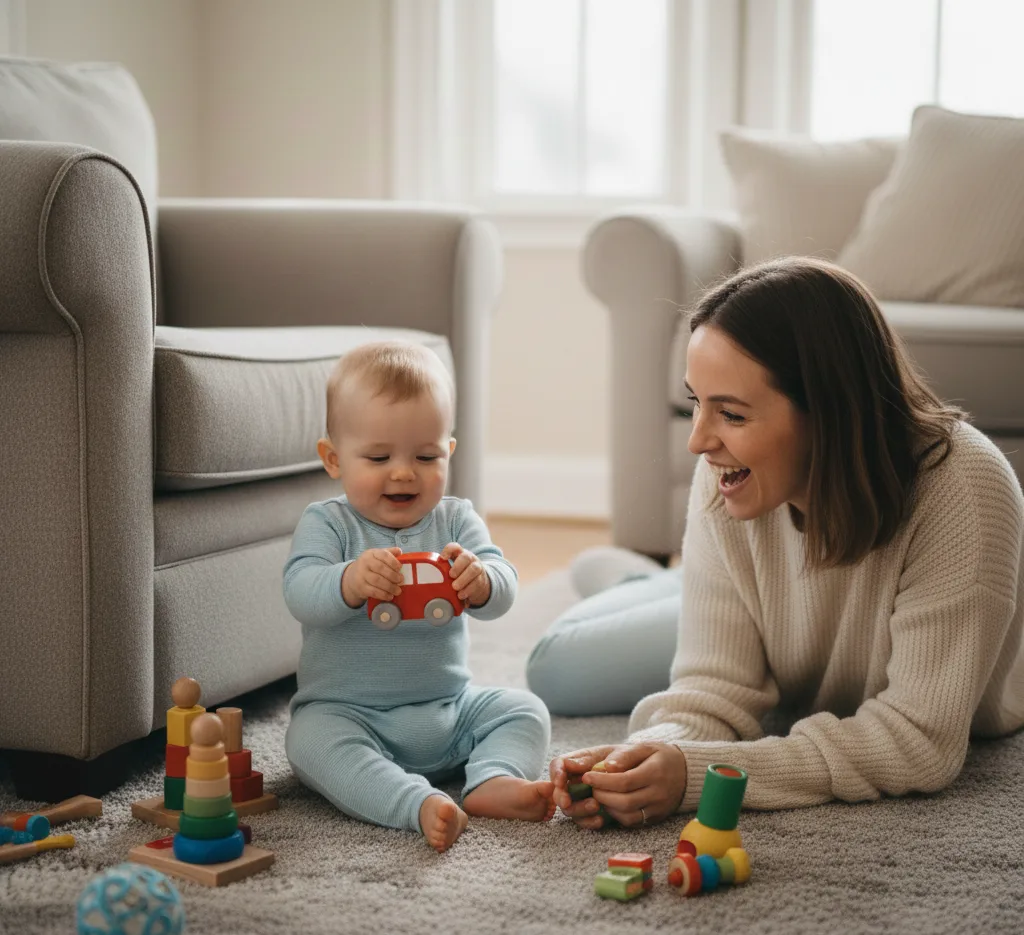
- The Exercise: Place toys just out of reach while your baby is on the floor. Encourage them to reach, roll, or crawl toward them.
- The Goal: This activates core muscles and wakes up the brain–body connection. In addition, it prepares the shoulders, hips, and tummy for standing practice.
- 💡 The Barefoot Advantage: Practicing barefoot allows the toes to grip the surface. This improves proprioception (the body’s internal map), helping the vestibular system calibrate balance much faster than it can through socks or shoes.
- Expert Tip: Let your baby “solve” the movement puzzle. Avoid placing them directly into a standing position; let them find their way there.
2. The Lift: Pull-to-Stand Practice (3 Minutes)
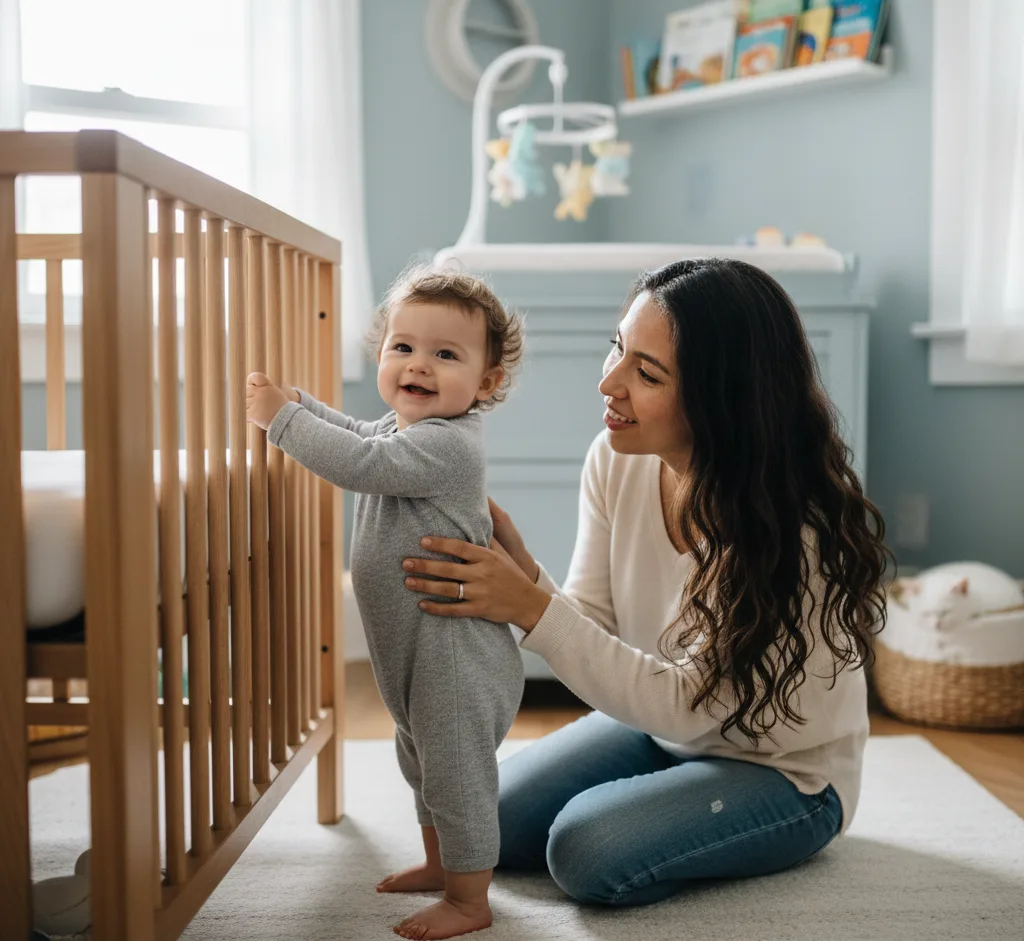
- The Exercise: Position your baby near a stable surface, such as a low table or ottoman. Encourage them to grasp the edge firmly and encourage them to use their arms and legs to push and pull themselves into an upright position.
- The Goal: Strengthens the grip-and-pull reflex, activates hip extensors and trunk stabilizers, and teaches the brain how to align the spine against gravity. Builds motor sequencing (grip → pull → balance → stand).
- Expert Tip: Support at the hips if needed. Avoid pulling by the arms, which bypasses core engagement and proper alignment.
3. Mini Squats: Supported Bend-and-Stand (2 Minutes)
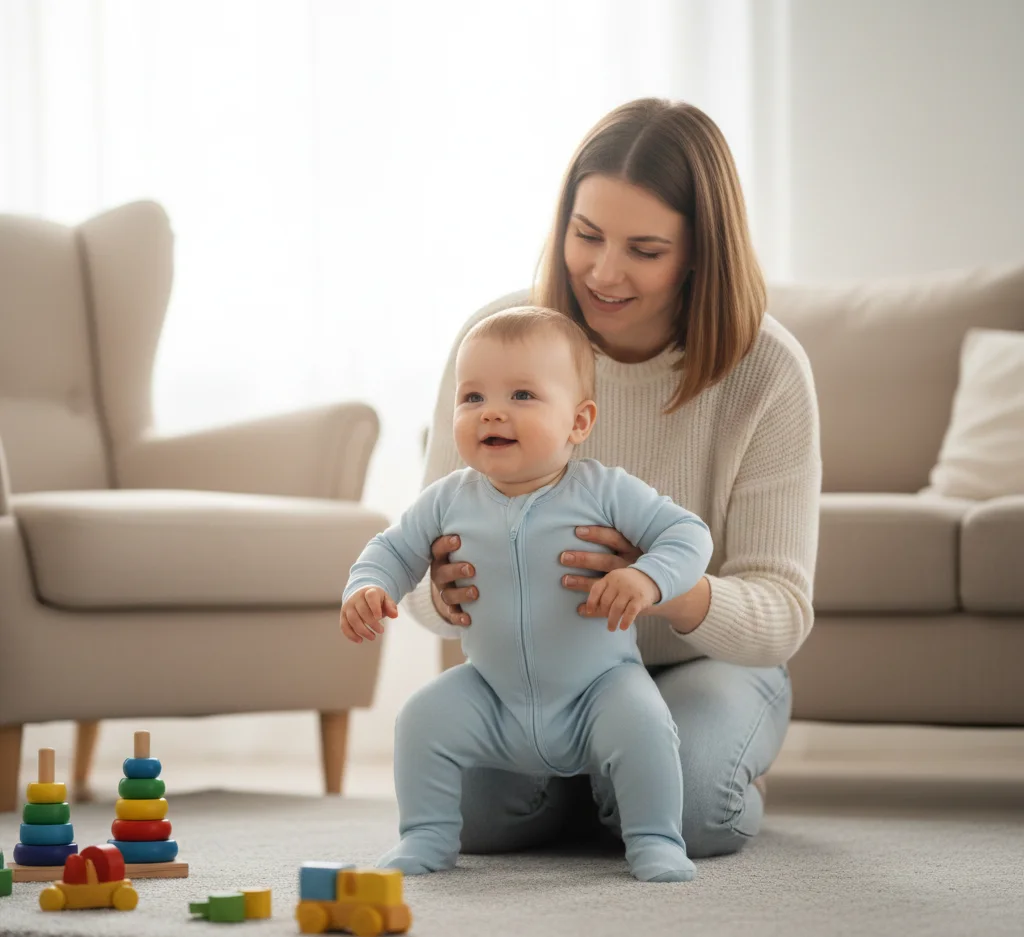
- The Exercise: Hold your baby’s back side or hips. Let them bend their knees into a small squat, then push back up to standing.
- The Goal: This builds leg and hip strength. In addition, it teaches the brain how to control going down and coming back up without falling.
- Expert Tip: Move slowly and calmly. Slow movements help the brain understand balance better.
4. Cruise Control: Side-Stepping Along Furniture (3 Minutes)
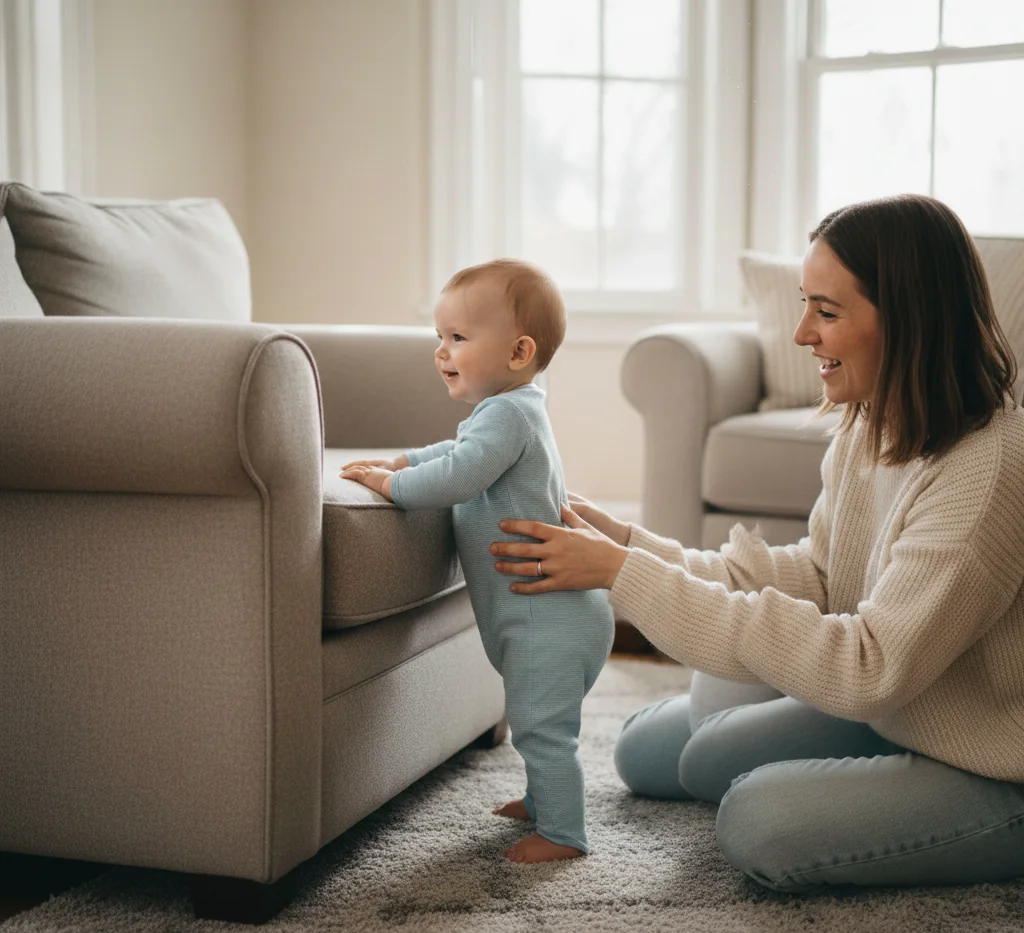
- The Exercise: Place toys along the edge of a sofa or table. Encourage your baby to move sideways while holding on to reach the toys.
- The Goal: This helps your baby learn how to shift weight from one foot to the other. As a result, balance and confidence improve.
- Expert Tip: Keep toys close enough to reach without stress. Fun practice works best.
5. The Reset: “The Plop” Practice (2–3 Minutes)
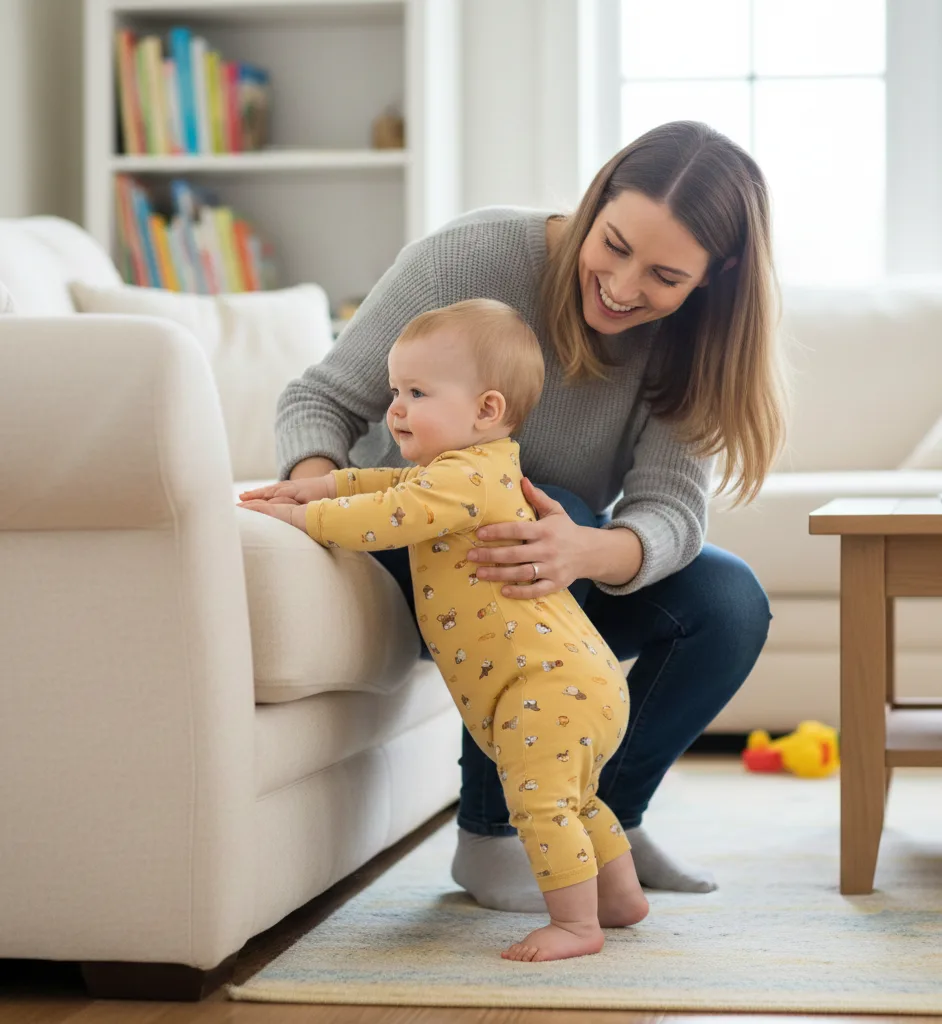
- The Exercise: When your baby is standing, gently guide them by the hips back down to a sitting position.
- The Goal: This stops the “stuck” factor. It teaches them how to sit down safely so they can settle themselves back to sleep at night.
- Expert Tip: Say “Plop!” or “Boop!” when they land. Turning the descent into a game removes the fear of falling.
Personal Note from Dr. Amit: I have seen this personally with my own baby. Babies who practice “plopping” safely during the day often settle much faster during night wakings. When they wake around 2:00 AM and realize they are standing, the brain can quickly access this built-in “down software.” As a result, they are able to sit back down calmly and drift back to sleep without a parent needing to step in.
Key Baby Safety Checks for Standing Milestones
As your baby reaches new heights, your baby-proofing needs to evolve. Ensure these safety steps are in place:
- Soften Sharp Corners: Use foam bumpers or corner guards on tables and furniture at head level to prevent injuries.
- Secure Heavy Furniture: Anchor shelves, TVs, and cabinets to the wall so they don’t tip if your baby pulls on them.
- Clear Tabletops and Low Surfaces: Remove hot drinks, décor items, and small objects your baby can now reach.
- Cover Electrical Outlets: Install outlet covers to stop finger pokes or chewing on plugs.
- Block Unsafe Areas: Use safety gates near stairs, kitchens, and balconies to prevent dangerous access.
- Check Floor Safety: Keep floors dry and clutter‑free to reduce slips during early standing practice.
- Lock Cabinets and Drawers: Add childproof locks to keep sharp tools, cleaning products, and medicines out of reach.
- Choose Stable Footwear or Bare Feet: Let your baby practice standing barefoot or in non‑slip socks for better balance and sensory feedback.
- Always Supervise Closely: Stay nearby during standing practice — falls are common at this stage.
Takeaway: The Journey to Independent Standing
- Respect the Timeline: Each baby follows their own pace. Most begin pulling to stand around 9–10 months, start cruising along furniture at 10-12 months, and achieve brief independent standing near 12 months. By 13–15 months, many can rise from the floor without support.
- The 15-Month Rule (CDC): According to CDC guidelines, most babies should stand independently by 15 months. If your baby is not standing alone by this point, or if you notice persistent stiffness, tiptoe standing, or a lack of weight-bearing, consult your pediatrician for a proactive developmental check.
- Prioritize Practice on the Floor: The floor is the best training ground. Limit time in walkers or jumpers, which can interfere with natural balance learning. Encourage safe, barefoot practice on flat surfaces to maximize sensory feedback.
- The Lift: Pull-to-Stand Practice: Position your baby near a stable surface, such as a low table or ottoman. Encourage them to grasp the edge firmly and pull their body into an upright posture. This exercise strengthens the grip-and-pull reflex and teaches the brain how to align the spine against gravity.
- Baby Safety: As your baby gains vertical independence, re-check your home for hazards at their new height. Look for sharp table corners, unstable furniture that needs anchoring, or reachable objects on tabletops. Always supervise practice sessions.
🌱 The Bottom Line
Standing is not just a physical act—it’s a brain milestone. Celebrate every pull-up, wobble, and “plop” as signs of progress. With consistent practice and patience, your baby will soon discover the joy of seeing the world from their own two feet!
Frequently Asked Questions (FAQ): Baby Standing Milestones
Q1. At what age do babies start standing?
Most babies begin pulling to a stand between 9 and 10 months and achieve the ability to stand independently around 12 months. However, the normal developmental window for this milestone ranges up to 15 months.
Q2. Why does my baby stand up in the crib and cry at night?
This is part of a motor-driven sleep regression. Your baby has mastered the “up” movement but hasn’t yet perfected the “down software”—the ability to sit back down safely. They feel “stuck,” which leads to frustration and night wakings.
Q3. When should I worry about my baby not standing?
According to the CDC and pediatric guidelines, you should consult your pediatrician if your baby is not bearing weight on their legs by 10 months or is not standing independently (without holding onto furniture or your hands) by 15 months. Early intervention is key if you notice persistent stiffness or a complete lack of interest in vertical movement.
Q4. Why can my baby stand while holding on but not alone?
This is a very common phase! While your baby has the leg strength, their vestibular system and proprioception (the brain’s sense of body position) are still maturing. It usually takes 2–3 months of “cruising” along furniture before the brain feels confident enough to let go.
Q5. Can baby walkers help my baby learn to stand faster?
No. The American Academy of Pediatrics (AAP) actually discourages the use of walkers. They allow babies to move before their muscles are ready, which can lead to tiptoe walking and can actually delay the development of the core and hip muscles needed for true independent balance.
Q6. Does crawling help a baby learn to stand?
Yes! Crawling is a vital precursor to standing because it builds bilateral coordination and strengthens the core and hip girdles. This “cross-body” movement wires the brain for the balance required to eventually stand and walk.
Q7. Is it normal for baby to stand on tiptoes?
Many parents ask, ‘Is it normal for baby to stand on tiptoes?‘ While occasional tiptoeing is a normal part of experimenting with balance, persistent tiptoeing after 12 months should be evaluated for muscle tightness.
Q8. How does barefoot practice help with standing?
Barefoot practice improves balance by giving the brain direct sensory feedback from the feet. This strengthens proprioception, activates the arches and toes, and helps the vestibular system calibrate balance more effectively than standing in shoes or socks.
Q9. Is it normal for a baby not to stand at 12 months?
Yes. Many healthy babies are not standing independently at 12 months, especially if they are focused on crawling, climbing, or language development. As long as your baby is bearing weight and progressing toward standing, this is usually normal up to 15 months.
References
📚 Click to view references
- Center for Disease Control and Prevention. (2022). Important Milestones: Your Baby By Nine Months. Available from: https://www.cdc.gov/act-early/milestones/9-months.html.
- Purves D, Augustine GJ, Fitzpatrick D, et al., editors. Neuroscience. 2nd edition. Sunderland (MA): Sinauer Associates; 2001. Chapter 14, The Vestibular System. Available from: https://www.ncbi.nlm.nih.gov/books/NBK10819/
- Casale J, Browne T, Murray IV, et al. Physiology, Vestibular System. [Updated 2023 May 1]. In: StatPearls [Internet]. Treasure Island (FL): StatPearls Publishing; 2025 Jan-. Available from: https://www.ncbi.nlm.nih.gov/books/NBK532978/
- Blumberg MS, Adolph KE. Protracted development of motor cortex constrains rich interpretations of infant cognition. Trends Cogn Sci. 2023 Mar;27(3):233-245. Available from: https://pmc.ncbi.nlm.nih.gov/articles/PMC9957955
- American Academy of Pediatrics (2009). Developmental Milestones: 12 Months. Available from: https://www.healthychildren.org/English/ages-stages/baby/Pages/Developmental-Milestones-12-Months.aspx
