
Written by: MediHealth PRO Editorial Team
Scientifically Reviewed by: Dr. Amit Pande, PhD
Molecular Biologist & Independent Scientific Advisor
Key Takeaways
- ADHD hyperfocus can make it difficult for a child to switch from one activity to another.
- Hyperfocus is not an official symptom of ADHD, but many children with ADHD experience it.
- It can support learning, creativity, and skill development when managed effectively.
- Challenges arise when hyperfocus interferes with school, daily routines, relationships, or sleep.
- Visual timers, transition cues, and consistent routines can help children shift attention more easily.
- Seek professional advice if hyperfocus regularly affects your child’s daily functioning.
Have you ever noticed your child become so absorbed in an activity that they tune out everything else? They may ignore their name, skip meals, or lose track of time while reading, drawing, building, or playing. This intense concentration is called ADHD hyperfocus.
ADHD is often associated with inattention and distractibility, but many children also experience periods of intense focus. During these episodes, they stay deeply absorbed in one activity for an extended period.
This pattern can be both helpful and challenging. It may boost learning and creativity, but it can also disrupt homework, daily routines, family activities, and sleep when it becomes difficult to stop.
What Is ADHD Hyperfocus?
ADHD hyperfocus is a state of unusually intense attention that some children with ADHD experience. It is often seen when an activity feels highly interesting, rewarding, or personally meaningful.
Cleveland Clinic describes hyperfocus as becoming deeply engaged in an activity for an extended period, often involving hobbies, games, or personal interests.
Hyperfocus is not an official diagnostic symptom of ADHD, but it is a commonly reported experience among many children with ADHD.
It reflects differences in attention regulation, not a child’s choice or lack of effort. Children may find it difficult to shift attention away from a highly engaging activity without support.
For a broader overview of ADHD symptoms, diagnosis, and treatment approaches, see our complete guide to ADHD in children.
Why Does ADHD Hyperfocus Happen?
Researchers are still working to understand why hyperfocus occurs in some children with ADHD. When an activity feels especially rewarding or engaging, the brain’s reward system may become more active, making it easier to maintain focus and more difficult to move away from the activity.
This pattern may be related to broader executive-function differences in ADHD, affecting skills such as planning, self-control, time management, and attention shifting, sometimes described as ADHD maturity delay.
These executive-function differences may help explain why some children with ADHD become deeply engaged in highly engaging activities and find it harder to transition away from them.
However, hyperfocus varies from child to child and is not experienced by everyone with ADHD. Common ADHD hyperfocus examples include:
- Video games and digital media
- Creative hobbies such as drawing, music, or building
- Challenging puzzles or problem-solving tasks
- Favourite topics or special interests
- Activities that feel especially exciting or personally meaningful
Research Snapshot:
Research on hyperfocus in children is still limited. Studies in adults with ADHD offer some insight, though findings may not directly apply to children. One 2021 review in Psychological Research described hyperfocus as an understudied but clinically significant aspect of attention. A 2025 study found that frequent hyperfocus episodes were commonly reported among adults with ADHD.
ADHD Hyperfocus vs Normal Concentration
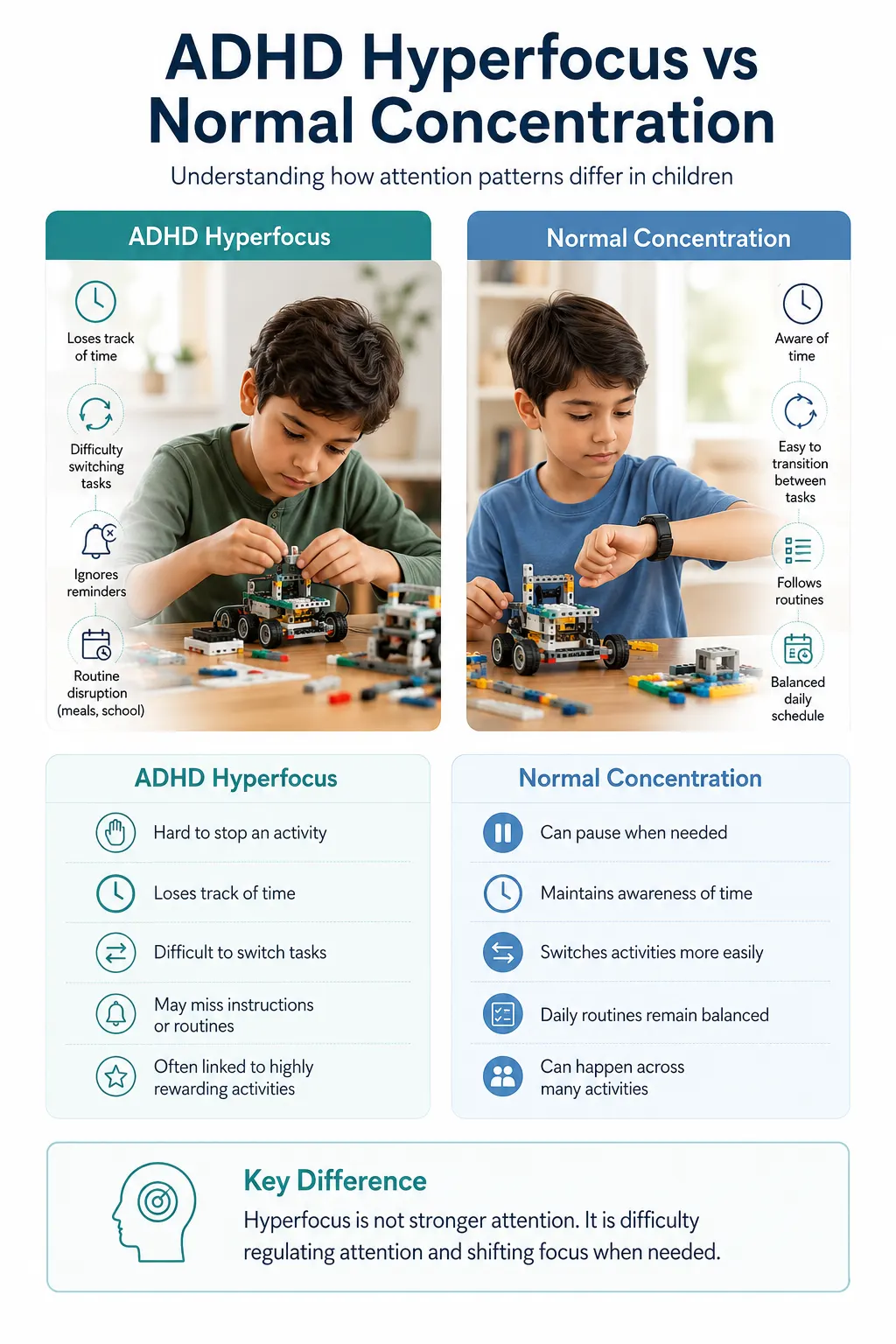
ADHD hyperfocus and normal concentration may look similar from the outside, but the main difference is flexibility.
During hyperfocus, a child may become deeply absorbed in a highly rewarding or engaging activity and find it difficult to stop, switch tasks, or notice the passage of time.
Normal concentration is usually more flexible. A child can remain focused on an activity while still being able to pause, respond when needed, and shift attention to another task without major difficulty.
The key difference is not how strongly a child can focus, but how easily they can regulate and shift their attention when the situation requires it.
 Signs of ADHD Hyperfocus in Children
Hyperfocus tends to show up differently depending on the setting. The table below outlines common patterns parents and teachers report.
| Setting | What It Often Looks Like |
|---|---|
| At home during play | Continues an activity well past the planned stopping point and becomes upset when asked to transition |
| During meals | Skips or forgets meals and snacks while absorbed in a preferred activity |
| At bedtime | Resists or delays sleep to continue a book, screen activity, or project |
| At school | Becomes deeply engaged in one task while missing instructions given to the class |
| In conversation | Does not respond when spoken to or called by name |
Important: Hyperfocus alone does not confirm ADHD. A healthcare professional considers it alongside other symptoms, a child’s developmental history, and behaviour across different settings before making a diagnosis.
Can Hyperfocus Occur in Preschoolers?
Yes. Hyperfocus can occur in preschoolers, although it may be harder to recognise because young children naturally become deeply engaged in play.
Many preschoolers spend long periods building with blocks, drawing, completing puzzles, or using imaginative play. Deep engagement alone is a normal part of early childhood and does not necessarily indicate ADHD.
Parents may wish to speak with their child’s paediatrician if this pattern occurs alongside other signs of ADHD, affects everyday functioning, and is seen across different settings. An early evaluation can help determine whether the behaviour reflects typical development or whether further assessment is appropriate.
Benefits of ADHD Hyperfocus
Hyperfocus is not always a negative trait. When directed toward meaningful activities, it can help children develop skills, build confidence, and achieve personal goals.
- Skill development. Children may develop advanced skills in a favourite hobby or interest through repeated, sustained practice.
- Depth of learning. Sustained focus may help a child explore a favourite topic in greater depth than would be possible with frequent interruptions.
- Creativity. Hyperfocus supports sustained creative work in art, music, writing, coding, or building projects.
- Persistence. Once genuinely engaged, children may persist with challenging tasks for longer than expected.
- Sense of accomplishment. Completing a self-directed project during a hyperfocus episode often builds confidence, particularly for children who struggle with sustained attention elsewhere.
These strengths are most valuable when children learn to balance deep focus with schoolwork, daily routines, and other responsibilities.
Challenges of ADHD Hyperfocus
Hyperfocus becomes a problem less because of the activity itself and more because of what gets displaced while it continues.
- Lost time on other priorities. Time spent fully absorbed in one activity is time not spent on tasks that also need attention, which can create a backlog of unfinished responsibilities.
- Strain on family routines. Repeated difficulty ending an activity on schedule can lead to friction with parents and siblings, particularly around shared mealtimes or planned outings.
- Delayed task-switching. Tasks that require frequent switching between activities, such as moving from one school subject to another, may become more difficult to manage.
These behaviours are usually not intentional. Many children with ADHD benefit from support and routines that help them balance highly engaging activities with everyday responsibilities. These challenges often overlap with broader ADHD transition difficulties, particularly when a child needs to move between activities without warning.
How to Manage ADHD Hyperfocus in Children
Many parents search for how to stop ADHD hyperfocus. In most cases, the aim is not to eliminate hyperfocus but to help children shift their attention more easily. The strategies below can help.
1. Set visible time cues
Children may not notice verbal reminders when deeply focused. A visual timer, countdown clock, or reminder alarm provides a clear signal that a transition is approaching.
2. Give transition warnings
Prepare your child before changing activities. Warnings given 10, 5, and 1 minute before a transition are often easier to follow than a single reminder.
3. Plan the next task
Children are more likely to leave a preferred activity when they know exactly what comes next. Give one simple instruction, such as packing a school bag or washing hands before dinner.
4. Use preferred activities thoughtfully
Schedule homework, chores, or other less enjoyable tasks before a favourite activity. This helps children complete important tasks before returning to something they enjoy.
5. Create visual routines
Checklists and picture schedules reduce the need for repeated verbal reminders and help children become more independent over time.
6. Support basic needs
Encourage short breaks for water, snacks, stretching, and bathroom visits during long periods of focus.
7. Work with the school
Share successful strategies with teachers so that similar approaches can be used at home and in the classroom, making transitions more consistent.
8. Know when to seek extra support
Speak with your child’s paediatrician or a qualified mental health professional if hyperfocus continues to interfere with sleep, school performance, relationships, or daily routines despite consistent support at home.
When to Seek Professional Help
Occasional hyperfocus does not usually require professional evaluation. It becomes worth discussing with a paediatrician or child psychologist when it starts affecting a child’s daily life or learning. For more information about ADHD symptoms, diagnosis, and treatment in children, see guidance from the Centers for Disease Control and Prevention (CDC).
Consider speaking with a professional if your child:
- Consistently falls behind on schoolwork or responsibilities despite support at home
- Becomes extremely distressed when interrupted or asked to change activities
- Regularly skips meals, sleep, or basic needs for extended periods
- Has ongoing friendship or family conflict tied to hyperfocus
- Shows other ADHD symptoms affecting learning, behaviour, or emotional regulation
What Conditions Can Be Confused With ADHD Hyperfocus?
Several situations and conditions can resemble ADHD hyperfocus. A healthcare professional considers a child’s overall development, behaviour across different settings, and other symptoms before making a diagnosis.
| Condition | How It Differs from ADHD Hyperfocus |
|---|---|
| Typical childhood concentration | Many children become deeply absorbed in play without having ADHD |
| Autism spectrum disorder (ASD) | Intense or restricted interests are usually linked to broader differences in communication, social interaction, and behaviour |
| Anxiety disorders | A child may resist changing activities because of worry or fear rather than hyperfocus |
| Giftedness | Gifted children may sustain attention on intellectually stimulating activities without meeting the diagnostic criteria for ADHD |
For a closer look at how ADHD-related traits differ from autism, see our guide on autism vs ADHD vs speech delay. If you are unsure whether your child’s behaviour is typical or may indicate ADHD, an assessment by a qualified healthcare professional can provide clarity and appropriate guidance.
Final Thoughts
ADHD hyperfocus can be both a strength and a challenge. With the right support, children can benefit from deep focus while learning to manage its impact on school, family life, and daily responsibilities.
If you have concerns about your child’s behaviour, speak with your paediatrician or a child psychologist. They can recommend practical strategies, therapy, or school accommodations tailored to your child’s individual needs.
Frequently Asked Questions
Can a child have ADHD without hyperfocus?
Yes. Hyperfocus is not required for an ADHD diagnosis. Some children with ADHD experience it frequently, while others rarely or never do. ADHD is diagnosed based on persistent symptoms of inattention, hyperactivity, and impulsivity that affect daily functioning.
Is ADHD hyperfocus the same as hyperfixation?
No. Hyperfocus refers to intense concentration on a task or activity. Hyperfixation describes a prolonged interest in a particular topic, hobby, or object. Although the terms are often used interchangeably, they are not the same.
Can children with ADHD control hyperfocus?
Not always. Many children know they should stop but find it difficult to shift their attention. Visual timers, transition warnings, consistent routines, and support from parents and teachers can make switching tasks easier.
Does screen time make hyperfocus worse?
Video games and other digital activities can trigger hyperfocus in some children because they are highly stimulating and rewarding. However, not every child responds the same way, and screen time is not the only trigger.
Can ADHD medication reduce hyperfocus?
ADHD medication may improve attention regulation, making it easier for some children to switch between activities. Treatment effects vary, so parents should always discuss medication concerns with their child’s healthcare provider.
Can children without ADHD experience hyperfocus?
Yes. Any child can become deeply absorbed in a favorite activity. The difference is that children with ADHD are more likely to have difficulty stopping or shifting their attention when needed.
Is hyperfocus a sign of high intelligence?
No. Hyperfocus is not a measure of intelligence. It reflects how attention is regulated, not how intelligent a child is.
Does hyperfocus improve with age?
It can. As executive function develops, some children become better at switching attention and managing transitions. However, the experience varies, and some individuals continue to experience hyperfocus into adulthood.
References
📚 Click to view references
- Cleveland Clinic. Attention-Deficit/Hyperactivity Disorder (ADHD). Read source
- Ashinoff, B. K., & Abu-Akel, A. (2021). Hyperfocus: the forgotten frontier of attention. Psychological Research, 85(1), 1–19. Read source
- Oroian, B. A., Nechita, P., & Szalontay, A. (2025). Hyperfocus in ADHD: A Misunderstood Cognitive Phenomenon. Read source
- Centers for Disease Control and Prevention (CDC). “Attention-Deficit/Hyperactivity Disorder (ADHD). Read source
