
Written by: MediHealth PRO Editorial Team
Scientifically Reviewed by: Dr. Amit Pande, PhD
Molecular Biologist & Independent Scientific Advisor
Medically Reviewed by: Dr. Arghyadeep Marik, MD
Independent Medical Reviewer, MediHealth PRO
- Autism symptoms can appear as early as 6 months in some children.
- Signs vary by age and development.
- No single symptom confirms autism.
- Doctors look for a pattern of differences in communication, social interaction, play, and behavior.
- Loss of previously learned words or social skills should never be ignored.
- Persistent concerns should be discussed with a pediatrician.
Autism symptoms can look different at different ages. A 9-month-old who does not respond to their name may show different signs than a toddler who stops using words they once knew.
This guide explains autism symptoms by age from 6 months to 5 years, what to watch for at each stage, and when to speak with your child’s doctor.
What Are Autism Symptoms?
Autism symptoms are signs that a child may communicate, play, interact, or respond differently than other children of the same age. These differences usually begin in early childhood, but they do not appear at the same age or in the same way for every child.
Some children show signs during infancy. Others develop expected skills at first, then stop using words, gestures, or social behaviors they had already learned.
According to the Centers for Disease Control and Prevention (CDC), autism affects each child differently. Doctors look for a pattern of differences across communication, social interaction, behavior, and development rather than one isolated symptom.
Early identification does not change who a child is, but it can help families access appropriate developmental support sooner if needed.
Common Autism Symptoms at Any Age
A child may show only a few of these signs, while another may have several. No single behavior confirms autism. Doctors consider the overall pattern of a child’s development over time.
Common signs of autism at any age include:
- Limited eye contact or reduced interest in interacting with others
- Delayed speech, language, or nonverbal communication
- Not responding consistently to their name or other social cues
- Repetitive movements, such as hand flapping, rocking, or spinning objects
- Strong preference for routines and becoming upset by unexpected changes
- Unusual responses to sounds, lights, touch, textures, or other sensory experiences
- Intense interest in specific objects or activities
- Limited pretend play or difficulty playing with other children
The sections below describe how autism symptoms may appear from 6 months to 5 years of age.
Autism Symptoms by Age: Visual Timeline
The infographic below summarizes the most common autism symptoms by age, from 6 months to 5 years.
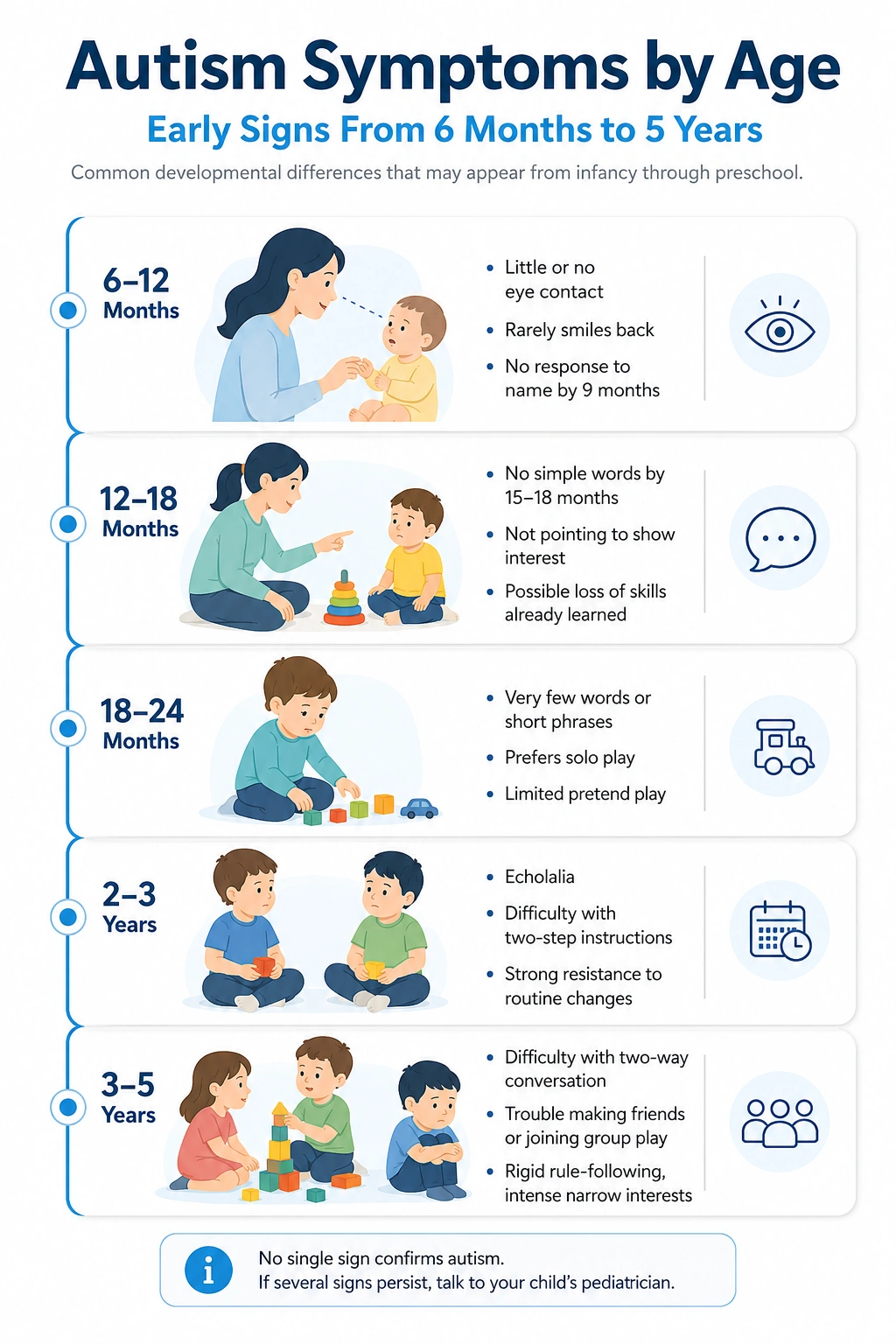
Autism Symptoms by Age: Quick Reference Table
The table below summarizes the most common autism symptoms by age, from 6 months to 5 years.
| Age | Common Autism Symptoms |
|---|---|
| 6–12 months | Little or no eye contact, rarely smiles back, does not respond to their name by around 9 months, and shows little interest in social games such as peekaboo. |
| 12–18 months | No simple words by 15–18 months, does not point to show interest, limited social interaction, or may lose words or gestures already learned. |
| 18–24 months | Very few words or short phrases, little pretend play, repetitive movements or play, and prefers to play alone. |
| 2–3 years | Repeats words or phrases (echolalia), difficulty with simple conversations, little or no pretend play, and difficulty following two-step instructions. |
| 3–5 years | Difficulty with back-and-forth conversations, limited interest in playing with other children, repetitive behaviors, and a strong preference for routines or specific interests. |
This table gives a quick overview of autism symptoms by age. No single sign confirms autism. If you notice several of these signs, or have concerns about your child’s development, talk to your child’s pediatrician.
Autism Symptoms at 6–12 Months (Early Infant Signs)
Autism signs in the first year are easy to miss. Babies this age are still learning to connect with people.
Signs between 6 and 12 months:
- Little or no eye contact
- Rarely smiles back at you
- Does not turn toward their name by 9 months
- Shows little interest in faces or games like peekaboo
- Makes few sounds or gestures, like reaching to be picked up
- Does not respond much to familiar voices
One sign alone does not necessarily mean a child has autism. Several signs together are worth mentioning to your pediatrician.
For a closer look at this specific sign, see Baby Not Responding to Name at 12, 18, or 24 Months.
Autism Symptoms at 12–18 Months (Toddler Signs)
Autism symptoms often become more noticeable between 12 and 18 months.
Signs between 12 and 18 months:
- Not using simple words by 15 to 18 months
- Not pointing to show interest or ask for something
- Limited eye contact
- Not responding consistently to their name
- Little interest in playing with others
- Repeating movements, such as hand flapping or rocking
- Becoming very upset by changes in routine
Losing words, gestures, or social skills a child already had is called developmental regression. Tell your pediatrician right away if you notice this.
For a complete red-flag checklist at this age, see Early Autism Signs in 18-Month-Olds: 9 Red Flags Checklist.
Autism Symptoms at 18-24 Months
Between 18 and 24 months, autism symptoms are usually more noticeable as language, social, and play skills develop rapidly.
Signs of autism between 18 and 24 months may include:
- Using very few words or short phrases.
- Not pointing to share interest or show things to others.
- Limited eye contact during interactions.
- Preferring to play alone most of the time.
- Repeating the same actions or lining up toys.
- Becoming very upset by changes in routines.
- Unusual reactions to sounds, lights, textures, or touch.
- Limited pretend play, such as feeding a doll or talking on a toy phone.
Some children also lose skills they had already learned, such as words, gestures, or social interaction. This is called developmental regression and should be discussed with your child’s pediatrician as soon as possible.
Autism Symptoms at 2–3 Years (Preschool Signs)
By 2 to 3 years, most children combine words into short sentences, take part in simple back-and-forth conversations, and use pretend play like feeding a doll or cooking.
Signs between 2 and 3 years:
- Speaking very few words or short phrases for their age
- Repeating words or phrases without using them to communicate (echolalia)
- Difficulty starting or continuing a simple conversation
- Difficulty following two-step instructions
- Little interest in playing near or with other children
- Little or no pretend play
- Repeating the same words, movements, or activities over and over
- Strong resistance to changes in routine
If your child is not yet combining words at this age, see My 2-Year-Old Is Not Talking Yet for guidance on when to act and activities that can help.
Autism Symptoms at 3–5 Years
By 3 to 5 years, most children hold conversations, play cooperatively with other children, and adapt to everyday routines. Social and communication skills expected at preschool or kindergarten can make autism symptoms more noticeable at this age.
Signs between 3 and 5 years:
- Difficulty holding a two-way conversation
- Talking mainly about their own interests, with little back-and-forth
- Difficulty making friends or joining group play
- Trouble understanding jokes, sarcasm, or figurative language
- Difficulty reading facial expressions or social cues
- Rigid rule-following or strong distress when rules are broken
- Intense, narrow interest in specific topics or objects
- Difficulty adapting to new places, people, or activities
Some children are first recognized at this age, when preschool or school settings make social and communication differences harder to miss.
If these signs affect your child’s daily life or learning, talk to your child’s pediatrician about a developmental evaluation.
Autism Symptoms That Should Never Be Ignored
Talk to your child’s pediatrician as soon as possible if your child:
- Loses words, gestures, or social skills they had previously learned (developmental regression)
- Does not respond to their name by around 9 months
- Does not point to show interest by around 18 months
- Has very few or no meaningful words by 18 to 24 months
- Shows several autism-related differences that persist over time
These signs do not confirm autism, but they are important reasons to discuss a developmental evaluation rather than waiting for the next scheduled checkup.
What Should Parents Do If They Notice Autism Symptoms?
One sign alone does not mean your child has autism. What matters most is the overall pattern of your child’s development over time.
If you have concerns, here are the next steps:
- Write down what you notice. Keep track of behaviors such as limited eye contact, delayed speech, repetitive movements, or loss of previously learned skills. Recording when these behaviors occur can help your child’s doctor understand your concerns.
- Talk to your child’s pediatrician promptly. Share your observations instead of waiting to see whether your child catches up on their own.
- Ask whether a developmental screening or referral to a specialist is appropriate. Your pediatrician can help decide whether further evaluation is needed.
- Keep talking, reading, playing, and interacting with your child every day. Responsive interactions support your child’s learning, communication, and social development regardless of the final diagnosis.
- Do not delay if your child loses skills. If your child stops using words, gestures, or social skills they previously had, contact your pediatrician as soon as possible rather than waiting for the next routine visit.
Seeking an evaluation does not mean your child has autism. It gives you clear answers, and if support is needed, it gets your child access to it sooner.
Autism Symptoms vs. Normal Child Development
Many behaviors that worry parents are actually part of normal development. Looking at the overall pattern is more helpful than focusing on a single behavior.
A shy toddler may avoid eye contact with strangers but makes eye contact with parents and other familiar people. A child with autism may show limited eye contact in many situations, including with familiar caregivers.
A late talker may have fewer words but still point, wave, and use gestures to communicate. A child with autism-related language delay may have limited gestures and pointing along with delayed speech. For a closer comparison, see Late Talker vs Autism: Key Differences in Toddlers.
A toddler who enjoys playing alone may still show a toy to a parent, smile, or seek attention during play. A child with autism may spend more time playing alone without trying to share their interests with others.
Many toddlers become upset when routines change. A child with autism may have stronger or longer-lasting distress and find it harder to adjust, even with reassurance.
| Typical Development | Possible Autism Sign |
|---|---|
| Shy with strangers but warm with family | Limited eye contact in many situations, including with familiar caregivers |
| Fewer words but points and uses gestures | Fewer words with limited pointing or gestures |
| Plays alone but shares toys or discoveries | Plays alone without trying to share interests with others |
| Upset by routine changes but settles with reassurance | Strong or prolonged distress after routine changes |
How Autism Is Diagnosed
There is no blood test, brain scan, or genetic test that can diagnose autism on its own. Doctors diagnose autism by evaluating how a child communicates, interacts with others, and behaves over time.
Autism can often be diagnosed reliably by around 2 years of age when an experienced clinician performs the evaluation.
The age of diagnosis varies: some children show signs during the first year of life, while others develop expected skills at first and later lose words, gestures, or social skills they had previously learned.
Diagnosis is based on established clinical criteria and a comprehensive developmental assessment rather than a single medical test.
The American Academy of Pediatrics recommends autism screening for all children at 18 and 24 months, alongside routine developmental checks at 9, 18, and 30 months.
1. Developmental Screening
The diagnostic process usually begins with a developmental screening during a routine well-child checkup.
Your child’s pediatrician may use a questionnaire such as the Modified Checklist for Autism in Toddlers, Revised (M-CHAT-R) to identify children who may benefit from further assessment.
Parents can also track developmental milestones and learn when to seek advice using the CDC’s Learn the Signs. Act Early. program.
A screening test does not diagnose autism. It only helps determine whether a comprehensive evaluation is recommended.
2. Comprehensive Autism Evaluation
A comprehensive autism evaluation is usually performed by a developmental pediatrician, child psychologist, child psychiatrist, or another specialist with experience in diagnosing autism.
A comprehensive autism evaluation may include:
- A detailed review of your child’s developmental and medical history
- Observation of your child’s communication, social interaction, play, and behavior
- Information from parents, caregivers, teachers, or daycare providers
- Standardized assessment tools, such as the Autism Diagnostic Observation Schedule, Second Edition (ADOS-2), when appropriate
3. Additional Medical Evaluation
Doctors may recommend additional tests depending on a child’s symptoms and developmental history.
These may include:
- Hearing and vision tests to rule out other causes of communication or developmental differences
- Genetic testing when a clinician suspects an underlying genetic condition or when it may help guide medical care
In many areas, autism evaluations can take several months to schedule. If your pediatrician recommends an evaluation, it is generally best to begin the referral process as early as possible.
Do Autism Symptoms Differ in Boys and Girls?
Autism affects boys and girls, but the signs are not always the same. Girls are often diagnosed later because their symptoms can be more difficult to recognize.
Some girls learn to mask their differences by copying peers, rehearsing conversations, or forcing eye contact. They may also have intense interests that appear more typical, such as animals or books, making autism less obvious.
Boys are more likely to show repetitive behaviors and restricted interests in ways that are easier to recognize. This is one reason autism has historically been diagnosed more often and at a younger age in boys.
Bottom Line
Autism symptoms can appear differently at each stage of childhood. Some signs may be noticed in the first year, while others become clearer as communication, play, and social skills develop. A single behavior does not confirm autism, but ongoing differences or loss of previously learned skills deserve attention.
If you have concerns about your child’s development, talk with your child’s pediatrician. Early evaluation helps you understand your child’s development and, if needed, connect your family with appropriate support and services.
Frequently Asked Questions
What is the earliest sign of autism?
Some babies show early autism symptoms between 6 and 12 months, including limited eye contact, rarely smiling back, little interest in social interaction, or not responding to their name by around 9 months. These signs can be subtle and do not always mean a child has autism.
At what age do autism symptoms usually appear?
Autism symptoms can appear as early as 6 months, but they are most commonly recognized between 12 and 24 months. Some children show subtle signs during infancy, while others become more noticeably different as communication and social skills develop.
Can autism be diagnosed before 2 years of age?
Yes. Early autism signs may appear as early as 6 months, but autism can often be diagnosed reliably between 18 and 24 months by an experienced specialist. The diagnosis is based on a child’s symptoms, developmental history, and a comprehensive developmental evaluation.
Can a child have autism without speech delay?
Yes. Some autistic children develop speech on time but show differences in social communication, play, or behavior. Others have significant language delays.
Do autism symptoms get worse with age?
Not necessarily. Autism symptoms often become more noticeable as social and communication demands increase with age. With early support, many children develop new skills and make meaningful progress.
Can a child show signs of autism and not be autistic?
Yes. Shyness, speech delay, hearing problems, and other conditions can share features with autism. This is why a full evaluation, not a checklist alone, is needed for diagnosis. If you are trying to distinguish between overlapping conditions, see Autism vs ADHD vs Speech Delay: Key Differences, Overlaps & Early Warning Signs.
Should I wait to see if my child catches up?
If you are concerned about your child’s development, talk to your child’s pediatrician. Do not wait for the next scheduled checkup. Early evaluation can help identify developmental differences and determine whether further assessment is needed.
Scientific References
📚 Click to view references
- Centers for Disease Control and Prevention (CDC). Autism Spectrum Disorder (ASD): Overview. https://www.cdc.gov/autism/index.html
- Centers for Disease Control and Prevention (CDC). Clinical Screening for Autism Spectrum Disorder. https://www.cdc.gov/autism/hcp/diagnosis/screening.html
- Centers for Disease Control and Prevention (CDC). Learn the Signs. Act Early. Program. https://www.cdc.gov/act-early/index.html
- American Academy of Pediatrics (AAP). Autism: Clinical Guidance and Resources. https://www.aap.org/en/patient-care/autism/
