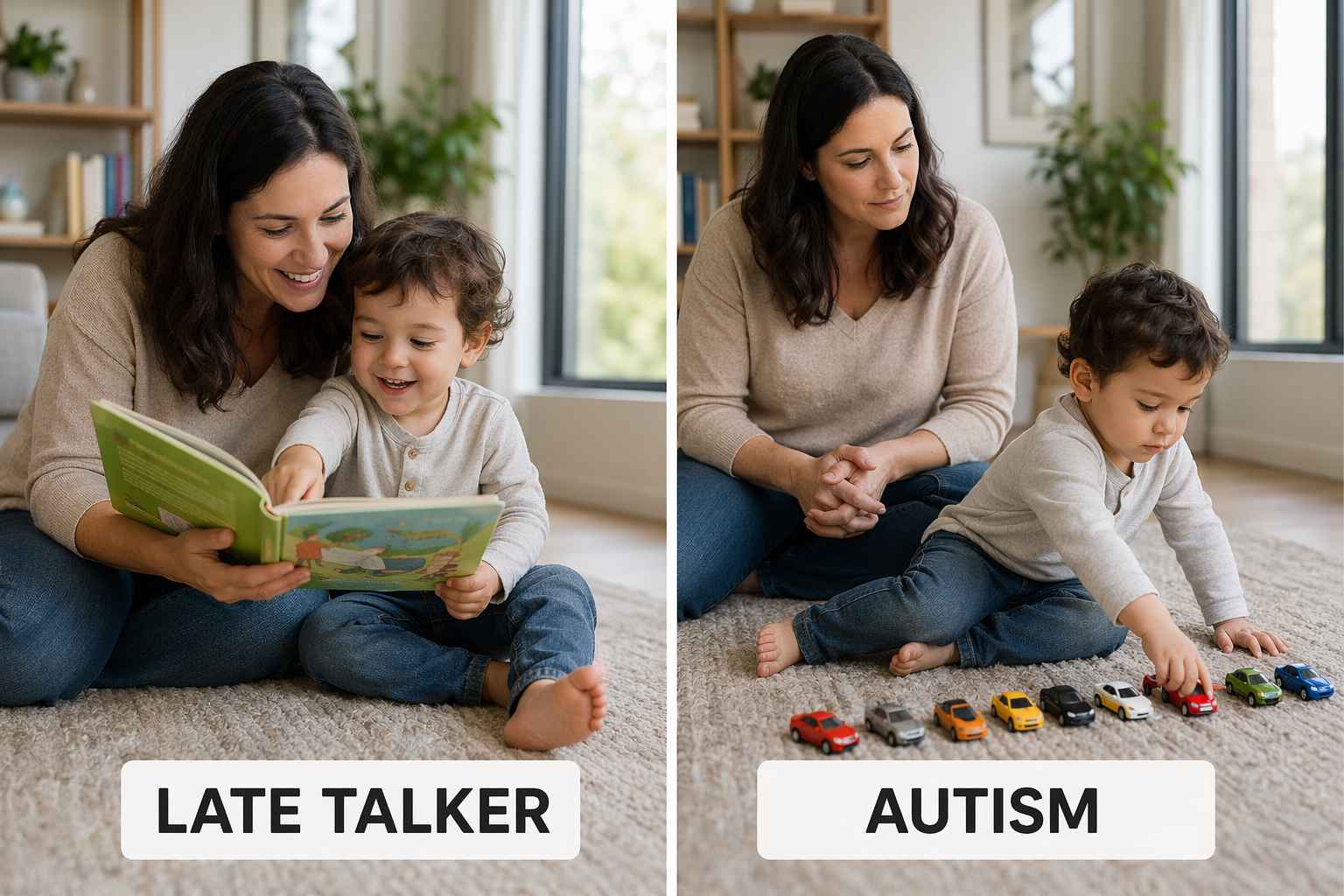
Late talker vs autism is one of the most common concerns parents face when their toddler is not speaking as expected. Many parents hear reassuring advice like “boys talk late” or “wait and watch.”
However, when a child is not meeting age-appropriate milestones, it is important to evaluate overall communication and social behavior. From a clinical perspective, early observation plays a key role in supporting better long-term outcomes for both late talkers and children on the autism spectrum.
Remember, not all speech delays are the same. Some children are simply late talkers with a delay in expressive language and catch up on their own. Others may show early signs of autism, where social interaction and communication develop differently.
At 18 to 24 months, these differences can be subtle, but they are very important to notice early. In this guide, you will learn the key differences between a late talker and autism in toddlers, including early signs such as eye contact, response to name, and joint attention. You will also understand when to wait, when to worry, and what steps to take next.
What is the difference between a late talker and autism? (Quick Answer)
The main difference between a late talker and autism in toddlers is social communication. A late talker has delayed speech but strong social interaction skills, using eye contact, pointing, and non-verbal cues to connect with others. In contrast, a child with autism may show reduced social engagement, including limited eye contact, a lack of joint attention, repetitive behaviors, and a weak response to their name.
What Is a Late Talker (Speech Delay)?
A late talker is a toddler (typically between 18 and 24 months old) who has a delay in expressive language but shows normal development in other areas. This means they are not yet using as many words as expected for their age, despite having strong social and cognitive skills.
According to the American Academy of Pediatrics (AAP) and the Centers for Disease Control and Prevention (CDC) developmental guidance, late talking should always be interpreted along with a child’s social communication abilities, not speech alone.
At 18–24 months, this can range from having only a few words to being completely non-verbal. However, the key distinction is that most late talkers have strong receptive language (they understand what is said to them) and show age-appropriate social behavior.
In simple terms, they may not speak much yet, but they are still connecting and communicating through non-verbal gestures.
5 Common Signs of a Late Talker (Speech Delay):
- Good Understanding: Follows simple instructions like “come here” or “get your shoes.”
- Strong Gestures: Uses pointing, waving, or showing objects to share interest.
- Social Connection: Makes consistent eye contact and responds to their name.
- Imitation: Tries to copy your actions, like pretending to talk on a phone or clapping.
- Intent to Interact: They clearly want to play and engage with you, even if they are currently non-verbal.
What Is Autism in Toddlers?
Autism Spectrum Disorder (ASD) is a neurodevelopmental condition that affects how a child communicates, interacts socially, and processes sensory information.
According to the CDC, early signs of autism are mainly related to differences in social communication and behavior, not just speech delay.
Unlike a late talker, a toddler with autism (typically observed between 18 and 24 months of age) may show differences in social engagement even before language develops. Autism affects how a child connects with people, communicates needs, and responds to their environment.
5 Common Early Signs of Autism in Toddlers:
- Social Disconnect: Limited eye contact or not responding to their name.
- Speech Gaps: May be completely non-verbal or repeat words without meaning.
- Missing Gestures: Rarely points to show you things or waves “bye-bye.”
- Solitary Play: Prefers playing alone and may not seek your attention.
- Repetitive Habits: Intense focus on spinning wheels, lining up toys, or hand flapping.
The Expert Rule: One sign alone does not confirm autism. Therefore, it is the overall pattern of behavior over time, especially between 18–24 months, that is important for evaluation.
Late Talker vs Autism in Toddlers: Key Differences (Quick Comparison)
While it can be difficult to differentiate between a late talker and early signs of autism, clinicians look for the intent behind the silence, not just speech.
Why the Confusion Happens: Late Talker vs Autism
It is common for parents to feel overwhelmed when comparing these two paths. At 18–24 months, developmental differences can be subtle and often overlap. Here is why the distinction is sometimes difficult to spot:
1. The “Silent” Phase
Both late talkers and children with autism may have very limited or no spoken words at this age. Without speech, it can be difficult to identify whether the delay is only in language or also involves social communication differences.
2. Overlapping Behaviors
Some toddlers with a speech delay may become frustrated due to difficulty expressing needs. As a result, they may avoid eye contact or show behavioral outbursts, which can sometimes resemble early autism signs.
3. Uneven Development
Child development does not follow a fixed pattern. A toddler may develop motor skills (like running or climbing) quickly while language remains delayed, making early differentiation challenging during a single clinical evaluation.
4. The “Wait and See” Trap
Many parents hear that some children are just “late bloomers.” While this may be true for some late talkers, delaying evaluation can also postpone early support when it is actually needed.
When to Worry About Speech Delay in Toddlers: Key Red Flags
As a parent, the line between “late blooming” and a “clinical delay” can feel blurry. However, from a clinical perspective, developmental pediatrics use specific age-based markers to determine when a child requires a formal developmental evaluation.
If a child is not meeting these milestones, a professional developmental assessment is recommended.
At 12 Months: The Foundation of Communication
The 12-month mark is the foundation of communication. At this age, a baby should be using eye contact and gestures to connect with you. It is a clinical red flag if a baby has:
- No “Social Gaze”: Does not make eye contact or look at you when you speak.
- Lack of Pointing: Does not point to objects or use “reaching” gestures to express a need.
- No Response to Name: Consistently fails to turn when called, despite having normal hearing.
👉 If your toddler is not responding consistently, read our guide on what to do when babies do not respond to their name at 12, 18, or 24 months.
At 18 Months: The Social Drive
At 18 months, a toddler should have a strong “social drive.” This means they want to share their world with you and copy what you do. It is a clinical red flag if a toddler has:
- Less than 6–10 Words: While the range varies, a complete absence of meaningful words (like “Mama,” “Dada,” or “No”) is a significant marker.
- Lack of Joint Attention: Does not look at an object you point to, or does not point to “show” you something interesting.
- No Imitation: Does not try to copy simple sounds or physical gestures (like clapping or waving).
👉 For a deeper checklist, explore our guide on early autism signs in 18-month-olds, including 9 key red flags and developmental milestones.
At 24 Months: The Language Explosion
By 24 months, most toddlers experience a “language explosion,” where they quickly learn new words and start putting them together. It is a clinical red flag if a toddler has:
- Fewer than 50 Words: This is the standard clinical cutoff for a “Late Talker.”
- No Two-Word Phrases: Does not combine words into simple requests like “More milk” or “Go out.”
- Inability to Follow Simple Commands: Does not understand basic instructions unless you use hand gestures.
👉 If your child is close to 2 years and not talking yet, read our detailed guide on what to do when a 2-year-old is not talking, including science-based next steps and home activities.
The “Red Flag” Rule: Regression
Regardless of age, the most critical sign to watch for is Regression. If your child had 10 words and suddenly stops speaking, or if they used to wave “bye-bye” but no longer do, this is a high-priority clinical red flag.
Studies indexed in the NCBI support that any loss of previously acquired skills should prompt immediate clinical evaluation to rule out underlying medical or developmental conditions. This is not a “wait and see” situation; it requires an urgent consultation with a pediatric specialist.
How to Support a Late Talking Toddler or a Child with Autism (11 Evidence-Based Strategies)

If your child shows signs of a late talker vs autism difference, these evidence-based strategies can help improve communication and social connection at home.
1. Use Self-Talk and Parallel Talk
Talk about what you are doing and what your child is doing. This helps them hear words in real situations.
- Example: While making lunch, say: “I am cutting the apple. Slice, slice, slice! Now the apple is in the bowl.”
2. The “Plus One” Rule (Expansion)
Meet your child at their current level and show them the very next step.
- Example: If your child points and says “Juice,” you respond with, “More juice!” or “Cold juice!”
3. Continuous Narrative (Sportscasting)
Talk about routine tasks to help their brain connect words to real-time actions.
- Example: While dressing, say: “Right foot in the sock. Left foot in the sock. Shoes on!”
4. Encourage Pretend Play
This is the most powerful way to encourage speech because it combines imagination with social connection.
- Example: Use a toy phone to “call” Grandma. Say, “Hello, Grandma! Teddy is sleeping.”
5. Validate Non-Verbal Cues
Treat every point, wave, or babble as a successful conversation. This reinforces their communicative intent.
- Example: If they point at a dog, don’t just look. Say, “Yes! I see the big brown dog!”
6. Prioritize Human Interaction
Limit screen time. High-quality human interaction is the primary driver of brain plasticity.
- Example: Replace 20 minutes of tablet time with 20 minutes of floor play, like rolling a ball back and forth.
7. Stop the “Questioning” Trap
Asking “What’s this?” creates performance anxiety. Instead, make statements.
- Example: Instead of asking “What is this fruit?”, simply say, “Yum, yellow banana. Sweet banana!”
8. Honor the ‘Processing Pause’
A toddler’s brain needs more time to “download” and “upload” information.
- Example: After asking “Do you want the car?”, count to ten slowly in your head before repeating the question.
9. The Modeling Method
Connect sounds to high‑energy actions with rhythm and repetition.
- Example: Say “Up… up… UP!” while lifting them into their high chair or More… more… MORE! (while giving food or toys in small portions). The rhythm helps the brain map the sound to the movement.
10. Interactive Reading
Do not just read the words; discuss the pictures to build vocabulary.
- Example: Point to a picture of a cat and say, “The cat says meow. Can you find the cat?”
11. Maintain a Positive Environment
Celebrate every small attempt to keep motivation high.
- Example: If they make a “B” sound when they want a ball, give them the ball immediately and say, “Yes! Ball! Good job!”
Takeaway: Late Talker vs Autism Difference
Not all silence means the same thing. Some toddlers are simply late talkers who need a little more time to express themselves. However, others may show early signs of autism, where the challenge is not just speech, but connection.
The key difference is not how many words your child says, but how they try to connect with you.
- If your child makes eye contact, uses gestures, responds to their name, and shows interest in people, they are likely a late talker who will catch up with support.
- However, if social connection feels limited, gestures are missing, or your child seems “in their own world,” it is important to look deeper and act early.
Do not rely only on “wait and watch.” Early action does not harm, but delayed action can miss a critical window for brain development.
Frequently Asked Questions (FAQ)
Q1. Can a child be a late talker and not autistic?
Yes. A late talker simply has a delay in spoken language. Many late bloomers have strong social skills, meet other milestones, and do not show signs of autism.
Q2. Does high-functioning autism delay speech?
It can, but not always. Some children speak on time but have difficulty with the social use of language, while others may have an early speech delay that improves with age.
Q3. Which speech pattern is observed in autistic children?
Speech may include echolalia (repeating phrases), a flat or unusual tone, or talking at length about specific interests without noticing the listener’s response. Some children may also have difficulty with back-and-forth conversation.
Q4. At what age is a child considered a late talker?
A child is usually considered a late talker around 24 months if they use fewer than 50 words or are not combining two words into simple phrases like “more milk.”
Q5. What is the biggest “red flag” for autism in a 2-year-old?
While every child is different, the most significant red flag is a consistent lack of joint attention. This means the child does not point to show you things, does not follow your point, and does not look at you to share an experience or emotion.
Q6. Does my late talker have autism if they do not respond to their name?
Not necessarily. A late talker might be deeply focused on play, or they could have an underlying hearing issue (like fluid in the ear). However, if they consistently fail to respond to their name AND avoid eye contact or gestures, you should consult a professional for an autism screening.
Q7. At what age can you officially tell the difference between a speech delay and autism?
Early signs can appear as young as 12–18 months. By 18 to 24 months, a professional can usually tell the difference by looking at a child’s social-emotional reciprocity and use of non-verbal gestures.
Q8. Will my late talker eventually catch up on their own?
Many late talkers do catch up, but “waiting and watching” is no longer the recommended clinical approach. Early intervention (like speech therapy) can speed up progress and prevent the frustration that often leads to behavioral issues.
References
📚 Click to view references
- American Academy of Pediatrics (2020). Promoting optimal development. Pediatrics, 145(1), e20193449. View source
- CDC. Learn the Signs. Act Early. View source
- CDC. Autism Spectrum Disorder (ASD). View source
- Furley K et al. (2023). Developmental regression in children. Cortex, 169:5–17. View source
- Lieberthal AS et al. (2013). Acute otitis media guidelines. Pediatrics, 131(3), e964–e999. View source
