

Many parents quietly wonder, “Why does my child with ADHD seem younger than other children the same age?” They see intelligence, creativity, and potential. Yet everyday situations, like managing frustration, waiting patiently, or handling transitions, can feel years behind their peers. The answer is often due to ADHD Brain Maturity Delay, a developmental difference that slows the timeline for building essential skills.
This is not the result of misbehavior or a parenting failure. It reflects how the ADHD brain develops, particularly in the prefrontal cortex, often called the brain’s “control tower” for executive functions.
Executive functions are the brain’s mental skills that manage:
- Attention
- Impulse control
- Emotional regulation
Research shows a developmental lag of up to three years in these skills.1 As a result, this delay often appears in daily routines, school expectations, and social situations.
In this article, you will learn the science behind this developmental gap, calculate your child’s Executive Age, and discover practical strategies to support their growth and everyday routines.
⚡ Executive Summary: The ADHD Development Gap
If you are short on time, here are the key insights into how ADHD affects brain maturity:
- The 3-Year Lag: The prefrontal cortex, the brain’s “Control Tower,” often matures about 2 to 3 years later in children with ADHD than in their peers.
- Smart ≠ Mature: A child can have a high IQ yet the emotional control of someone years younger.
- The Rule of Two-Thirds: Multiply your child’s age by 0.67 (Age × 0.67) to estimate their “Executive Age” and set realistic expectations.
- A Shifted Timeline: ADHD brains are not broken; they follow the same developmental path, just at a slower pace, often continuing to mature into the late 20s.
- Scaffolding Is Key: Because the internal control system is still developing, external supports such as routines, visual cues, and reminders help bridge the gap.
These delays do not mean a child is less intelligent—they simply highlight the need for patience, scaffolding, and support.
ADHD and Brain Maturity Delay
Children with ADHD often experience slower development of the prefrontal cortex, the brain’s “control tower” for focus, impulse control, decision-making, and emotional regulation.2 When this region develops on a delayed timeline, everyday tasks can feel harder than for peers.
Why the Prefrontal Cortex Matters
This region manages executive functions, the mental skills that help children:
- Focus and shift attention
- Pause before acting
- Regulate big emotions
- Plan and organize tasks
- Start and complete work
In all children, the prefrontal cortex is the last part of the brain to fully mature, often continuing into the early to mid-twenties, while in children with ADHD, this “construction” follows a slower, shifted timeline.3
Research shows children with ADHD may have slightly smaller total brain volume and experience a 2–3 year developmental lag in executive function.4,1,5,6
How This Delay Looks in Everyday Life (Signs of Brain Maturity Delay in ADHD)
Because the brain’s control system is still under construction, children with ADHD may struggle with:
- Emotional Regulation: Frequent meltdowns or difficulty calming down under stress.
- Impulse Control: Acting before thinking, blurting out, or struggling to wait their turn.
- Executive Function: Forgetting school materials, losing items, or having trouble following multi-step instructions.
- Transition Challenges: Difficulty switching from one task to another, resisting changes in routine. For a deeper look, see ADHD Transition Difficulties in Kids for why routines feel harder and strategies to help.
- Social Preferences: Often preferring younger children whose pace matches their own.
- Delayed Internal Dialogue: Limited ability to “talk themselves through” problems silently.
Even highly intelligent children can appear emotionally or behaviorally younger in certain situations. Recognizing these patterns helps parents and teachers support skills like planning, self-control, and emotional resilience.
Why IQ Does Not Match Maturity
A common question parents ask is, “My child is so smart. Why can not they act their age?”
It’s important to remember that Children with ADHD follow the same developmental journey as their peers but their timeline is simply later.7,8,9 Full maturity still happens, but it arrives after a longer developmental window.
This explains why a child may be intellectually bright yet struggle with the everyday maturity expected of their age.
For example, a child may be a gifted reader or strong in math (their IQ), yet still forget their school bag every single day (their executive age). This gap is where many families feel stuck.
The Rule of Two-Thirds (30% Rule): Understanding Your Child’s “ADHD Executive Age”
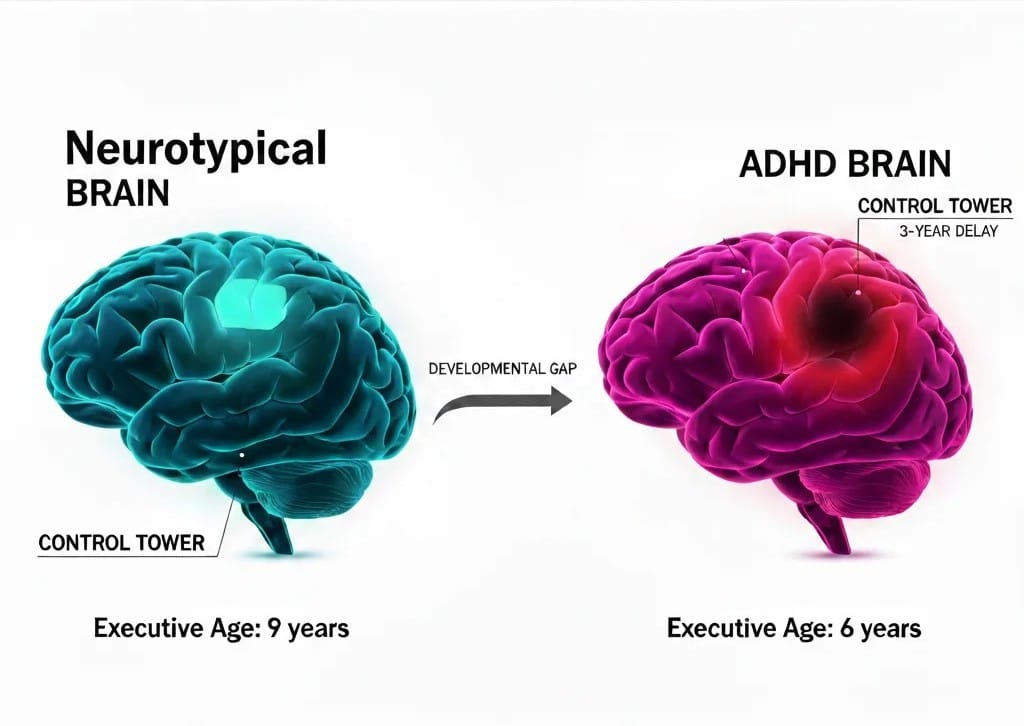
To help parents translate this delay into everyday life, experts such as Dr. Russell Barkley describe the ADHD 30% Rule, often referred to as the Rule of Two-Thirds.10
How to Calculate Executive Age:
To find your child’s “Executive Age,” take their chronological age and multiply it by 0.67.
- 9 years old × 0.67 ≈ 6 years old
- 12 years old × 0.67 ≈ 8 years old
- 15 years old × 0.67 ≈ 10 years old
💡 In other words, a nine-year-old with ADHD may function more like a six-year-old in impulse control, planning, and self-regulation.
ADHD Development Gap Examples
Chronological Age Estimated Executive Age What You Might Notice 6 years 4 years Difficulty waiting turns, frequent emotional outbursts 9 years 6 years Needs help starting homework, forgets instructions 12 years 8 years Struggles with organization and time management 15 years 10 years Impulsive decisions, inconsistent self‑control
Note: This table is a guide, not a strict rule. Every child is different.
Why This Matters
If you expect a nine-year-old with ADHD to behave like a typical nine-year-old in emotional control, you may feel constant frustration. However, if you understand their executive skills are closer to age six, your approach naturally shifts. As a result, you may:
- Give shorter instructions
- Provide more reminders
- Break tasks into smaller steps
- Offer structured routines
- Stay calmer during emotional outbursts
This approach is not about lowering expectations—it’s about matching support to your child’s real abilities, making daily challenges easier and fostering confidence.
The Catch‑Up Myth: Is This Delay Permanent?
A common fear for parents is: “Will my child always be behind?” The short answer is no. While ADHD is a lifelong neurological condition, the developmental gap is a temporary timing issue.
As a molecular biologist, I explain to parents that ADHD is not a “broken” brain—it is a brain on a different schedule. The processes of myelination (insulating the brain’s wiring for speed) and synaptic pruning (trimming unnecessary connections) simply follow a delayed timeline.
By the mid-to-late twenties, the ADHD brain finally reaches full structural maturity.8 At this stage, while traits like distractibility may remain, the maturity gap narrows significantly.
What Changes as They Grow?
As the brain matures, the gap often begins to narrow. However, it can look different at each stage of life:
1. In Adolescence (The Peak of the Gap)
The gap often feels the widest here. While peers are gaining independence, a teen with ADHD still requires significant “External Brain” support.
They may have the physical body and social desires of a 16-year-old, but the impulse control and organizational skills of a 13-year-old. This is the stage where they need “scaffolding” the most—not because they are rebellious, but because their brain wiring is under maximum pressure.
2. In Early Adulthood (The “Click” Moment)
Many young adults find their executive skills begin to “click” in their mid-20s. This is the biological “catch-up” period where the prefrontal cortex finally reaches its full processing power.
You will likely see a surge in their ability to manage their own schedules and regulate emotions. During this time, they often move from needing your reminders to using their own compensatory strategies, like digital alerts, planners, and structured routines.
3. In Adulthood (Full Maturity at Age 28–30)
By the time the brain reaches full maturity, the developmental lag usually stabilizes. While traits like distractibility may remain, the maturity “gap” disappears.
Most adults with ADHD learn to choose careers that highlight their strengths—such as creativity, high energy, or crisis management—rather than focusing on their executive weaknesses.
Practical Strategies: How to Support a Child with Brain Maturity Delay?
When we understand that a 12‑year‑old with ADHD may have an “Executive Age” closer to 8, our parenting toolkit changes. Instead of punishing the 12‑year‑old, we begin supporting the 8‑year‑old within them.
Here are 8 practical strategies to support your child’s development using the Rule of Two‑Thirds (30% Rule):
1. Match Expectations to Executive Age
If your 10‑year‑old functions more like a 7‑year‑old in planning and impulse control, adjust accordingly.
- Supervise homework more closely
- Pack school bags together
- Give step‑by‑step guidance instead of broad instructions
This does not lower long‑term goals—it simply provides the support a younger child would need right now.
2. Use External Structure Generously
Children with ADHD often struggle to stay organized on their own. External systems make life easier.
- Use visual schedules and checklists.
- Set timers for tasks.
- Keep routines consistent.
Structure reduces stress and helps behavior improve naturally.
3. Break Tasks Into Smaller Steps
Large instructions like “Clean your room” can feel overwhelming. Break them down into manageable parts:
- Put books on the shelf
- Place clothes in the laundry basket
- Make the bed
Smaller steps feel manageable and reduce resistance.
4. Teach Skills, Do not Assume Them
Children with ADHD often lag in executive skills, and these abilities do not simply “click” on their own—they must be taught, modeled, and practiced step by step.
Examples of skills to teach:
- Using a planner: show them how to write down tasks and check them off
- Pausing before reacting: practice taking a breath before responding
- Problem‑solving after mistakes: guide them to ask, “What can I do differently next time?”
- Calming strategies: rehearse simple tools like deep breathing or squeezing a stress ball
Practice these skills during calm, everyday moments—not in the middle of a meltdown.
5. Stay Calm During Emotional Storms
Emotional outbursts are usually a sign of delayed regulation, not defiance. Try these simple steps:
- Lower your voice: a calm tone helps ease big emotions.
- Validate their feelings first: let them know it’s okay to feel upset.
- Offer a short reset break: give them space to regain control.
Your calm nervous system helps guide theirs back to balance.
6. Use Scaffolding, Then Step Back
Scaffolding is like temporary support around a building—it’s there while the structure is growing, then removed once it’s strong. Children with ADHD often need this kind of support as they learn new skills.
Examples of scaffolding:
- Sit beside them during homework
- Remind routines daily
- Help organize materials
As their skills improve, gradually step back. The goal is to give just enough help at first, then reduce it so they can practice independence.
7. Protect Sleep, Movement, and Nutrition
Healthy routines strengthen emotional control and attention. When these basics are steady, children with ADHD have more energy to focus and regulate themselves.
Key habits to protect:
- Consistent sleep schedules
- Daily physical activity
- Balanced meals
- Limited late‑night screen time
8. Reinforce Effort, Not Just Outcome
Children with ADHD often hear more correction than positive feedback. That’s why it’s important to notice the effort they make, even if the job is not finished perfectly.
Celebrate effort when your child:
- Starting a task on their own
- Pausing before reacting
- Remembering one step without being reminded
Recognizing these small wins builds confidence and strength.
When parents prioritize these routines, children feel calmer, stay more focused, and handle daily challenges with greater confidence.
The Takeaway
ADHD brain maturity delay does not mean a child is lazy, undisciplined, or broken. It means their brain is developing on a different timeline. By understanding the Rule of Two-Thirds and recognizing your child’s Executive Age, you can shift from frustration to empathy.
The most important message is this: Your child will catch up. With patience and structure, you are not just managing behavior. You are creating the environment their brain needs to grow, strengthen, and function independently.
Frequently Asked Questions (FAQ)
Q1: What is ADHD brain maturity delay?
ADHD brain maturity delay refers to a slower development of the prefrontal cortex, the brain’s “Control Tower” for attention, impulse control, and emotional regulation. This delay can create a developmental lag of up to 2–3 years compared to peers.
Q2: Does ADHD brain maturity delay mean my child is less intelligent?
No. ADHD affects executive function skills, not intelligence. A child may be academically advanced yet still struggle with planning, organization, or impulse control.
Q3: How can I calculate my child’s “executive age”?
Experts use the Rule of Two‑Thirds (ADHD 30% Rule). Multiply your child’s chronological age by 0.67 to estimate their executive age. For example, a 9‑year‑old may function more like a 6‑year‑old in self‑regulation.
Q4: Is ADHD brain maturity delay permanent?
No. ADHD brain maturity delay is a shifted timeline, not a permanent deficit. ADHD brains are not broken. They follow the same developmental path, just at a slower pace, often continuing to mature into the late 20s.
Q5: How can parents support a child with ADHD brain maturity delay?
Parents can scaffold skills by breaking tasks into smaller steps, using visual schedules, offering reminders, and adjusting expectations to match executive age. Empathy and structure are key.
Q6: Why does my child seem smart but act younger than their age?
This mismatch happens because intelligence (IQ) and executive function develop on different timelines. ADHD delays executive skills, so a child may excel academically but struggle with everyday maturity.
Q7: Can ADHD brain maturity delay improve with support?
Yes. Thanks to neuroplasticity, the brain can adapt and grow. Consistent routines, positive reinforcement, and scaffolding strategies help children strengthen executive skills over time.
References
📚 Click to view references
- National Institute of Health (NIH). (2014, September). Focusing ADHD: How the Brain Manages Attention. View Source (NIH)
- Deshmukh MP, Khemchandani M, Thakur PM. Exploring role of prefrontal cortex region of brain in children having ADHD with machine learning: Implications and insights. Appl Neuropsychol Child. 2026 Jan-Mar;15(1):71-83. View Source (PubMed)
- Shaw P, Eckstrand K, Sharp W, et al. Attention-deficit/hyperactivity disorder is characterized by a delay in cortical maturation. Proc Natl Acad Sci U S A. 2007 Dec 4;104(49):19649-54. View Source (PMC)
- Hoogman M, Bralten J, Hibar DP, et al. Subcortical brain volume differences in participants with ADHD in children and adults: a cross-sectional mega-analysis. Lancet Psychiatry. 2017 Apr;4(4):310-319. View Source (PMC)
- Shaw et al. (2007). Attention‑deficit/hyperactivity disorder is characterized by a delay in cortical maturation. View Source (PubMed)
- Sadozai, A.K., Sun, C., Demetriou, E.A. et al. Executive function in children with neurodevelopmental conditions: a systematic review and meta-analysis. Nat Hum Behav 8, 2357–2366 (2024). View Source (Nature)
- Fujita S, Hagiwara A, Hori M, et al. 3D quantitative synthetic MRI-derived cortical thickness and subcortical brain volumes. J Magn Reson Imaging. 2019 Dec;50(6):1834-1842. View Source (PubMed)
- Berger I, Slobodin O, Aboud M, et al. Maturational delay in ADHD: evidence from CPT. Front Hum Neurosci. 2013 Oct 25;7:691. View Source (PMC)
- National Institute of Mental Health. (2007). Brain matures a few years late in ADHD, but follows normal pattern. View Source (NIMH)
- Barkley, R. A. (2012). This is how you treat ADHD based on science. Keynote lecture at the 2012 Burnett Seminar. Watch Video (YouTube)
