
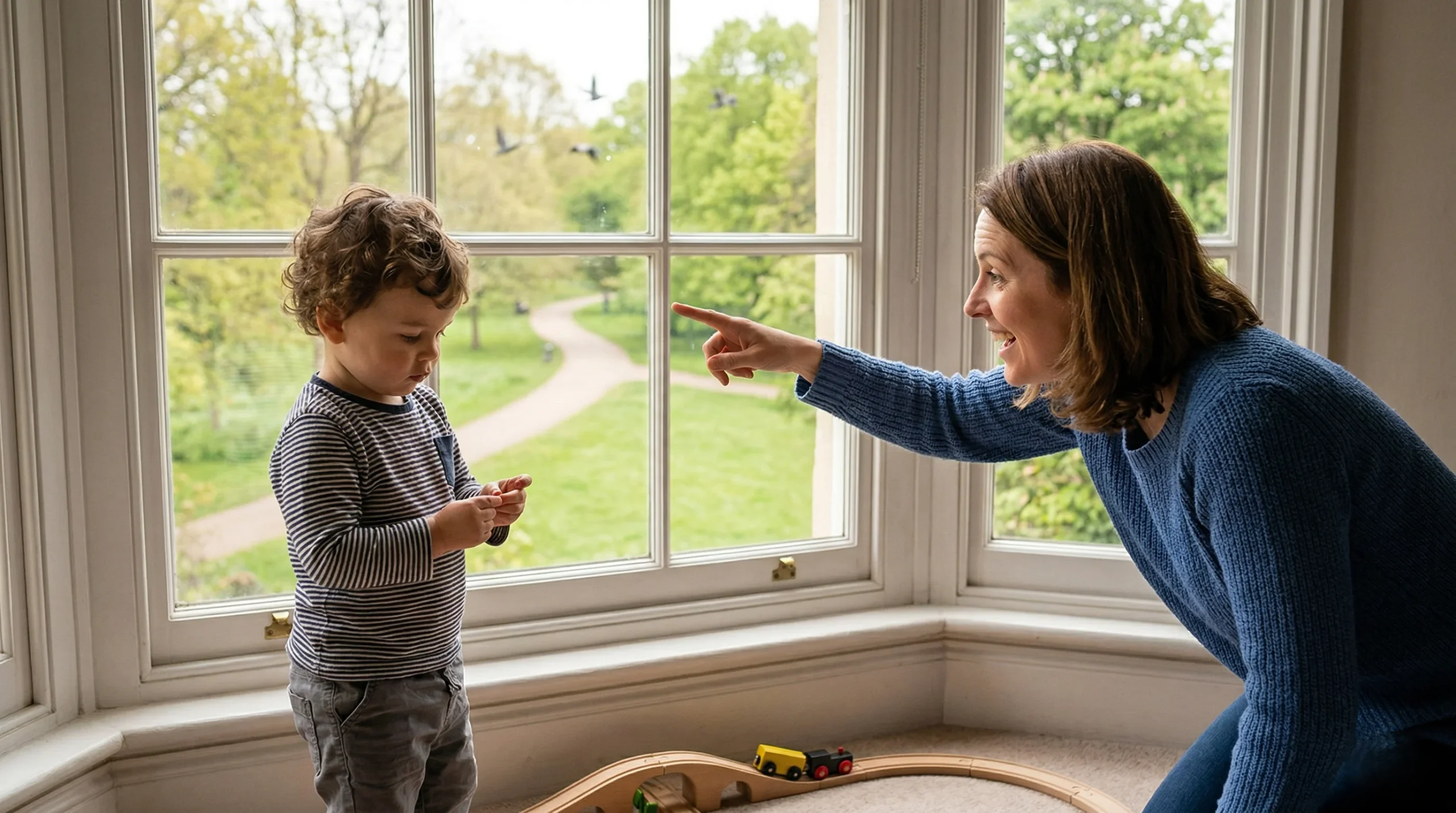
By 18 months, most toddlers are naturally engaged with the people around them. They smile, point to share interests, and actively “check in” with parents during play. However, when these milestones are consistently missing, it is natural for parents to feel concerned about early autism signs in 18-month-olds.
According to the Centers for Disease Control and Prevention (CDC) and the American Academy of Pediatrics (AAP), developmental differences often emerge before age 2, most commonly between 12 and 18 months. At this stage, signs typically appear as delays in social communication and the presence of repetitive behaviors.
In this guide, we break down current medical screening guidelines to help parents distinguish between typical development and neurological red flags.
Key Early Autism Red Flags at 18 Months
While every child develops at their own pace, clinicians prioritize a lack of back-and-forth social connection—such as a toddler “checking in” with parents during play—as the most reliable early indicator. Key red flags include:
- Social Communication: Limited eye contact or consistently not responding to their name.
- Joint Attention: Lack of pointing to share interest or limited use of gestures like waving or clapping.
- Repetitive Actions: A fixation on repetitive play, such as spinning wheels or lining up toys.
- Autism and ADHD Overlap: Persistent hyperactivity, which may signal a co-occurrence of autism and ADHD.
These signs alone are not enough for a diagnosis. However, when several appear together and persist over time, they may indicate a need for further evaluation.
What Is Normal Development at 18 Months?
By 18 months, toddlers are usually eager to connect with the world around them. They begin showing curiosity, experimenting with language, and engaging in simple social play. These milestones are part of typical growth and help parents track healthy development.
5 Key 18-Month Milestones
- Pointing to show interest: Showing you a bird or a toy just to share the moment.
- Saying 1–3 simple words: Beginning to use consistent sounds for specific things.
- Responding to their name: Turning their head when you call them from across the room.
- Copying actions: Mimicking you when you clap, wave, smile, or make a funny face.
- Showing interest in people: Preferring to look at your face and engage in shared play rather than just playing alone.
The CDC highlights that delays in joint attention (looking at what you are looking at or pointing), gestures, responding to their name and overall social responsiveness at this age may be early indicators of developmental differences, including autism.
What Is Autism Spectrum Disorder (ASD)?
Autism Spectrum Disorder (ASD) is a group of neurodevelopmental conditions that affects three main areas:
- Social interaction (How a child connects with others)
- Communication skills (How a child shares needs and ideas)
- Behavior and learning patterns (How a child plays and explores)
It is called a “spectrum” because every child is unique. Just like a rainbow has many colors, autism looks different in every child. Some children may need significant support with daily tasks, while others may need very little and will hit many typical milestones on time.
Autism Prevalence: The Latest 2022–2026 Data
To understand the current landscape of neurodiversity, here are the latest key statistics:
- U.S. Prevalence: 1 in 31 children (3.2%) are identified with autism by age 8. This increase from 1 in 36 reflects improved screening and awareness (CDC ADDM, 2025)
- Global Rate: About 1 in 100 children (1%) are diagnosed with autism
(Journal of Autism Research) - Gender Gap: Boys are diagnosed 3.4 to 4 times more often than girls (CDC)
- ADHD Overlap: Around 30% to 40% of autistic individuals also have ADHD (Research in Autism Spectrum Disorders)
- Diagnosis Gap: Autism can be identified reliably by 18 months, yet the average diagnosis happens around 4 years (AAP)
Early Autism Signs in 18-Month-Olds: Detailed Checklist for Parents

One of the most common early signs of autism in 18-month-old children is a strong preference for repetitive play with objects rather than social interaction.
By 18 months, most toddlers are “social scientists.” They are constantly testing how you react to their smiles, their babbles, and their play. In my clinical experience, the biggest red flags at this age aren’t just about what a child can’t do, but about how they connect with you.
Instead of focusing on a single behavior, it is more helpful to look for patterns across social connection, communication, and play.
Below is a checklist of early autism signs in 18‑month‑olds that clinicians and pediatricians highlight.
1. Limited or Inconsistent Eye Contact
Eye contact is one of the earliest ways children build connection. If a toddler rarely looks at you during play, feeding, or shared moments, it may signal difficulty in social engagement.
Example: During snack time, a typical toddler looks at their parent’s face while reaching for food. A child showing early autism signs may focus only on the cracker, never glancing up.
2. Does Not Respond to Name Consistently
A typical toddler turns when called. If responses are rare or inconsistent, it suggests challenges in attention and social awareness.
Example: You call “Emma!” across the room. Instead of turning, she continues stacking blocks as if she didn’t hear you.
3. Lack of Pointing (Joint Attention Delay)
Pointing shows a child wants to share interest. Absence of pointing by 18 months can indicate delays in joint attention.
Example: A toddler sees a bird outside. Most children point excitedly to share the moment. A child with autism signs may watch silently without trying to involve you.
4. Limited Gestures (Waving or Clapping)
Gestures are a toddler’s first “social language.” If waving, clapping, or simple hand motions are missing, it may reflect difficulty with nonverbal communication.
Example: When grandma leaves, most toddlers wave goodbye automatically. A child showing early autism signs may watch silently without lifting their hand.
5. Delayed Speech or Minimal Babbling
By 18 months, most toddlers use a handful of words or consistent sounds. Very limited speech or babbling, especially alongside reduced social interaction, is worth noting.
Example: A typical toddler might say “ball” or “mama” while playing. A child with autism signs may only make repetitive sounds or remain unusually quiet.
6. Reduced Social Interest
Preferring objects over people, or seeming disengaged from faces and voices, can be an early red flag. Typical toddlers seek human interaction as much as toys.
Example: During playdates, most toddlers look at other children and try to join in. A child showing early autism signs may stay focused on a toy car, ignoring the group.
7. Lack of Shared Attention
Toddlers usually “check in”—looking back at you while exploring or playing. If this back‑and‑forth is missing, it suggests difficulty with social reciprocity.
Example: A toddler stacking blocks often glances at a parent to share excitement. A child with autism signs may continue stacking without ever looking up.
8. Repetitive Behaviors or Unusual Play
Lining up toys, spinning objects, or fixating on parts of items (like wheels) instead of whole play can indicate differences in development.
Example: Instead of rolling a toy car across the floor, a child may spin its wheels repeatedly and become upset if interrupted.
9. Hyperactivity (Autism and ADHD Overlap)
Hyperactivity (running, climbing, or moving constantly) alone does not equal autism. But when paired with other early autism signs in 18‑month‑olds—such as reduced social interest, repetitive play, or limited gestures—it becomes an important red flag worth discussing with your pediatrician.
Example: During a group activity, a child may pace or climb furniture incessantly, showing no interest in the social interaction or the task at hand.
If you notice hyperactivity in your child, see our guide: Early Signs of ADHD in Toddlers (Ages 2–5): What Is Normal vs. a Neurological Red Flag?
Autism vs Typical Toddler Behavior at 18 Months (Key Differences)
The difference between a “phase” and a “red flag” often lies in the intent and consistency of the behavior. Use this table as a guide for your observation log.
| Category | Typical Toddler | Possible Autism Sign |
|---|---|---|
| Gestures | Uses gestures (waving, clapping, reaching) | Few or no gestures |
| Speech / Sounds | Uses a few words or babbles to engage | Minimal or repetitive sounds |
| Interest in People | Seeks interaction; shares attention | Prefers objects; limited social interest |
| Play Style | Uses toys normally; simple pretend play | Repetitive play; fixates on parts |
| Responding to Name | Usually responds when called | Rarely responds |
| Eye Contact | Frequent; used to connect | Limited or avoidant |
| Pointing | Points to share interest | Rarely points; may guide your hand |
| Repetitive Behaviors | Occasional, flexible habits | Frequent, rigid, hard to interrupt |
Important: One Sign Does NOT Mean Autism
Before we look at the specific red flags, it is vital to share a key piece of clinical context: No single behavior on this list automatically means a child is autistic. Development is rarely a straight line.
At 18 months, toddlers are “brain-building” at a massive rate, and they often pick up strange or repetitive habits simply because they are exploring their senses.
As per our study and clinical experience, we do not look for one isolated sign. Instead, we look for a pattern of behaviors across three specific areas:
- Frequency: Does the behavior happen all day, every day, or just once in a while?
- Intensity: Is the child so focused on a spinning wheel that you cannot distract them even with their favorite snack?
- The Social Gap: Is the behavior happening instead of connecting with you?
The Clinical Rule: We are looking for a “constellation” of signs. If your child is hitting their social milestones—like pointing, sharing joy, and responding to their name—but happens to love spinning car wheels, that is often just a typical toddler phase.
We only become concerned when these “social sparks”—the smiles, the pointing, and the back-and-forth connection—are missing.
When a child is so focused on a repetitive pattern that they no longer look to you for shared joy or help, it suggests their brain is prioritizing objects over people. This “Social Gap” is the most important indicator we look for.
What to Do If You Notice Autism Signs at 18 Months
Recognizing early signs of autism at 18 months is only the first step. The next—and most important—step is knowing how to act. If you recognize several of these signs in your child, the goal is not to panic, but to gather the right information.
1. Start a “Connection Log” (Track Patterns for 2–3 Days)
Before jumping to conclusions, begin by observing patterns. For the next 2–3 days, write down specific moments when your child does—or does not—engage socially.
Focus on:
- Response to name
- Eye contact during play or feeding
- Use of gestures (pointing, waving, clapping)
- Attempts to share interest or excitement
This simple log helps you move from a ‘gut feeling’ to identifying a clear Social Gap—which is the most valuable information you can give a pediatrician.
Example: “Called your child’s name 4 times during play; no response or eye contact.”
2. Request an Autism Screening (M‑CHAT‑R/F)
If concerns persist, don’t wait for the next routine visit. Contact your pediatrician and request a developmental screening for autism, specifically the M‑CHAT‑R/F (Modified Checklist for Autism in Toddlers, Revised with Follow‑Up).
This screening tool is:
- Recommended by the American Academy of Pediatrics (AAP)
- A gold-standard tool used by clinicians worldwide
- Designed specifically for toddlers between 16 and 30 months
It helps identify whether your child may need a more comprehensive developmental evaluation.
Important: Screening does not confirm a diagnosis—it simply ensures that no developmental delays are overlooked.
3. Rule Out Hearing or Medical Causes
Some behaviors that look like autism—especially not responding to a name—can be caused by hearing issues.
Schedule a professional hearing (audiology) test to rule out:
- Fluid buildup in the ear
- Mild or partial hearing loss
- Temporary hearing disruptions
In clinical practice, this step is essential because it clarifies whether the issue is sensory (hearing‑related) or social‑communication based.
Example: A toddler who appears to “ignore” their name may not be disengaged—they may simply not be hearing clearly.
4. Trust Patterns, Not One‑Off Behaviors
It’s important to remember: one sign alone does not indicate autism.
Instead, look for:
- Behaviors that happen frequently (daily, not occasionally)
- Behaviors that are intense or hard to interrupt
- A noticeable lack of social connection (limited sharing, eye contact, or back‑and‑forth interaction)
Pediatricians and specialists look for a pattern across multiple areas, not a single missed milestone.
Why Early Screening of ASD Matters
Most children are not officially diagnosed with autism until age 3 or 4, yet the first developmental signs frequently appear much earlier—often between 12 and 15 months.
This delay is a missed opportunity for early support. To close this gap, the American Academy of Pediatrics (AAP) strongly recommends that every child receive a formal developmental screening at their 18-month and 24-month check-ups, with special attention to early warning signs as young as 12–15 months.
What Happens After an Autism Screening?
Recognizing early autism signs in 18‑month‑olds is only the first step. If your child’s M‑CHAT‑R/F screening suggests the need for follow‑up, the next step is a comprehensive developmental evaluation. This evaluation goes beyond a quick checklist—it provides a deeper look at your child’s communication, social interaction, play behavior, and learning patterns.
Who Conducts the Evaluation?
Your pediatrician will likely refer you to specialists with deep expertise in child development, such as:
- Developmental Pediatricians
- Child Psychologists
- Pediatric Neurologists
These professionals use structured observations, parent interviews, and standardized developmental tests to understand your child’s specific strengths and challenges. Importantly, they aren’t just looking for what is “wrong”—they are studying how your child learns and connects.
Screening vs. Diagnosis
It’s important to remember:
- A screening is not a diagnosis. It simply flags whether a more in‑depth look is needed.
- Think of a screening as a doorway, not a label. It ensures your child gets the right support at the right time, especially during this critical window of early brain development.
What Happens Next?
If a developmental delay or autism diagnosis is confirmed, your child may become eligible for Early Intervention (EI) services. Research shows these services are most effective when started as early as possible. Support may include:
- Speech Therapy: To support language and build “communicative intent.”
- Occupational Therapy: To strengthen motor skills and help with sensory processing.
- Behavioral Support: To encourage social connection and reduce frustration.
Example: A toddler who consistently misses the “social spark” of responding to their name may begin speech therapy and parent‑child interaction sessions. Over time, these supports help the child build the social bridges they need to thrive.
The Takeaway
Recognizing early autism signs in 18‑month‑olds isn’t about finding what’s wrong—it’s about noticing how your child connects. Based on clinical experience and current research, the most reliable indicator isn’t a single missed word or a repetitive habit—it is the Social Gap. If you feel that key “social sparks,” such as eye contact, pointing, or shared joy, are missing, do not wait.
At 18 months, a child’s brain is incredibly adaptable. Early intervention uses this natural window of growth to build communication pathways that are much harder to establish later.
Pediatricians see your child for 15 minutes; you see them every day. If your gut feeling persists despite a “passing” score on a screening, advocate for a second opinion or a follow-up in six months.
Your Next 7 days action plan:
- Observe your child’s social connection patterns
- Document specific examples.
- Schedule a dedicated “Developmental Concerns” visit with your pediatrician.
Frequently Asked Questions (FAQ): Early Autism Signs in Toddlers
Q1. What are the earliest signs of autism in an 18-month-old?
Early signs may include limited eye contact, not responding to their name, lack of pointing or gestures, delayed speech, and reduced interest in people. The most important pattern to watch is difficulty with social connection and back-and-forth interaction.
Q2. Can autism be diagnosed at 18 months?
Yes. Research shows autism can be reliably identified as early as 18 months. However, some children may not receive a formal diagnosis until later, which is why early screening is important.
Q3. What if my toddler is not responding to their name?
Occasional distraction is normal. But if your child rarely or consistently does not respond, it may indicate a delay in social communication or hearing issues. A hearing test and developmental screening are recommended.
Q4. Is delayed speech always a sign of autism?
No. Many toddlers with delayed speech do not have autism. However, if speech delay occurs alongside limited gestures, eye contact, or social interaction, it may be a sign of a broader developmental difference.
Q5. Can autism be missed at 18 months?
Yes. Some children, especially girls or those with milder traits, may not show clear signs during early screenings. If concerns continue, request a follow-up screening at 24 or 30 months.
Q6. What should I do if I notice early autism signs?
Start by tracking behaviors over a few days, then speak with your pediatrician. Ask for an M-CHAT-R/F screening and consider a hearing test to rule out other causes.
Q7. What happens after an autism screening?
If a screening shows concern, your child may be referred for a comprehensive developmental evaluation. Early intervention services, such as speech or occupational therapy, may be recommended if needed.
Scientific References
📚 Click to view references
- Zeidan J, et al. Global prevalence of autism: A systematic review update. Autism Research (2022). View Study
- Centers for Disease Control and Prevention (CDC). Autism Data & Research. View CDC Source
- Lyall K, et al. Inattention and hyperactivity in autism spectrum disorders. Research in Autism Spectrum Disorders (2017). View Study
- American Academy of Pediatrics (AAP). Identification, Evaluation, and Management of ASD. View AAP Guideline
- Autism Research Institute (ARI). Co-Occurring Conditions and Autism. View Source
- Nature Communications / Scientific Reports. Study on autism-related developmental patterns and behavioral traits. View Source
