

Written by: MediHealth PRO Editorial Team
Scientifically Reviewed by: Dr. Amit Pande, PhD
Molecular Biologist & Independent Scientific Reviewer
Key Takeaways
- The 8-month sleep regression is a temporary phase of disrupted sleep associated with rapid developmental changes.
- It commonly occurs between 7 and 10 months, not always exactly at 8 months.
- Common causes include rapid brain development, new motor skills, separation anxiety, and the 3-to-2 nap transition.
- Most babies improve within 2 to 6 weeks, though timing varies.
- Consistent routines, age-appropriate wake windows, and a calm sleep environment can help your baby through this phase.
- Contact your pediatrician if sleep problems persist beyond 6 weeks, worsen, or are accompanied by feeding, breathing, growth, or other health concerns.
Has your 8-month-old baby suddenly started waking several times a night after sleeping well for weeks or even months? Are naps getting shorter, bedtime becoming a struggle, or is your baby suddenly much more clingy? If so, the 8-month sleep regression may be the reason.
Around 8 months of age, babies go through rapid physical, cognitive, and emotional development. Learning to crawl, pulling up to stand, and becoming more aware of their surroundings can temporarily disrupt sleep, making this one of the most common causes of temporary sleep problems during infancy, even in babies who were previously sleeping well.
In this guide, you will learn the signs, common causes, how long it typically lasts, and practical ways to help your baby sleep better again.
Is the 8-Month Sleep Regression Real?
The term “8-month sleep regression” is commonly used by parents and sleep experts to describe a temporary period of disrupted sleep. It is not a formal medical diagnosis, but it reflects a pattern of sleep changes that many families notice during periods of rapid development.
What Is the 8-Month Sleep Regression?
The 8-month sleep regression refers to noticeable changes in a baby’s sleep pattern around 8 months of age. A baby who was sleeping well may suddenly start waking more often at night, taking shorter naps, resisting bedtime, or needing extra help to fall asleep.
These changes do not mean your baby’s development is moving backward. Around this age, rapid brain development, new motor skills such as crawling and pulling up to stand, and a growing awareness of the world can temporarily affect your baby’s ability to settle and stay asleep.1
Not every baby goes through the 8-month sleep regression, and it does not always begin exactly at 8 months. Some babies experience it between 7 and 10 months. In most cases, sleep becomes more predictable again within a few weeks as babies adapt to these developmental changes.
If your baby has already been through the 4-month or 6-month sleep regression, this stage may feel familiar, although the causes are different. Another sleep regression often occurs around 12 months as babies begin walking.
Signs of the 8-Month Sleep Regression
Every baby experiences the 8-month sleep regression differently. Some may have only mild sleep changes, while others wake more often and need extra comfort throughout the night. Common signs include:
- Waking more often during the night.
- Taking longer to fall asleep at bedtime.
- Shorter or resisted naps, sometimes fighting sleep even when tired.
- Waking earlier than usual in the morning.
- Becoming more clingy, especially at bedtime or overnight.
- More crying or distress when separated from a parent, even briefly.
- Practicing new skills, such as crawling or pulling up to stand, in the crib instead of settling down.
- Struggling to fall back asleep without a parent’s help.
For a complete timeline from infancy through the preschool years, read our Sleep Regression Symptoms by Age guide.
❓ Is It the 8-Month Sleep Regression or Teething?
Around 8 months, teething and sleep regression often overlap. Teething usually causes swollen gums, drooling, and frequent chewing, while the 8-month sleep regression is more often linked to bedtime resistance, frequent night wakings, and practicing new skills like crawling or pulling up to stand. If your baby has signs of both, see our Teething and Sleep Regression Together guide.
What Causes the 8-Month Sleep Regression?
There is no single cause of the 8-month sleep regression. Instead, several developmental changes often occur at the same time, making it harder for babies to fall asleep, stay asleep, and settle themselves after waking.
1. Rapid Brain Development
Around 8 months, your baby’s brain is developing rapidly. Every day, your baby is learning new skills, building memories, and making sense of the world around them.
These developmental changes may temporarily affect sleep patterns, making some babies more likely to wake or have difficulty settling.1
2. New Motor Skills
Between 8 and 10 months, many babies begin crawling, sitting independently, pulling up to stand, and cruising along furniture.2 These exciting milestones do not stop at bedtime. Some babies practice their new skills in the crib, while others wake after pulling themselves to a standing position before they have learned how to sit back down.
3. Separation Anxiety and Object Permanence
Around this age, babies develop object permanence, meaning they understand that parents still exist even when they are out of sight. As this new understanding develops, many babies also experience separation anxiety. They may resist bedtime, cry when a parent leaves the room, or wake during the night seeking comfort and reassurance.3
4. The 3-to-2 Nap Transition
Many babies start moving from three naps to two naps between 7 and 9 months.4 Longer wake windows are a normal part of this transition. However, if a baby stays awake for too long, they can become overtired, making it more difficult to fall asleep and stay asleep.
5. Teething
Some babies begin cutting new teeth around this age. While teething is not considered a direct cause of the 8-month sleep regression, sore gums and discomfort can make nighttime waking and bedtime resistance more noticeable.
If your baby is showing both teething symptoms and regression signs at the same time, our Teething and Sleep Regression Together guide covers how to manage the overlap.
6. Greater Awareness of the World
By 8 months, babies are becoming more aware of the people, sounds, and activities around them. This growing curiosity can make it harder to switch off at bedtime, especially after a busy or stimulating day.
In many babies, the 8-month sleep regression happens because several of these developmental changes occur at the same time. As your baby adjusts to these new skills and routines, sleep usually becomes more settled again.
Do 7-, 9-, or 10-Month Sleep Regressions Also Happen?
Yes. The 8-month sleep regression is not tied to an exact age. Some babies go through it at 7 months, and others do not show signs until 9 or 10 months.
This is because milestones such as crawling, pulling up to stand, and separation anxiety happen at different times for every baby. The causes and ways to manage it are the same, regardless of when it begins.
How Long Does the 8-Month Sleep Regression Last?
For most babies, the 8-month sleep regression lasts a few days to several weeks, with many improving within 2 to 6 weeks. The exact duration varies depending on your baby’s development, temperament, sleep habits, and whether other factors, such as illness or teething, are also affecting sleep.
Some babies experience only a brief period of disrupted sleep, while others take longer to settle into a new routine. As they become more confident with skills like crawling and pulling up to stand, sleep usually becomes more predictable.
If your baby’s sleep difficulties last longer than 6 weeks, continue to worsen, or are accompanied by symptoms such as poor weight gain, breathing problems during sleep, persistent pain, or a fever, contact your pediatrician to rule out another underlying cause.
Typical Timeline
| Time | What You May Notice |
|---|---|
| First week | More frequent night wakings, shorter naps, and increased bedtime resistance. |
| Weeks 2–4 | Crawling, pulling up to stand, and separation anxiety may continue to disrupt sleep. |
| Weeks 4–6 | Many babies return to a more predictable sleep pattern as they adjust to these developmental changes. |
For a complete timeline from infancy through the preschool years, explore our Sleep Regression Symptoms by Age guide.
My Baby Has Never Had a Sleep Regression. Is This Normal?
Yes. Some babies move through this stage with little or no noticeable change in their sleep. Every baby develops at their own pace, and not experiencing an 8-month sleep regression is just as normal as experiencing one. If your baby is healthy, growing well, and meeting developmental milestones, there is usually no cause for concern.
How to Help Your Baby Sleep Through the 8-Month Sleep Regression
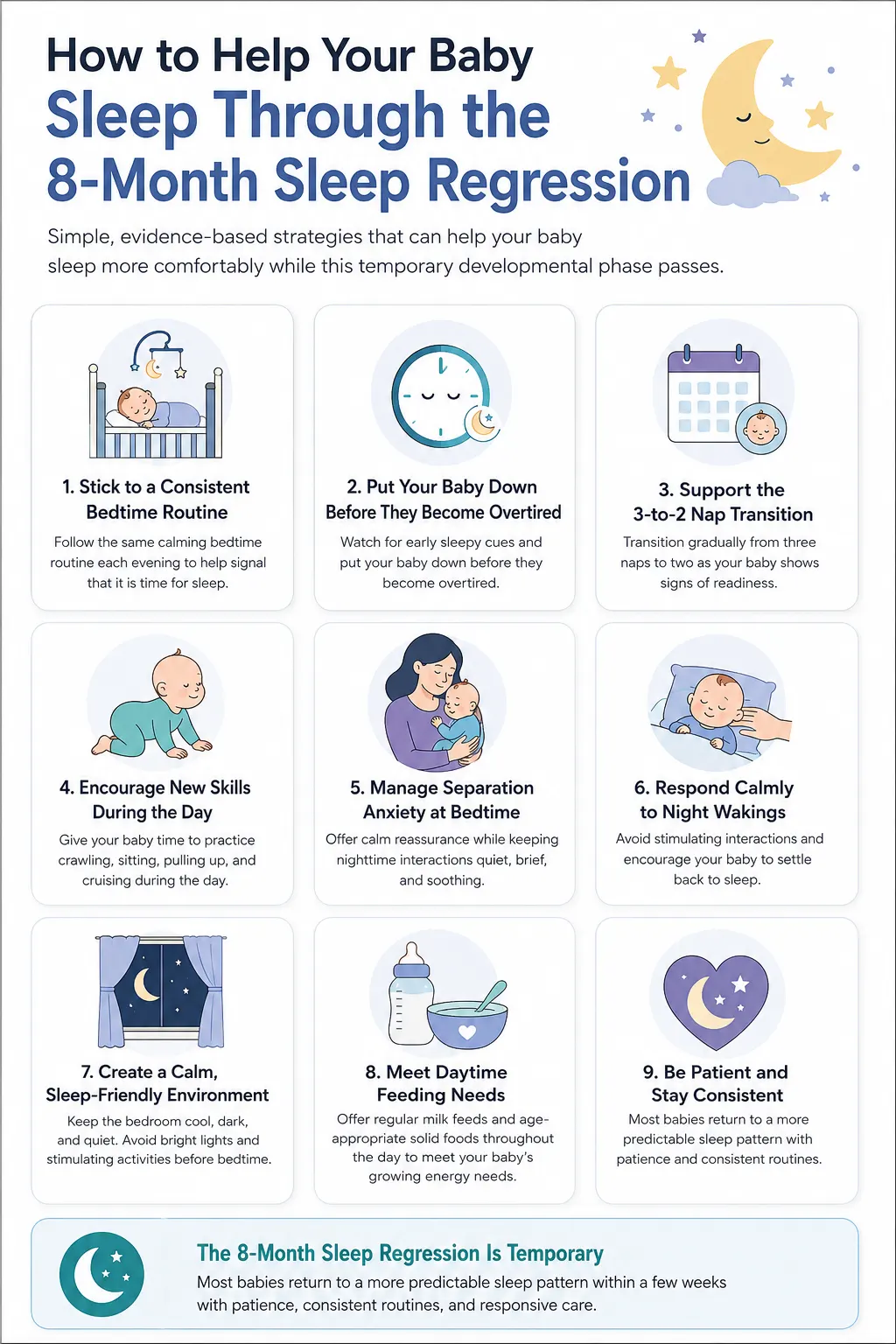
You cannot prevent the 8-month sleep regression, but a consistent routine and a few simple strategies can help your baby sleep more comfortably until it passes.
1. Stick to a Consistent Bedtime Routine
A predictable bedtime routine helps signal that it is time to sleep. Aim for a calming routine that lasts 20 to 30 minutes, such as a warm bath, changing into pajamas, reading a short story, singing a lullaby, or enjoying quiet cuddles. Following the same steps each night helps your baby feel secure and ready for sleep.
2. Put Your Baby Down Before They Become Overtired
Watch for early signs of sleepiness, such as yawning, rubbing their eyes, looking away, or becoming less interested in play. Putting your baby to bed before they become overtired can make it easier for them to fall asleep and stay asleep.
3. Support the 3-to-2 Nap Transition
Many babies begin transitioning from three naps to two between 7 and 9 months. During this transition, avoid dropping the third nap too quickly. Some babies continue to need a short third nap on certain days before they are ready for a consistent two-nap schedule.
4. Encourage New Skills During the Day
Give your baby plenty of opportunities to practice crawling, sitting, pulling up to stand, and cruising while they are awake. Extra daytime practice may reduce the urge to rehearse these new skills at bedtime or during the night.
5. Manage Separation Anxiety at Bedtime
Around 8 months, many babies develop separation anxiety and may wake more often looking for a parent. Offer calm reassurance with a soothing voice or gentle touch while keeping interactions quiet and brief. This helps your baby feel secure without encouraging extended wakefulness or play.
6. Respond Calmly to Night Wakings
If your baby wakes during the night, avoid stimulating activities or prolonged interactions. When possible, place your baby back in the crib while they are drowsy but still awake to help them continue practicing independent sleep skills.
7. Create a Calm, Sleep-Friendly Environment
A cool, dark, and quiet bedroom creates the ideal conditions for restful sleep. During the hour before bedtime, avoid active play, bright lights, loud toys, and screens to help your baby wind down and prepare for sleep.
8. Make Sure Your Baby Gets Enough to Eat During the Day
As babies become more active, their energy needs increase. Offering regular breastfeeds or formula feeds, along with age-appropriate solid foods, can help meet their nutritional needs throughout the day.
9. Be Patient and Stay Consistent
The 8-month sleep regression is temporary. Keep bedtime, naps, and your response to night wakings as consistent as possible. Avoid introducing new sleep habits that may be difficult to change later. With patience and consistency, most babies return to a more predictable sleep pattern within a few weeks.
Safety Tip:
Continue following safe sleep guidelines during the 8-month sleep regression. Always place your baby on their back to sleep in a safety-approved crib with a firm mattress and a fitted sheet. Keep the sleep space free of pillows, blankets, stuffed toys, and crib bumpers.5
Sample 8-Month-Old Sleep Schedule (Two-Nap Example)
By 8 months, many babies are transitioning from three naps to two naps, although some may still need an occasional third nap.
The schedule below is an example to help you plan your baby’s day. Adjust the timing to match your baby’s sleep cues and daily routine.
| Time | Activity |
|---|---|
| 7:00 AM | Wake up and milk feed |
| 8:00 AM | Breakfast (if eating solids) |
| 9:30–11:00 AM | First nap |
| 11:00 AM | Milk feed and playtime |
| 12:30 PM | Lunch (if eating solids) |
| 2:30–4:00 PM | Second nap |
| 4:00 PM | Milk feed and playtime |
| 5:30 PM | Dinner (if eating solids) |
| 6:30 PM | Calm bedtime routine |
| 7:00–7:30 PM | Bedtime |
Tips for Following an 8-Month-Old Sleep Schedule
- Most 8-month-olds sleep about 12 to 16 hours in 24 hours, including naps.6
- Many babies do well with 2.5 to 3.5 hours of awake time between sleep periods, although individual needs vary.
- If your baby is still adjusting to the 3-to-2 nap transition, an occasional short third nap may be appropriate.
- Focus on a consistent bedtime and wake-up time rather than following the clock exactly.
- Watch your baby’s sleep cues and adjust the schedule as needed.
What If Your Baby’s Sleep Problems Do Not Improve?
Most babies settle into a more predictable sleep routine within a few weeks. If your baby’s sleep is not improving, consider whether one or more of these factors could be contributing.
Wake Windows Need Adjusting
Most 8-month-olds do well with 2.5 to 3.5 hours of awake time between sleep periods. Wake windows that are too short or too long can make it harder for babies to fall asleep and stay asleep.
The 3-to-2 Nap Transition Is Still in Progress
Many babies move from three naps to two naps between 7 and 9 months, but the transition does not happen overnight. Dropping the third nap too early can lead to overtiredness, while keeping three naps for too long may delay bedtime or reduce sleep pressure.
Separation Anxiety Has Increased
As separation anxiety becomes more noticeable, some babies wake more often looking for comfort and reassurance. This is a normal developmental stage and usually improves with time.
The Sleep Environment Needs Adjusting
A cool, dark, and quiet bedroom can help promote better sleep. Reducing noise, bright lights, and other distractions may help limit unnecessary night wakings.
If your baby’s sleep has not improved after several weeks, or you are concerned about feeding, growth, breathing during sleep, or overall health, speak with your pediatrician to rule out another possible cause.
Can I Start Sleep Training During the 8-Month Sleep Regression?
Many healthy babies are developmentally ready for sleep training by 8 months of age, if that is the approach your family chooses. Some parents prefer step-based methods with regular reassurance. Others use more structured routines.
There is no single best method. The right choice depends on your baby’s temperament and your family’s comfort level. If your baby has a medical condition or feeding concerns, talk with your pediatrician before starting.
Looking for more guidance? Explore our TRUST Method for Sleep Regression, a gentle, connection-based approach to reducing night wakings in babies and toddlers from 4 months to 4 years.
What Not to Do During the 8-Month Sleep Regression
When your baby starts waking more often, it is natural to try anything that promises more sleep. However, some approaches can make this temporary phase more challenging.
Change the Sleep Schedule Too Often
Try to keep bedtime, naps, and wake-up times as consistent as possible. Frequent changes can make it harder for your baby to develop a predictable sleep routine.
Drop Naps Too Soon
Many babies are still adjusting to the 3-to-2 nap transition. Dropping the third nap before your baby is ready can lead to overtiredness and more disrupted sleep.
Keep Your Baby Awake to Sleep Better
Keeping a baby awake longer in the hope that they will sleep through the night often has the opposite effect. Overtired babies may have more difficulty falling asleep and may wake more frequently.
Overstimulate Before Bed
Active play, bright lights, loud toys, and screens close to bedtime can make it harder for babies to relax. A calm bedtime routine is more likely to support restful sleep.
Expect Immediate Improvement
The 8-month sleep regression is a normal developmental phase. Some nights will be better than others, so try to stay consistent with your routine rather than changing strategies every few days.
4-Month vs 6-Month vs 8-Month Sleep Regression
Each sleep regression is triggered by different developmental changes. Understanding these differences can help you know what to expect as your baby grows.
| Feature | 4-Month Regression | 6-Month Regression | 8-Month Regression |
|---|---|---|---|
| Main Cause | Permanent maturation of sleep cycles | New motor skills, such as rolling and sitting | Crawling, pulling up to stand, separation anxiety, and the 3-to-2 nap transition |
| Typical Duration | 2–6 weeks | 2–6 weeks | A few days to several weeks, often 2–6 weeks |
| Most Common Signs | Frequent night wakings and shorter naps | Practicing new movements in the crib and resisting sleep | Increased clinginess, separation anxiety, standing in the crib, and more frequent night wakings |
The 4-month sleep regression marks a permanent change in how babies sleep, as their sleep cycles become more like an adult’s. The 6-month and 8-month sleep regressions are mainly linked to rapid physical, cognitive, and emotional development. As babies adjust to these milestones, their sleep usually becomes more settled again.
Could Something Else Be Causing the Night Wakings?
Sometimes, yes. Ear infections, reflux, eczema, and other illnesses can also disrupt a baby’s sleep and can be mistaken for the 8-month sleep regression. The section below outlines the signs that suggest another cause may be involved.
When to Contact a Pediatrician
The 8-month sleep regression is usually a normal part of development and often improves within a few weeks. Some sleep problems may be caused by an underlying medical condition rather than a sleep regression.
Contact your pediatrician if your baby:
- Has sleep problems that last longer than 6 weeks or continue to worsen.
- Snores loudly, pauses in breathing, or has difficulty breathing during sleep.
- Has a fever, persistent ear pain, or other signs of illness.
- Refuses feeds or has a noticeable decrease in appetite.
- Is not gaining weight or growing as expected.
- Seems unusually sleepy, difficult to wake, or much less active than usual.
- Cries inconsolably or appears to be in significant pain.
A pediatrician can determine whether your baby’s sleep changes are part of normal development or whether another condition, such as an ear infection, reflux, or another medical problem, may be affecting sleep.
Final Thought
The 8-month sleep regression is usually a temporary part of your baby’s development. As your baby learns new skills, becomes more aware of the world around them, and reaches new milestones, sleep may be less predictable for a while.
Staying consistent with your baby’s bedtime routine, following their sleep cues, and responding with patience can help make this transition easier. With time, most babies settle into a more predictable sleep pattern and start sleeping better again.
Frequently Asked Questions About the 8-Month Sleep Regression
Can the 8-month sleep regression start early?
Yes. Although it is commonly called the 8-month sleep regression, some babies show signs as early as 7 months, while others do not experience it until 9 or 10 months. The timing depends on when each baby reaches key developmental milestones.
Why is my 8-month-old waking every hour?
Frequent night wakings can happen during the 8-month sleep regression as babies learn new skills and become more aware of their surroundings. If your baby wakes every hour for several weeks or has symptoms such as fever, breathing problems, or poor weight gain, contact your pediatrician.
Can the 8-month sleep regression affect naps?
Yes. Some babies take shorter naps, resist daytime sleep, or skip naps altogether during the 8-month sleep regression. These changes are usually temporary and improve as your baby adjusts to this stage of development.
Is it normal for my baby to stand up in the crib instead of sleeping?
Yes. Many 8-month-olds practice pulling up to stand or cruising in the crib instead of settling to sleep. Some babies wake after pulling themselves up because they have not yet learned how to sit back down.
Should I sleep train during the 8-month sleep regression?
There is no single approach that works for every family. If you are already using gentle sleep training, consistency is often more helpful than making major changes during the regression. If you are unsure which approach is right for your baby, discuss it with your pediatrician.
What is the best bedtime for an 8-month-old?
Many 8-month-olds do well with a bedtime between 7:00 p.m. and 8:00 p.m. The ideal bedtime depends on your baby’s nap schedule, wake windows, and individual sleep needs.
Should I feed my baby every time they wake at night?
Not always. Some night wakings happen because babies need comfort rather than food. If your baby is feeding well during the day and growing as expected, try soothing them before offering a feed. If you are unsure whether your baby still needs nighttime feeds, ask your pediatrician for guidance.
Can teething cause an 8-month sleep regression?
Teething alone does not typically cause the 8-month sleep regression. New teeth can disrupt sleep for a few nights around the time they emerge, but this discomfort usually resolves quickly. If bedtime struggles and frequent night wakings continue for several weeks, a developmental cause is more likely than teething.
Can the 8-month sleep regression happen more than once?
The 8-month sleep regression is usually a one-time developmental phase. However, babies may experience other sleep regressions later in infancy and toddlerhood, such as around 12 months, 18 months, or 2 years, as they reach new developmental milestones.
Is It Safe to Bring My Baby Into Bed During the Regression?
After several sleepless nights, you may feel like bringing your baby into bed. The American Academy of Pediatrics (AAP) recommends that babies sleep in their own crib or bassinet on a firm, flat surface.[5] If you bring your baby into bed for feeding or comfort, place them back in their own sleep space before you fall asleep. Never sleep with your baby on a sofa or armchair, as it increases the risk of suffocation.
References
📚 Show References
- Tham EK, Schneider N, Broekman BF. Infant sleep and its relation with cognition and growth: a narrative review. Nat Sci Sleep. 2017;9:135–149.
https://pmc.ncbi.nlm.nih.gov/articles/PMC5440010/ - Adolph KE, Franchak JM. The development of motor behavior. Wiley Interdiscip Rev Cogn Sci. 2017;8(1–2).
https://pmc.ncbi.nlm.nih.gov/articles/PMC5182199/ - Scher A. Maternal separation anxiety as a regulator of infants’ sleep. J Child Psychol Psychiatry. 2008.
https://pubmed.ncbi.nlm.nih.gov/18341549/ - Patel AK, Reddy V, Shumway KR, et al. Physiology, Sleep Stages. StatPearls Publishing; Updated 2024.
https://www.ncbi.nlm.nih.gov/books/NBK526132/ - Centers for Disease Control and Prevention (CDC). Safe Sleep for Babies.
https://www.cdc.gov/sudden-infant-death/sleep-safely/index.html - American Academy of Sleep Medicine. Recommended Amount of Sleep for Pediatric Populations, endorsed by the American Academy of Pediatrics.
https://publications.aap.org/aapnews/news/6630/AAP-endorses-new-recommendations-on-sleep-times
