
Written by: MediHealth PRO Editorial Team
Reviewed by: Dr. Amit Pande, PhD
Molecular Biologist & Clinical Research Expert
Attention-deficit/hyperactivity disorder (ADHD) in girls vs boys does not always look the same. Boys are more likely to show visible hyperactivity and impulsive behavior, while girls often have quieter symptoms such as inattention, daydreaming, anxiety, or emotional sensitivity.
Because these signs are less disruptive, many girls are diagnosed later or overlooked altogether.
What Is the Biggest Difference Between ADHD in Girls and Boys?
Quick Answer: Girls with ADHD are more likely to have inattentive symptoms such as daydreaming, forgetfulness, disorganization, and difficulty staying focused. Boys are more likely to have hyperactive-impulsive symptoms such as fidgeting, excessive talking, interrupting others, and acting without thinking. Either presentation can occur in both girls and boys.
ADHD in Girls vs Boys: Quick Comparison
The table below highlights the most common differences in how ADHD presents in girls and boys. These are general patterns rather than fixed rules.
| Feature | Girls (More Commonly) | Boys (More Commonly) |
|---|---|---|
| Common ADHD presentation | Predominantly Inattentive | Hyperactive-impulsive or combined |
| Typical behavior | Internalizing (anxiety, self-blame, withdrawal) | Externalizing (fidgeting, interrupting, physical restlessness) |
| Classroom behavior | Less disruptive and easily overlooked | More disruptive and likely to attract attention |
| Masking | More likely to hide or compensate for symptoms | Less likely to mask symptoms |
| Common Challenges | Organization, planning, emotional regulation | Impulse control, behavior regulation, following rules |
| Social Difficulties | Friendship maintenance, emotional rejection sensitivity | Peer conflict from impulsivity or difficulty following rules |
| Typical Diagnosis Age | Late elementary school, adolescence, or adulthood | Early childhood (preschool through early primary grades) |
These are general patterns, not fixed rules. Some girls have prominent hyperactivity, and some boys primarily struggle with inattention.
Similarities Between ADHD in Girls vs Boys
ADHD is the same neurodevelopmental condition in girls and boys. Both are diagnosed using the same clinical criteria, and either can have predominantly inattentive, hyperactive-impulsive, or combined ADHD.
The main difference is how symptoms are expressed and recognized, not whether ADHD is present or how severe it is.
The same evidence-based treatments, including behavioral therapy, medication when appropriate, parent training, and school support, can benefit both girls and boys.
Why Recognition Differs Between Girls and Boys
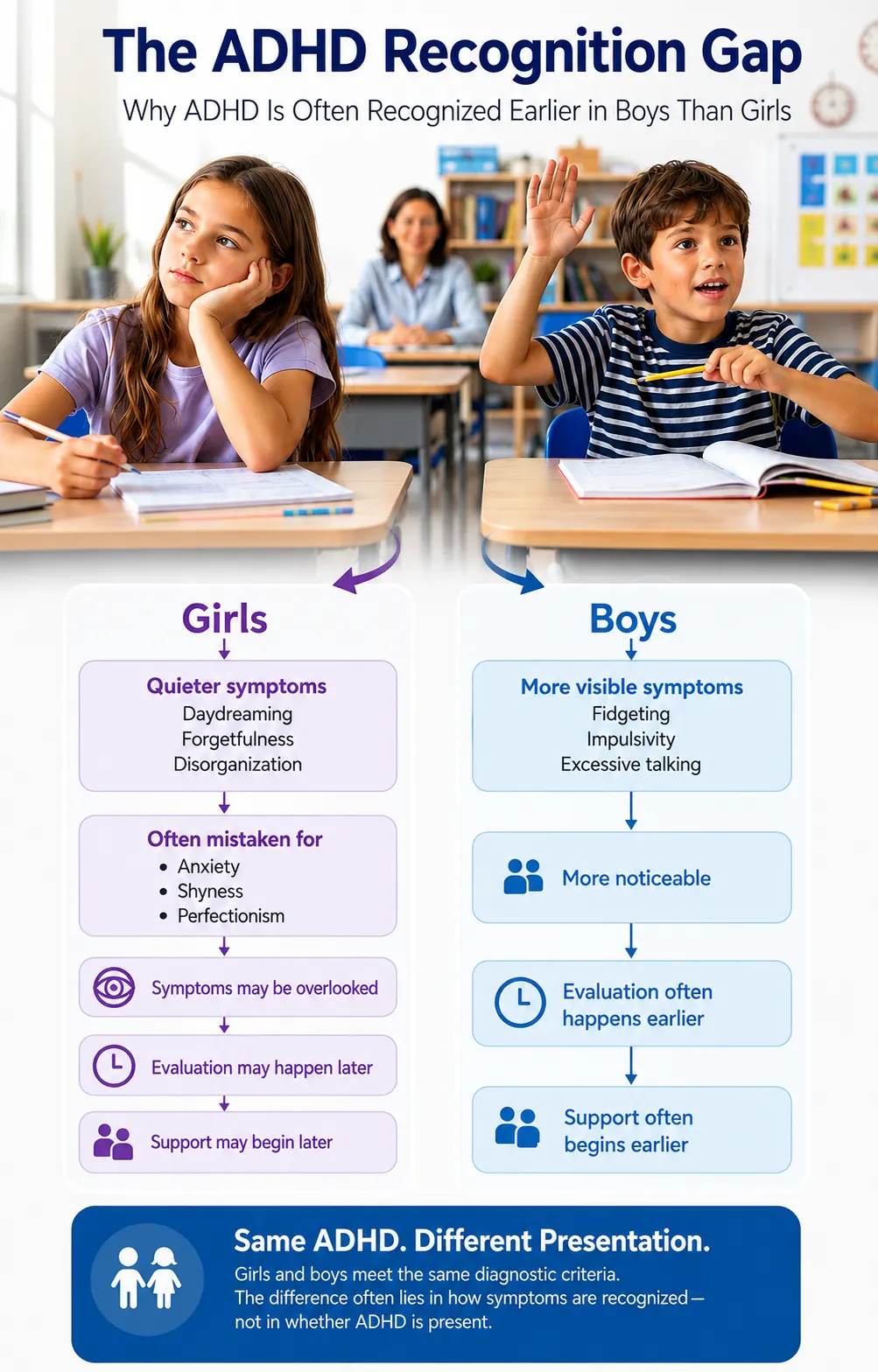
According to the CDC, about 7% of girls and 13% of boys have been diagnosed with ADHD during childhood.1 However, research suggests the true difference between girls and boys is smaller than diagnosis rates indicate because ADHD in girls is more likely to be overlooked.2
The gap appears to lie not in how common ADHD is, but in how often it is recognized.
Boys are more likely to be identified with ADHD early because hyperactivity and impulsivity are more noticeable in classrooms and other structured settings.
Girls often have symptoms that are less noticeable in classrooms and other structured settings. Their difficulties may be mistaken for shyness, anxiety, daydreaming, or a lack of confidence rather than ADHD.
Many girls also develop coping strategies that make their symptoms less visible.3,4 They may work harder to stay organized, copy classmates, or remain quiet to avoid drawing attention. While these strategies can hide ADHD, they do not address the underlying challenges.
Several factors contribute to the recognition gap:
- Inattentive symptoms are easier to overlook than hyperactive behavior.
- Girls are less likely to disrupt the classroom.
- Symptoms may be mistaken for anxiety, perfectionism, or daydreaming.
- Many girls mask their difficulties, especially at school.
- Most early ADHD research and diagnostic criteria were based primarily on male presentations.
For a detailed discussion of masking and early warning signs, read 10 Early Signs of ADHD in Girls Parents Should Never Ignore.
ADHD Symptoms in Girls vs Boys
The core symptoms of ADHD are the same in girls and boys, but they often appear differently in everyday life. (For a full breakdown of ADHD symptoms, brain development, and treatment options, see our ADHD in Children guide.)
Girls are more likely to have inattentive ADHD, while boys more commonly have hyperactive-impulsive or combined ADHD. Either presentation can occur in both sexes.
Inattention
Girls with ADHD often appear quiet rather than disruptive. They may:
- Daydream during class.
- Lose track of instructions.
- Forget homework or personal belongings.
- Struggle with organization and time management.
Hyperactivity and Impulsivity
Boys are more likely to show outward signs of hyperactivity and impulsivity, such as:
- Constant fidgeting or difficulty sitting still.
- Excessive talking or interrupting others.
- Acting without thinking.
- Difficulty waiting their turn.
- Frequent classroom disruptions.
Emotional and Social Differences
Girls with ADHD are more likely to experience emotional sensitivity, low self-esteem, and friendship difficulties, particularly if their symptoms go unrecognized.
Boys may be more likely to face conflict from impulsive behavior, rule-breaking, or difficulty controlling their actions. Some of these behaviors, including a tendency to lie or bend the truth, are explored further in Why Children with ADHD Lie More Often.
Why Are Girls More Likely to Mask ADHD?
Many girls with ADHD learn to hide their symptoms to fit in at school, with friends, or at home.3 This behavior, known as masking, involves consciously or unconsciously covering up ADHD-related difficulties to avoid negative attention or criticism.
Common examples of masking include:
- Copying classmates to avoid making mistakes.
- Spending extra time on homework to hide attention problems.
- Staying quiet instead of asking for help.
- Carefully watching others to imitate appropriate social behavior.
- Suppressing restlessness or impulsive urges in public.
Although masking may make ADHD less noticeable, it often comes at a cost. Constantly hiding symptoms can be mentally exhausting and may contribute to stress, anxiety, and low self-esteem over time.
Masking is more commonly reported in girls, but boys can mask too. A child who appears to be coping well at school may still meet criteria for ADHD and benefit from a full evaluation.
ADHD Diagnosis in Girls vs Boys
There is no separate diagnostic test or different criteria for girls and boys. Healthcare professionals use the same diagnostic guidelines for every child. The difference lies in how symptoms present and whether they are recognized early.5
Girls are more likely to be diagnosed later because inattentive symptoms are quieter and easier to overlook. Boys are more often referred for evaluation after hyperactive or impulsive behaviors become noticeable at home or school.
During an ADHD evaluation, healthcare professionals consider:
- The type and severity of symptoms.
- When the symptoms first appeared.
- Whether symptoms occur in more than one setting, such as home and school.
- The impact on learning, friendships, daily activities, and family life.
- Whether another condition, such as anxiety, autism, a learning disorder, or sleep problems, could better explain the symptoms.
An accurate diagnosis depends on a comprehensive assessment, not on whether a child is a girl or a boy. If you are wondering whether lab work plays any role in this process, see Are There Blood Tests for ADHD?
Treatment Considerations for Girls vs Boys
The main treatments for ADHD are the same for girls and boys: medication, behavioral therapy, parent training, and school accommodations.6
The biggest difference is not the treatment itself, but when children receive it. Because ADHD is often recognized later in girls, access to treatment, school accommodations, and other forms of support may also be delayed.
Delayed Diagnosis
When ADHD is not recognized early, children may miss opportunities for timely treatment, school accommodations, and practical strategies that support learning and everyday functioning.
Earlier recognition allows children and families to access the right support before difficulties become more challenging at home or at school.
Co-occurring Conditions
Anxiety, depression, learning disorders, and other conditions often occur alongside ADHD. According to the CDC, nearly 78% of children with ADHD have at least one co-occurring condition.1
Girls are sometimes evaluated or treated for anxiety or depression before ADHD is recognized because these concerns may be more noticeable than their attention difficulties.
When ADHD is not identified alongside these conditions, problems with attention, organization, and emotional regulation may continue even after treatment begins.
School Support
Girls with ADHD are often well behaved and may work hard to hide their difficulties at school. Teachers may not recognize that they need additional support.
School accommodations should be based on a child’s learning needs rather than classroom behavior. Clear written instructions, extra time for assignments, organizational support, and regular teacher check-ins can help some girls succeed, even when their ADHD is not obvious.
Family Support
Girls who have spent years masking their symptoms may hesitate to ask for help or blame themselves for their struggles.
Parents can build confidence by listening without judgment, acknowledging their child’s challenges, and reminding them that ADHD is a medical condition, not a personal weakness.
When Should Parents Seek an ADHD Evaluation?
Every child has moments of distraction, forgetfulness, or high energy. An ADHD evaluation is worth considering when these behaviors are persistent, occur in more than one setting, and begin to affect daily life.
You should consider speaking with a healthcare professional if your child:
- Has symptoms that have lasted for at least 6 months.
- Shows similar difficulties at both home and school.
- Struggles with learning, organization, or completing age-appropriate tasks.
- Has ongoing problems with friendships, family relationships, or emotional regulation.
- Experiences declining academic performance or low self-esteem related to attention or behavior difficulties.
An early evaluation does not mean a child will be diagnosed with ADHD. It simply identifies whether ADHD, another condition, or a combination of factors is behind the difficulties, so the right next step is clear.
Conclusion
ADHD in girls vs boys can look very different, even though the underlying condition is the same. Boys are more likely to attract attention because of hyperactive or impulsive behavior, while girls often have quieter symptoms that are easier to overlook.
This recognition gap, not severity, explains why many girls are diagnosed later.
If your child’s attention, behavior, or emotional difficulties are persistent and affecting everyday life, speak with a qualified healthcare professional. A comprehensive evaluation can determine whether ADHD or another condition is behind these difficulties.
For symptoms specific to younger girls, see ADHD Signs in a 5-Year-Old Girl: Is It ADHD or Just Normal Behaviour?
Frequently Asked Questions
Why is ADHD diagnosed later in girls?
Many girls do not fit the traditional picture of ADHD. They may daydream, lose focus, or work hard to hide their difficulties instead of displaying disruptive behavior. Their symptoms are more likely to be overlooked by adults, which can delay diagnosis.
Can girls have hyperactive ADHD?
Yes. Although inattentive ADHD is more common in girls, some have hyperactive-impulsive or combined ADHD. Restlessness, excessive talking, interrupting others, and difficulty waiting their turn can all occur in girls as well.
Can boys have inattentive ADHD?
Absolutely. Not every boy with ADHD is hyperactive. Some primarily struggle with attention, organization, forgetfulness, and following instructions, making inattentive ADHD an important diagnosis in boys too.
Should girls and boys be evaluated differently for ADHD?
The diagnostic criteria are the same for every child. What differs is how symptoms are recognized and interpreted. A thorough evaluation considers the child’s behavior across different settings rather than relying on whether they are a girl or a boy.
At what age is ADHD usually diagnosed in girls?
Many girls are diagnosed during the primary school years, but some are not identified until adolescence because their symptoms are less disruptive. The age of diagnosis varies depending on when symptoms begin to affect learning, relationships, or daily functioning.
Can a girl with ADHD be quiet and well behaved?
Yes. Many girls with ADHD are quiet in the classroom and work hard to meet expectations. Their challenges may be hidden behind daydreaming, disorganization, or extra effort to keep up with schoolwork.
Do girls and boys respond differently to ADHD treatment?
The recommended treatments are the same for girls and boys. An effective treatment plan is based on each child’s symptoms, strengths, daily challenges, and individual needs rather than sex alone.
References
📚 Click to view scientific references
- Centers for Disease Control and Prevention. Data and Statistics on ADHD. Reviewed July 8, 2026. https://www.cdc.gov/adhd/data/index.html
- Andersson A, et al. Identity work among girls with ADHD. struggling with Me and I, impression management, and social camouflaging in school. Frontiers in Psychology. 2025. https://pmc.ncbi.nlm.nih.gov/articles/PMC12308699/
- Young S, Adamo N, Ásgeirsdóttir BB, et al. Females with ADHD. An expert consensus statement taking a lifespan approach providing guidance for the identification and treatment of attention-deficit/hyperactivity disorder in girls and women. BMC Psychiatry. 2020;20(1):404. https://pubmed.ncbi.nlm.nih.gov/32787804/
- Mowlem FD, Rosenqvist MA, Martin J, Lichtenstein P, Asherson P, Larsson H. Sex differences in predicting ADHD clinical diagnosis and pharmacological treatment. Eur Child Adolesc Psychiatry. 2019;28(4):481-489. https://pubmed.ncbi.nlm.nih.gov/30097723/
- American Psychiatric Association. Diagnostic and Statistical Manual of Mental Disorders, Fifth Edition, Text Revision (DSM-5-TR). Washington, DC: American Psychiatric Association Publishing; 2022. https://www.ncbi.nlm.nih.gov/nlmcatalog/490020
- Wolraich ML, Hagan JF, Allan C, et al. Clinical Practice Guideline for the Diagnosis, Evaluation, and Treatment of Attention-Deficit/Hyperactivity Disorder in Children and Adolescents. Pediatrics. 2019;144(4):e20192528.
https://publications.aap.org/pediatrics/article/144/4/e20192528/81590/Clinical-Practice-Guideline-for-the-Diagnosis
