

The sun is not even fully up, and you are already drained. If you are parenting a neurodivergent toddler, you know that the “simple” tasks—getting dressed, eating breakfast, and leaving the house—can feel like daily battles.
If you’re trying to create a morning routine for an ADHD toddler, you may feel like every step turns into a struggle. One small request can spark resistance, and simple transitions can quickly spiral into meltdowns. That’s why mastering an ADHD toddler morning routine can feel less like a routine and more like an impossible challenge.
But here is the truth. Your child is not being difficult. Their brain is developing differently, particularly in areas responsible for attention, impulse control, and emotional regulation. The good news is that with the right structure, mornings can become calmer and more predictable.
In this guide, you’ll learn why mornings feel especially hard for ADHD toddlers and discover five science-backed steps to create a stress-free ADHD toddler morning routine. These strategies are practical, parent-friendly, and designed to help you start the day with less chaos and more confidence.
Why Morning Routines for ADHD Toddlers Are So Challenging?
Many parents of toddlers with attention challenges describe the same exhausting pattern. Waking up is slow, getting dressed turns into a battle, and simple steps like brushing teeth or putting on shoes feel like climbing a mountain that never ends.
So what is actually happening in your toddler’s brain?
Here are the four brain-based reasons mornings feel so hard.
1. Delays in Executive Function
One of the biggest reasons mornings feel so hard is a gap in executive function — the brain’s management system. These skills include:
- Attention
- Impulse control
- Emotional regulation
Research shows that executive function continues maturing into adolescence. In ADHD, however, this “construction” follows a slower, shifted timeline than their peers.1
Studies suggest executive skills in children with ADHD may mature two to three years later than peers.2,1,3
As a result, simple tasks feel complex and overwhelming. For example, when you say, “Get ready,” it sounds straightforward. However, your toddler hears a chain of invisible steps:
- Find socks
- Put on socks
- Find shoes
- Put on shoes
Each step requires focus, memory, and coordination that your toddler’s brain may not yet be ready to sequence smoothly.
2. Difficulty with Task Transitions (Often Called “Transition Blindness”)
Another major hurdle is task transitions (also called task-switching).
Research shows that children with ADHD face measurable challenges in task-switching.4 This difficulty is often rooted in reduced cognitive flexibility—the executive function skill that allows the brain to shift attention from one activity to another.
Because the ADHD brain becomes so intensely focused on the current activity that the next task feels invisible or even intrusive.
As a result, moving from a warm bed to a cold bathroom is not just a minor inconvenience; it is a significant neurological demand.
Here’s what that looks like in real life.
Imagine a toddler happily building blocks. Suddenly, a parent says, “Shoes on.” To the adult brain, it’s a small shift. To the child’s brain, it feels like being pulled mid-sentence from a favorite story.
For an ADHD toddler, this shift requires a complex four-step neurological process:
- Stopping the current activity.
- Disengaging emotionally from what they were doing.
- Redirecting attention to a new goal.
- Initiating the new task.
Because these shifting skills are still developing, resistance is common. Therefore, when your child pushes back, it is not stubbornness. It reflects a real neurological difficulty with switching gears.
3. Sensory Processing Difficulties
Studies estimate that 40–60% percent of children with ADHD also experience sensory processing differences.5,6
Mornings are full of sensory input. The smell of toast, the tag on a shirt, bright lights, or the loud noise of a hairdryer can trigger an immediate “fight or flight” response. What feels minor to you can feel intense and uncomfortable to them.
For a toddler with ADHD, these everyday sensations can quickly become overwhelming, sparking meltdowns before the day even begins. This is not overreacting. It reflects a nervous system that is already working hard to regulate incoming sensory information.
4. Sleep Challenges Play a Role
Up to 70% of children with ADHD struggle with sleep.7
Whether it’s trouble falling asleep or restless nights, a tired brain has even less capacity for focus and emotional regulation.
When your toddler is sleep-deprived, small frustrations escalate quickly, making the morning routine feel nearly impossible to manage.
When Morning Struggles May Signal ADHD
Most toddlers resist transitions or dislike getting dressed from time to time. However, with ADHD, the patterns tend to be more intense, frequent, and persistent.
Here are some signs that morning challenges may reflect more than typical toddler behavior:
- Daily meltdowns during simple transitions
- Extreme resistance to routine tasks like brushing teeth or putting on shoes
- Difficulty following even one-step instructions
- High impulsivity or constant movement from the moment they wake
- Emotional reactions that seem bigger than the situation
The key difference is consistency and intensity. If these patterns happen most mornings and significantly disrupt family life, it may be worth discussing your concerns with a pediatrician or child psychologist.
5 Steps to a Stress‑Free Morning Routine for ADHD Toddlers
To transform your morning from a battle into a rhythm, you need to work with your toddler’s brain, not against it. Here are five practical, research-informed strategies to reduce friction and prevent meltdowns.
1. Use a Visual Schedule (Show, Do not Just Tell)
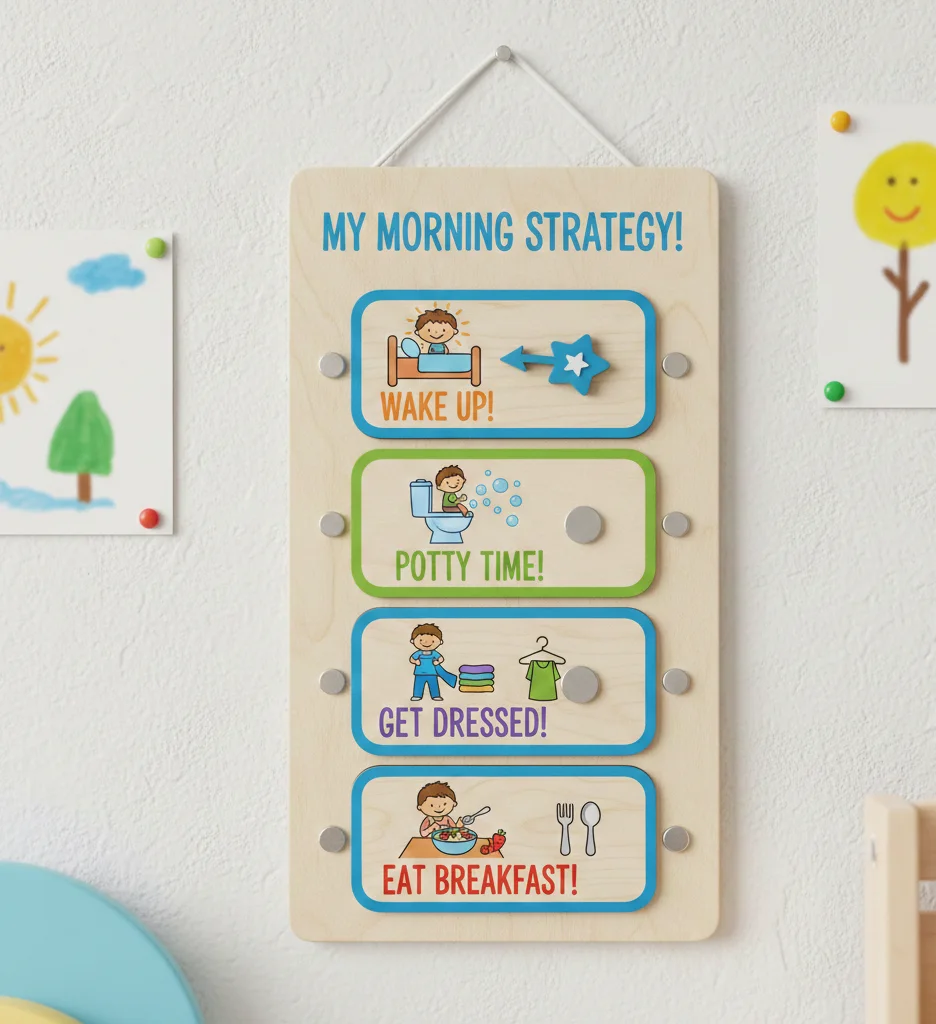
Because ADHD toddlers struggle with working memory, they often forget what they are doing in the middle of a task. A verbal command like “Go brush your teeth” can literally vanish from their mind before they reach the bathroom.
- The Strategy: Create a vertical board with simple icons or photos of your child performing each task (waking up, potty, dressing, eating).
- Why it works: Visuals stay “fixed” in your child’s mind, while verbal instructions can vanish. A visual schedule acts like an external brain, holding the sequence so your toddler does not have to remember each step.
2. Implement “Heavy Work” for Sensory Regulation

If your toddler wakes up “seeking” sensory input—jumping, stomping, or moving around energetically—they need proprioceptive input to calm their nervous system.
- The Strategy: Incorporate 5 minutes of “heavy work.” Have them do “bear crawls” to the kitchen or carry a small basket of laundry.
- Why it works: Pushing and pulling against resistance helps regulate the nervous system and improve focus, helping them feel grounded and focused for breakfast.
3. The “Two-Choice” Power Play

Toddlers with executive dysfunction can struggle with open-ended questions. Asking, “What do you want to wear?” makes their brain work too hard to figure it out, often causing a pause, freeze, or meltdown during the morning routine.
- The Strategy: Give two specific choices. “Do you want the gray shirt or the dinosaur shirt?”
- Why it works: It lets toddlers feel independent while keeping choices simple enough to avoid stress.
4. Use “Now-Next” Language to Bridge Transitions

To solve “Transition Blindness,” you need to give the brain time to shift gears.
- The Strategy: Instead of saying, “Eat breakfast now!”, use a bridge: “Now we’re brushing our teeth; next we’ll eat breakfast.”
- Pro Tip: Use a visual timer or a simple cue (like a sticker chart or colored card) so your child can see each step coming. This helps their brain anticipate the transition and reduces resistance.
5. Front-Load the Prep (The 10-Minute Night Shift)

The best ADHD toddler morning routine actually starts the night before. Too many decisions can drain both a parent and a child before the day even begins.
- The Strategy: Pick out the outfit (down to the socks), pack the school bag, and set the breakfast table before you go to sleep.
- Why it works: Removing these morning decisions reduces mental stress. With fewer logistical tasks to manage, you have more energy to stay calm and guide your child through the morning with ease.
The “Perfect” ADHD Toddler Morning Schedule
This sample schedule is designed to accommodate the executive function gap and sensory needs of a neurodivergent child.
Parent Pro-Tip: Do not aim for the exact minute. Aim for the sequence. It’s the order of events that creates the feeling of safety for an ADHD brain.
Here’s an example of how a 90-minute morning might flow:
Time (Column 1) Task (Column 2) The "ADHD-Friendly" Secret (Column 3) 7:00 AM Gentle Wake-Up Use a "Now-Next" bridge while they are still in bed. Keep lights low. 7:15 AM Sensory Heavy Work 5 mins of "animal crawls" or jumping to ground their nervous system. 7:20 AM Visual Schedule Review Physically point to the first picture. "Now we eat, Next we dress." 7:45 AM Breakfast + Dopamine Use a "special" colorful plate or a favorite morning podcast. 8:10 AM The "Two-Choice" Dress Give two specific options (Dino vs Robot shirt) to avoid paralysis. 8:25 AM Final Transition Start the "Transition Song." Shoes on, bag grabbed. 8:30 AM Success! Give a high-five or move the "Finished" magnet on their board.
What to Avoid (The “Morning Killers”)
Even with the best ADHD toddler morning routine, certain habits act as “kryptonite” for a neurodivergent brain. To keep the peace, try to eliminate these four common mistakes.
1. The “Hurry Up” Trap
It is the most common phrase in parenting, but for an ADHD toddler, it is a major trigger.
- The Problem: The ADHD brain often processes information more slowly when under pressure. Saying “Hurry up!” triggers a spike in cortisol (the stress hormone).
- The Result: Instead of moving faster, your toddler likely “freezes,” shuts down, or has an emotional outburst.
- The Fix: Use objective timers. Instead of “Hurry up!”, say: “The red timer says we have 2 minutes until we leave.”
2. The Screen Time “Dopamine Crash”
It’s tempting to put on a cartoon so you can get dressed in peace, but this often backfires.
- The Problem: ADHD brains are naturally dopamine-seeking. Tablets and TV provide an intense flood of dopamine.
- The Result: When the screen goes off to do something “boring” (like putting on a coat), the toddler experiences a physical dopamine crash. This makes the transition feel painful, leading to a massive meltdown.
- The Fix: Keep the morning a “screen-free zone” until they are fully ready to walk out the door.
3. Multi-Step Verbal Commands
We often give instructions in “strings” without realizing it: “Go upstairs, get your shoes, and bring me your backpack.”
- The Problem: This requires high-level working memory, which is still developing in toddlers with ADHD.
- The Result: Your toddler will likely get upstairs and forget why they are there.
- The Fix: Give one command at a time. Wait for them to finish before giving the next one, or let your visual chart do the “talking” for you.
4. High-Sugar Breakfasts
While a quick pastry is easy, it can derail the chemistry of an ADHD brain for the rest of the day.
- The Problem: Sugar may cause energy spikes followed by drops, which can worsen irritability and focus challenges in some children.
- The Result: A mid-morning meltdown at daycare or preschool.
- The Fix: Focus on Iron, protein and healthy fats (eggs, Greek yogurt, or nut butters). These support the production of dopamine and norepinephrine, which are essential for emotional control.
The Secret Ingredient: Parental Co-Regulation
Your child’s nervous system is constantly looking to yours for cues. In short: If you are frantic, they will be frantic.
To maintain a calm atmosphere, practice these three co-regulation habits:
- The 1-Minute Reset: If you feel your blood boiling, step into the bathroom for 60 seconds of deep “box breathing.”
- Lower Your Voice: The louder a child gets, the quieter you should become. It forces them to focus on your input.
- Change the Narrative: Instead of thinking “They are being difficult,” tell yourself “They are having a hard time.” This shift from frustration to empathy changes your physiological response.
The Takeaway
Mornings with an ADHD toddler are challenging, but not impossible. When you understand what’s happening in your child’s brain, you can stop blaming yourself and start working with their needs.
Using tools like visual schedules and ‘Now-Next’ language gives your child the structure their brain needs. Pair this with night-before prep to reduce stress and confusion that often leads to meltdowns. Avoiding the “Hurry-Up” trap and screen-time crashes protects their dopamine levels and helps keep their nervous system regulated.
Managing ADHD mornings is not about perfection; it’s about creating predictability, reducing stress, and building connection. With small, consistent changes, mornings can shift from daily battles to smoother routines—helping both you and your child start the day with confidence.
What is the one thing you’re going to try tomorrow morning? Let me know in the comments below—we’re in this together!
Frequently Asked Questions (FAQ) About Morning Routines for ADHD Toddlers
Q1: What age should I start a morning routine for my ADHD toddler?
You can start as early as age 2–3. Even before a formal diagnosis, toddlers thrive on predictability. Establishing a consistent ADHD toddler morning routine early on helps build independence and reduces anxiety as they grow.
Q2: My toddler refuses to follow the visual schedule. What should I do?
Make it interactive. Use stickers, magnets, or let your child move a “Done” marker after each step. When a child has physical “buy-in” and control over the board, their engagement increases and power struggles decrease.
Q3: How long should a morning routine for ADHD toddlers take?
Ideally, aim for 60–90 minutes. Rushing is a major trigger for executive dysfunction. Building in “buffer time” allows for transitions and sensory regulation activities without the stress of the “Hurry-Up” trap.
Q4: Can screen time ever be part of the morning?
Yes, but with a strict rule: Screens only come on after your child is fully dressed and ready to leave. This prevents the “dopamine crash” that occurs when you try to transition them from a high-stimulation show to a “boring” task like putting on shoes.
Q5: What if my toddler still melts down despite the routine?
Meltdowns are part of the neurodivergent experience. The goal of a routine isn’t to eliminate them 100%, but to reduce their frequency and intensity. Stay consistent; the more predictable the world feels, the safer your child’s nervous system will become.
Q6: How do I handle mornings when sleep was especially poor?
On “low-sleep” mornings, simplify everything. Skip non-essential steps, provide only one choice instead of two, and focus entirely on connection. A tired brain has zero “gas” in the executive function tank—give them (and yourself) extra grace.
Q7: Should I talk to my pediatrician about these struggles?
Yes. If mornings consistently feel unmanageable or if you are seeing high levels of aggression or despair, consult a pediatrician or child psychologist. They can help rule out sensory processing disorders or other issues and provide tailored support.
References
📚 Click to view references
- Shaw P, Eckstrand K, Sharp W, et al. (2007). Attention-deficit/hyperactivity disorder is characterized by a delay in cortical maturation. Proceedings of the National Academy of Sciences, 104(49), 19649–19654. Available from: https://pmc.ncbi.nlm.nih.gov/articles/PMC2148343/
- National Institute of Mental Health. (2014). Focusing on ADHD. Available from: https://newsinhealth.nih.gov/2014/09/focusing-adhd
- Sadozai AK, Sun C, Demetriou EA, et al. (2024). Executive function in children with neurodevelopmental conditions: A systematic review and meta-analysis.
Nature Human Behaviour, 8(12), 2357–2366. Available from: https://www.nature.com/articles/s41562-024-02000-9
- Rauch WA, Gold A, Schmitt K. (2012). Task-switching deficits in children with ADHD.
Attention Deficit and Hyperactivity Disorders, 4(4), 179–187. Available from: https://pubmed.ncbi.nlm.nih.gov/22760550/
- Little LM, Dean E, Tomchek S, Dunn W. (2018). Sensory Processing Patterns in Autism, ADHD, and Typical Development. Physical & Occupational Therapy in Pediatrics, 38(3), 243–254. Available from: https://pubmed.ncbi.nlm.nih.gov/29240517/
- Söderlund GBW, Hadjikhani N, Thorsson M, et al. (2024). Sensory white noise in clinical ADHD.
Scandinavian Journal of Child and Adolescent Psychiatry and Psychology, 12(1), 92–99. Available from: https://pmc.ncbi.nlm.nih.gov/articles/PMC11585357/
- Sciberras E, Hiscock H, Cortese S, et al. (2023). Variation in sleep profiles in children with ADHD. Journal of Child Psychology and Psychiatry, 64(10), 1462–1469. Available from: https://pmc.ncbi.nlm.nih.gov/articles/PMC10952554/
