

Watching your baby roll over for the first time is a magical moment. In fact, it’s often the first sign that your “stationary” newborn is becoming an active, independent little person. However, for many parents, the question “when do babies roll over” also brings worry, especially when a baby is not rolling yet or there are concerns about a possible rolling over developmental delay in babies.
Typically, most babies master the tummy-to-back roll first. After that, they usually learn the more challenging back-to-tummy flip a few weeks later. However, development is a range, not a single date on the calendar. Therefore, if a baby is not rolling by 6 months, feeling concerned is completely natural.
To understand why a baby may not be rolling yet, we must look at the neurological maturation behind the movement. In this guide, we explain when babies usually roll over, the neurological science behind the movement, red flags to watch for by 6 months, and simple, evidence-based exercises to help your baby build this skill safely and confidently.
When Do Babies Usually Roll Over? A Simple Developmental Timeline
Most babies begin rolling over between 4 and 6 months of age, although this window can vary. This range reflects the average age babies roll over, not a strict deadline.
The timeline often follows this pattern:
- 3–4 months: “Accidental” rolls occur. Your baby might push up during tummy time and accidentally flip from tummy to back because their head is heavy.
- 4–5 months: Intentional rolling from tummy to back becomes more consistent.
- 5–6 months: The “Big Flip.” At this stage, most babies master the more difficult back-to-tummy roll, which requires more core strength and coordination.
However, some healthy babies roll earlier, while others take a little longer. Most importantly, the quality of movement matters more than the exact age.
Dr. Pande’s Note: New developmental milestones like rolling over can temporarily disrupt sleep. If your baby is rolling instead of sleeping, our guides on 4-Month Sleep Regression in Babies and 4-to-3 Nap Transition Guide can help.
Why Is My Baby Not Rolling Yet? The Neurological Development Behind Rolling Over
Rolling is often viewed as a simple milestone of physical strength. However, from a clinical perspective, rolling is primarily a neurologically-led movement skill.
For successful baby rolling, the following four neurological systems must be mature and able to communicate in a precise sequence.
1. The Vestibular System (Balance and Body Orientation)
Located in the inner ear, this acts as an internal compass. It informing the brain of the body’s position related to gravity1.
It also helps a baby tolerate movement when baby changes position like up, down, and sideways.
Before rolling can happen smoothly, this system must be mature enough to handle motion. If it is not, a baby may feel uncomfortable or disoriented, leading to resistance, stiffness, or crying when placed on their side.
2. The Motor Cortex (Movement Planning)
This is the part of the brain that sends signals to the muscles, telling them when and how to move2. Rolling requires the brain to activate the neck, trunk, and hips in a specific sequence rather than all at once.
However, at first (from birth), primitive reflexes (automatic movements they are born with) help guide these early movements of the hands, legs, and body. As the motor cortex matures, it gradually takes over, allowing the whole baby to roll intentionally and with control.
3. Sensory Feedback (Body Awareness)
Nerves in the skin and joints send feedback to the brain about pressure and position3. This is known as Proprioception. Through this feedback, the baby learns which movements help them turn and which do not. This helps the brain build an “internal map” of where the arms and legs are, even when the baby is not looking at them.
4. Crossing the Midline (Connecting Upper and Lower Body)
Rolling is a midline skill, meaning the left and right sides of the body must work together4, 5. This coordination forms the foundation for later milestones such as sitting, crawling, and walking. If a baby struggles to twist or rotate the trunk, rolling may be delayed.
Baby Not Rolling by 6 Months? Clinical Red Flags Parents Should Watch For
If your baby is not rolling by 6 months, it does not always mean there is a problem, but it is a good time to observe their movement patterns.
Consult your pediatrician if you notice several of the following signs:
- No attempts to roll in either direction: The baby does not try to roll from tummy to back or back to tummy during play.
- Persistent body stiffness or extreme floppiness: The body feels very tight and rigid, or unusually loose with poor muscle tone.
- Strong preference for one side only: The baby consistently turns the head, reaches, or moves toward the same side.
- Poor tolerance for tummy time: The baby cries quickly, arches the back, or avoids pushing up on the arms.
- Minimal trunk rotation during movement: Arms and legs move, but the body does not twist or roll as one unit.
- Poor head control during transitions: The head falls back or lags when changing positions, such as during pull-to-sit.
- Limited reaching across the body: The baby rarely reaches across the midline to grab toys.
- Little weight shifting during floor play: The baby stays flat or stiff and does not shift weight from side to side.
- Stiff or symmetrical limb movements: Arms and legs move together instead of smoothly and independently.
- Discomfort in side-lying positions: The baby resists or cries when placed on the side, which is important for rolling.
Reassurance for parents: Seeing one sign does not automatically mean something is wrong. However, if several of these signs appear together, early guidance from a pediatric professional can help support healthy movement development.
How to Help a Baby Roll Over: 6 Brain-Based Exercises to Encourage Rolling
If your baby is approaching the 6-month mark and has not quite mastered the roll, these six brain-based exercises can help.
1. Side-Lying Play: The “Bridge” to Rolling
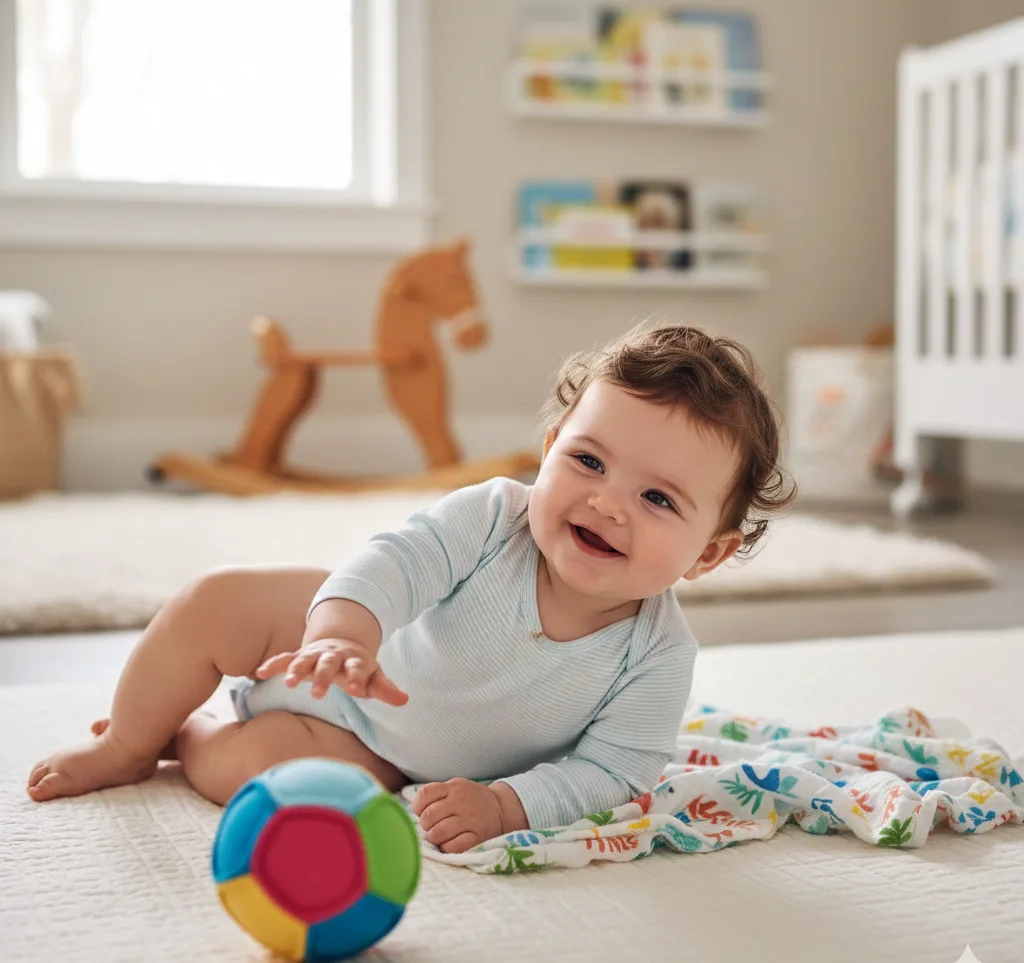
- What it is: In this exercise, your baby is placed in a comfortable middle position, not fully on the back and not fully on the tummy. This side-lying position acts as a gentle bridge between the two.
- Why it works: Side-lying creates the missing link between the back and the tummy and activates the vestibular system (balance) without forcing the baby to fight gravity entirely. As a result, movement feels safer and more controlled.
- How to do it:
- Place your baby on their side on a firm mat.
- Support their back with a rolled-up towel if they feel wobbly.
- The Goal: Position toys at chest level to encourage them to reach forward, which naturally tips the body toward a roll.
Pro Tip: If your baby “hates” tummy time, start here. Side-lying is often more comfortable for babies with sensory sensitivities.
2. Purposeful Weight Shifting (Active Tummy Time)

- What it is: This is tummy time with gentle side-to-side movement, not just lying flat. While standard tummy time builds basic neck and shoulder strength, weight shifting teaches your baby how to move their center of gravity.
- Why it works: Regular tummy time builds strength. However, adding gentle rotation teaches the body how to start a roll.
- How to do it:
- Place your baby on their tummy on a firm surface.
- Place a toy slightly to one side, just out of their reach.
- As they look toward the toy, gently guide the opposite hip forward to encourage a reaching motion.
- The Goal: To encourage the chest to rotate and lift rather than staying flat against the floor.
Pro Tip: Keep sessions short (2–3 minutes) and frequent throughout the day to build skill without causing fatigue or frustration.
3. Assisted Rolling with “Strategic Pauses”
- What it is: You gently help your baby start a roll and pause, giving them a chance to continue the roll by themselves.
- Why it works: Babies need time to process new movements. If you roll them too fast, their brain doesn’t learn anything. A 5-second pause lets their brain realize, “Oh, I am on my side right now!”
- How to do it:
- Lay your baby on their back.
- Gently hold one leg and move it across their body.
- The Pause: When they are on their side, stop. Hold them there for 3 to 5 seconds.
- Let them try to finish the roll onto their tummy by themselves.
- The Goal: Let the baby’s brain “register” the side-lying position before they complete the roll onto their tummy.
- Pro Tip: Always guide from the hips. Never pull on their arms, as this can hurt their shoulders and doesn’t help them learn to use their core.
4. Reaching Across the Midline

- What it is: This is simple play that encourages your baby to reach for a toy placed on the opposite side of their body. For example, reaching with the right hand toward something on the left side.
- Why it works: Rolling is a midline skill, which means both sides of the brain must work together. When your baby reaches across the center of their body, the chest and tummy naturally twist. This twisting motion is exactly what helps start a roll.
- How to do it:
- Lay your baby on their back on a firm, safe surface. Make sure they are relaxed and comfortable.
- Hold a favorite toy above the center of their chest so they can see it clearly.
- Slowly move the toy toward the opposite shoulder, giving your baby time to watch and think.
- Stop moving the toy and give your baby time to reach for it.
- The Goal: Encourage your baby to reach across their body rather than reaching straight upward.
Pro Tip: This movement helps the body learn to twist, which is needed for rolling from back to tummy.
5. Foot-to-Hand Play (Hip Initiation)
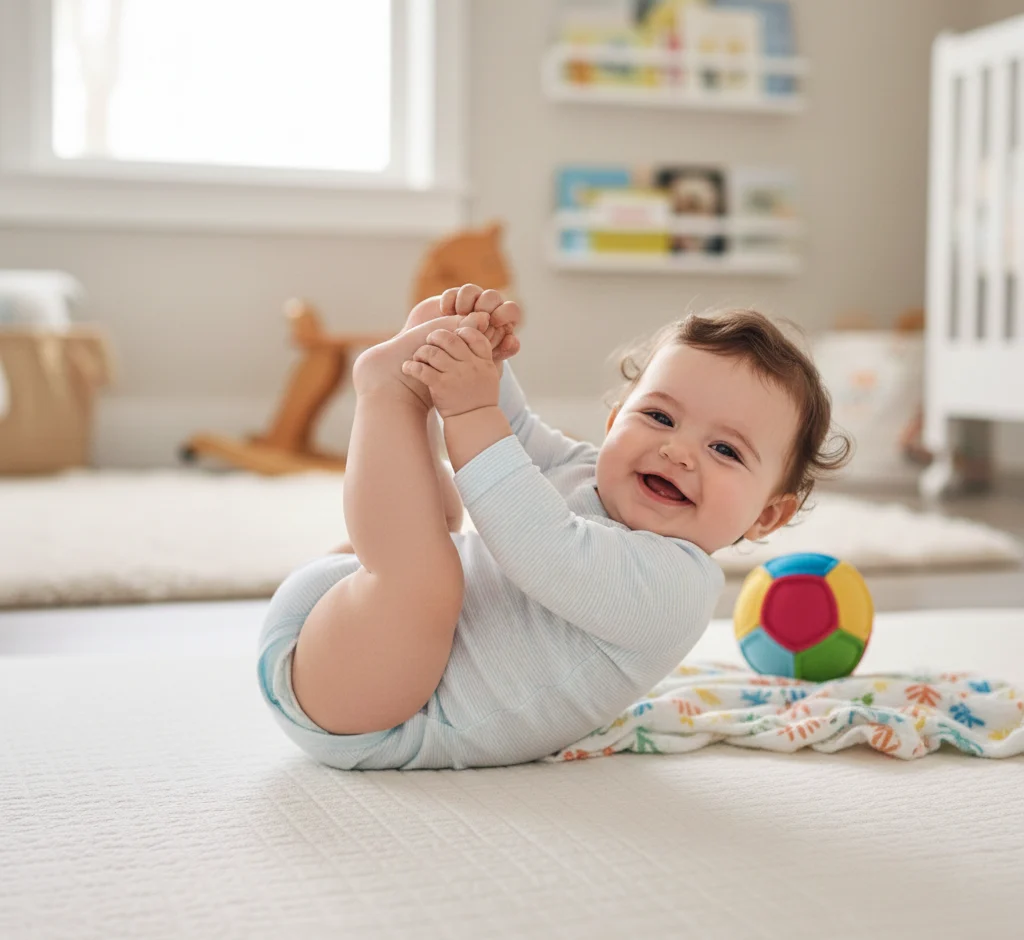
- What it is: Helping your baby find their feet and bring them up toward their hands. This is often called the “Happy Baby” pose.
- Why it works: Many babies try to roll using only their head and neck. However, true rolling begins in the middle of the body (tummy and hips). This activity helps your baby feel how the hips can start and guide movement.
- How to do it:
- Gently lift your baby’s feet toward their hands (the “happy baby” pose).
- Once they are holding their feet, gently rock their hips from side to side like a little boat.
- The Goal: To help your baby learn how to use their tummy and hip muscles so the lower body can lead the movement.
- Pro Tip: If your baby isn’t interested in their feet yet, try using high-contrast (black and white) socks or “foot rattles.” The noise and bright colors will encourage them to reach down and grab.
6. Encourage Unrestricted Floor Play
- What it is: Creating a safe, flat, and firm area where your baby can move freely without being held in a “container” (like a bouncer, swing, or car seat).
- Why it works: The floor play gives your baby the freedom to twist and push against a solid surface. This “free time” helps their brain figure out how to flip over.
- How to do it:
- Use a firm mat or a thin blanket on the floor.
- Give your baby a few floor sessions each day (about 20 minutes each) while they are awake and supervised.
- Place a few toys just out of reach to encourage reaching, wiggling, and turning.
- The Goal: To give your baby the freedom to explore how their body moves and experiment with flipping over naturally.
- Pro Tip: Use a firm surface to help your baby feel their body better. Avoid using a soft bed or couch, which makes movement much harder.
What NOT to Do: Common Mistakes to Avoid When Your Baby Is Learning to Roll
Parents often try to help with the best intentions. However, some well-meaning actions can actually slow progress.
- Do not force your baby into a roll. Forced movement bypasses learning and can increase fear or resistance.
- Do not pull your baby by the arms. This can strain the shoulders and does not teach core control.
- Do not rush tummy time if your baby is upset. Short, frequent sessions work better than long stressful ones.
- Do not rely heavily on containers like swings, bouncers, or loungers. Too much time in these limits movement exploration.
- Do not compare your baby constantly to others. Development varies, and comparison often increases unnecessary anxiety.
- Do not ignore asymmetry. If your baby always moves in one direction, it deserves attention.
⚠️ Important Safety Note: Never leave a baby unattended on a raised surface (like a changing table or couch), even if they haven’t started rolling yet. Many “first rolls” happen unexpectedly!
Takeaway
The baby rolling over milestone is an early indicator of healthy neurological development and motor coordination. While most babies roll between 4 and 6 months, the quality of movement is more important than the date on the calendar. With regular floor play and brain-based exercises, parents can gently support this important skill.
When to call a specialist: If there is no progress after 2–3 weeks of practice, or if your baby appears consistently stiff or floppy, a Pediatric Physical Therapist can provide a customized plan to support your baby’s unique development.
Frequently Asked Questions (FAQ)
Q1. How can I encourage my baby to roll over safely?
Focus on Tummy Time and Side-Lying play. Use high-contrast toys to encourage them to track movements with their eyes, which naturally leads to the head turning and the body following.
Q2. How do babies start to roll?
It usually starts with a “weight shift.” When a baby reaches for a toy on one side, they shift their weight to the opposite hip. This momentum, combined with a strong push from their arms, flips them over.
Q3. When should I worry if my baby is not rolling?
Most babies begin rolling between 4 and 6 months. While every child develops at their own pace, you should consult your pediatrician if your baby is not rolling by 7 months, especially if they also struggle to hold their head up or don’t push up with their arms during tummy time.
Q4: Why does my baby hate tummy time?
It may be a vestibular sensitivity or a lack of upper body strength. Try starting with “Side-Lying Play” (Exercise #1) to build confidence first.
Q5. Is it normal if my baby rolls back to tummy but not tummy to back?
Yes! While most babies master tummy-to-back first (because the head is heavy and gravity helps), some babies find back-to-tummy easier because they can use their legs for leverage.
References
📚 Click to view references
- Siegel DN, Ogle MM, Wilson C, Scholes O, Prow A, Mannen EM. How do babies roll? Identifying the coordinated movements of infant rolling through video compared to laboratory techniques. Technol Health Care. 2024;32(4):2527-2539. Available From: https://pmc.ncbi.nlm.nih.gov/articles/PMC11222302/
- Siegel DN, Siddicky SF, Davis WD, Mannen EM. Muscle activation and coordinated movements of infant rolling. J Biomech. 2024 Jan;162:111890. Available From: https://pmc.ncbi.nlm.nih.gov/articles/PMC10898450/
- Hoogenboom BJ, Voight ML, Cook G, Gill L. Using rolling to develop neuromuscular control and coordination of the core and extremities of athletes. N Am J Sports Phys Ther. 2009 May;4(2):70-82. Available From: https://pmc.ncbi.nlm.nih.gov/articles/PMC2953329/
- Siegel DN, Siddicky SF, Davis WD, Mannen EM. Infant muscle activity is modified by inclined environments during different styles of rolling. Infant Behav Dev. 2025 Jun;79:102049. Available From: https://pmc.ncbi.nlm.nih.gov/articles/PMC12483187/
