

If your baby is fighting naps, struggling at bedtime, and waking frequently at 2:00 AM—you have likely hit the 8-Month Sleep Regression.
While it feels like a setback, this is actually a developmental progression—a temporary “storm” that typically hits between 7 and 10 months. It is primarily driven by two major neurological shifts: intense separation anxiety and rapid physical milestones like crawling, pulling up, and cruising.
If you navigated the 4-month or 6-month regressions, you know that consistency is your best tool.. This guide provides a complete 8-Month Sleep Regression Roadmap to help you understand the neurological causes of these wake-ups and provide a step-by-step plan to stabilize naps and restore peaceful sleep for your whole family.
📖 Executive Summary: Your Plan to Fix the 8-Month Sleep Regression
- The Most Effective Fix: Consistently teach your baby independent sleep (self-soothing).
- Daytime Focus: Optimize wake windows (2.5 to 3.5 hours) and provide ample time for practicing new motor skills. Why it works: Prevents overtiredness, the number one cause of night wakings.
- Nighttime Focus: Use the Calm–But–Awake Rule consistently and apply the Pause Rule (wait 1–5 minutes before intervening) to encourage self-soothing. Why it works: Babies gradually learn that the crib is a safe place to fall asleep on their own.
Understanding the 8-Month Sleep Regression
The 8-Month Sleep Regression is a temporary phase, usually lasting 2–6 weeks.1 It is caused by rapid brain development and new skills, primarily crawling, and standing.
Although it is commonly called a “regression,” it is actually a developmental progression. Your baby’s sleep is not getting worse because of bad habits or a problem. Instead, it is temporarily disrupted because the brain and body are developing at an intense pace.
Around eight months, multiple developmental changes happen at the same time. Each one places new demands on your baby’s nervous system. As a result, sleep can become lighter, more fragmented, and harder to settle.
👉 Note: After the 8-month sleep regression, you may also encounter the 12-month sleep regression(due to walking and a shift to a single nap).
Signs Your 8-Month-Old is Regressing
If you are asking, “Is my 8 month old having a sleep regression?” look for these following key symptoms
- Frequent night wakings after previously long stretches
- Shortened or skipped naps
- Bedtime battles or trouble settling
- Increased clinginess and separation anxiety
- Practicing new skills (crawling, pulling up) in the crib
- Restlessness despite being tired
8-Months Sleep Regression or Teething: How to Tell the Difference
It is easy to blame teeth for every wake-up. However, understanding the difference between 8-month sleep regression or teething is important. The 8-month regression is neurological, whereas teething is physical. Use this checklist to tell them apart:
1. The “Duration” Test
- Teething: Usually causes acute fussiness for 3–4 days right before and after a tooth erupts.
- Regression: Lasts 2–6 weeks. If it’s been 10 days of poor sleep and no tooth has appeared, it’s a regression.
2. Physical vs. Mental Energy
- Teething: Your baby seems “low” or irritable. They may have a slight fever (under 100.4°F), excessive drooling, or a facial rash.
- Regression: Your baby seems “wired.” They are busy, active, and frustrated by their own desire to move and explore.
3. The “Chew” Factor
- Teething: They will aggressively gnaw on their hands, toys, or your shoulder. They may also show a decreased appetite for solids because their gums are sore.
- Regression: Their appetite remains normal, but their “fears” are new. They aren’t looking for a teether; they are looking for you.
Are you seeing both at once? Read our complete survival guide: Teething and Sleep Regression Together? 8 Real-World Steps to Survive the ‘Double Disruption’
Root Causes: The Science Behind the 8-month Wake-Ups
The 8-month sleep regression is usually triggered by neurological and biological shifts.
1. The Cortisol Crash (The Overtiredness Trap)
By around 8 months, your baby’s internal clock, also called the circadian rhythm, is more mature. However, it is still sensitive. As a result, the common shift 3-to-2 nap transition can easily disrupt sleep patterns.
- The Science: Sleep is regulated by Adenosine (sleep pressure) and Melatonin (the sleep hormone). These are balanced by Cortisol, the body’s natural “alertness” hormone.2, 3, 4
- The Conflict: If a baby stays awake longer than their ideal wake window (because a nap was skipped due to 3-to-2 nap transition) or has an inconsistent sleep environment, the brain interprets extreme tiredness as stress. This triggers a rise in cortisol in the evening, when levels should be at their lowest, which interferes with melatonin.
- The Outcome: As a result, sleep becomes lighter and more fragmented, leading to frequent night wakings.
2. The “Crib Gym” (Motor Cortex Hyper-Activity)
At 8 months, the motor cortex is more active than at almost any other point in infancy as babies master crawling, pulling up, and “cruising.5
- The Science: During REM (dream) sleep, the brain consolidates physical memories. It “replays” the day’s movements to strengthen neural pathways.
- The Conflict: This neurological “rehearsal” often causes babies to physically pull themselves up to a standing position while they are still half-asleep.
- The Challenge: Because the “down” movement (lowering back to a sit) is a separate motor skill they may not have mastered yet, they wake up “stuck” at the crib rails. They are physically awake but neurologically exhausted, leading to frustrated crying.
3. Separation Anxiety & Object Permanence (The Emotional Leap)
The biggest change during the 8-month sleep regression is a major psychological shift: Separation Anxiety. This is not just a “behavioral” phase; it is a sign of high-level cognitive growth.
- The Science: Around 8 months, babies develop Object Permanence. This means they now understand that people (like you!) still exist even when you leave the room.6
- The Conflict: Because they don’t understand time, they don’t know if you are gone for one minute or forever. When you leave the room, they feel a deep sense of loss. They know you are “somewhere,” and they are crying to bring you back.
- The Result: Your baby might start crying the moment you walk toward the door or begin their bedtime routine. They are anticipating the separation, making the crib feel like a lonely place rather than a safe one.
4. The Metabolic Surge (The Energy Gap)
Between 7 and 9 months, babies are often doubling their birth weight and reaching a peak in physical growth. Their bodies are working overtime to build bone, muscle, and brain tissue.7
- The Science: The brain is a high-energy organ. During major physical leaps (like learning to crawl or stand), a baby’s metabolic rate increases significantly. They are burning much more energy during the day than they were just a few weeks ago.
- The Conflict: If a baby’s daytime calorie intake (from milk and the early stages of solids) does not keep up with this surge in activity, they experience a “Glucose Drop” at night.
- The Result: This triggers a biological hunger signal that overrides sleep hormones. In this case, your baby isn’t just waking for comfort; they are waking because their body genuinely needs to “refuel” to support their brain’s nighttime developmental work.
Your 8-Step Roadmap to Fix the 8-Month Sleep Regression
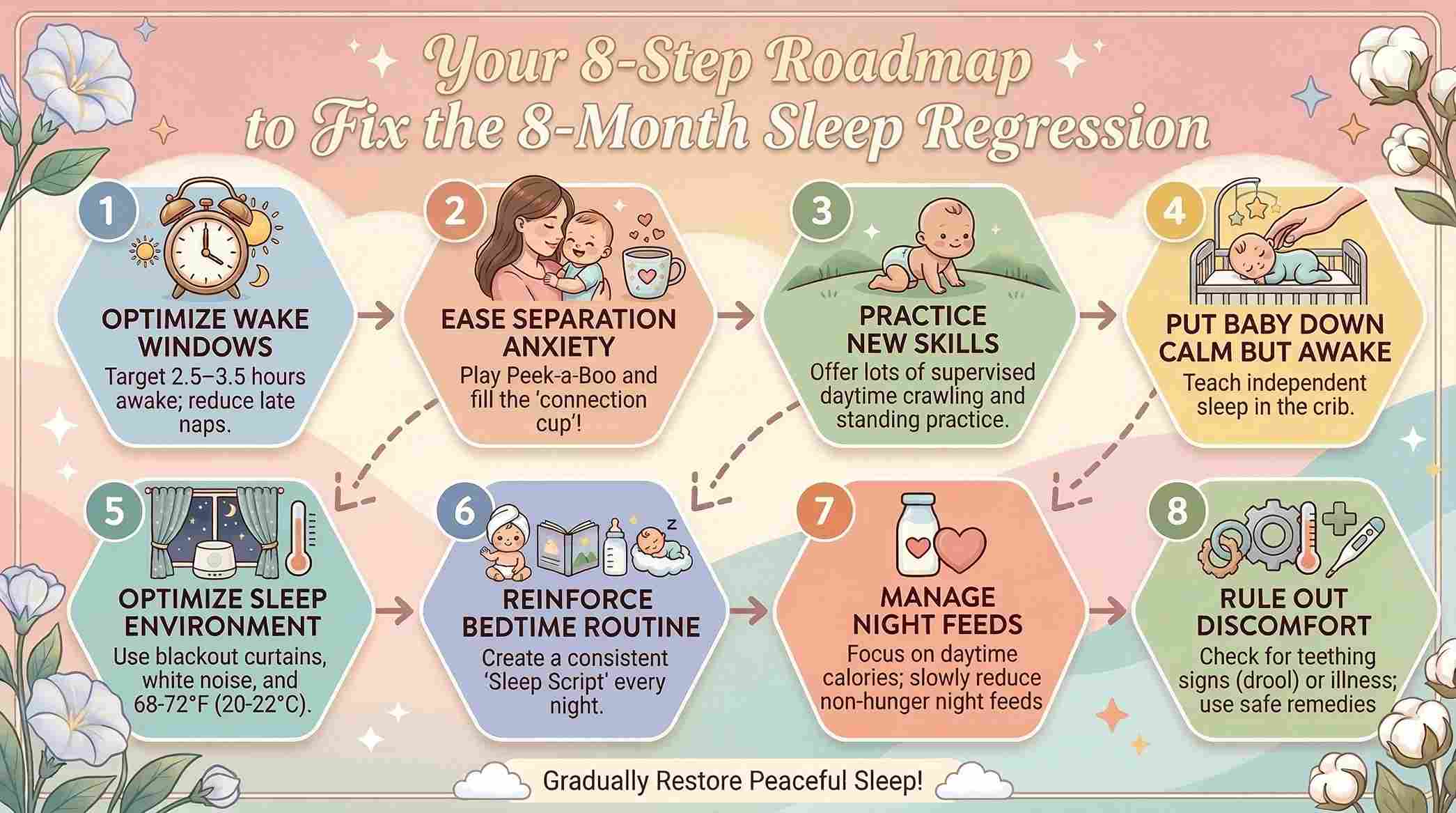
This 8 step plan addresses major developmental shifts and promotes self-soothing through consistent routines and a secure environment.
Important: Follow the following plan consistently for 2 to 3 weeks to see meaningful improvements. Sleep regressions resolve gradually as your baby’s brain and body adapt.
Step 1: Optimize the Day to Fix the Night
The Fix:
- The 3-to-2 Nap Transition: Most babies at this age are ready to drop their third nap. Keeping that late-afternoon “catnap” often steals sleep from the night.
- Stretch the “Wake Windows”: Aim for 3–4 hours of awake time between sleeps. This builds enough “sleep pressure” for your baby to stay asleep longer. Below, we have shared an 8-month-old sleep schedule with a focus on two naps.
- The 4:00 PM Cutoff: Ensure the second nap ends by 3:30 PM or 4:00 PM. This creates a “buffer” that makes falling asleep at bedtime much easier.
Struggling with the Nap? Check out our Complete Guide to the 3-to-2 Nap Transitionto find the perfect wake windows for this age.
Step 2: Navigate Separation Anxiety (Connection Strategy)
Around 8 months, babies often start experiencing separation anxiety. This happens because they now understand object permanence—they know you exist even when you are not in sight.
When you leave the room, they realize you’re gone and may feel scared or upset, often leading to more frequent night wakings as they seek comfort and reassurance.
The Fix:
- Boost Daytime Connection: Spend extra one-on-one time during the day, focusing on cuddles and positive interaction. A baby with a full “connection cup” is less likely to panic when you leave at night.
- The Peek-a-Boo Principle: Before bedtime, play simple games like “peek-a-boo” where you leave and come back quickly. This teaches your baby that you always return and helps them sleep independently.
Step 3: Manage the New Skills with Daytime Practice
When babies learn to crawl or stand, they often do it in their sleep! They wake up, practice, and then cry because they can’t figure out how to get back down, This can cause repeated night wakings.
The Fix:
- Practice, Practice, Practice: Let your baby practice new skills like standing and crawling a lot during the day with your supervision. Daytime practice helps them learn safely, build confidence, and use up energy, so they’re less likely to wake at night to try new skills.
- Nighttime Rule: If they stand and cry at night, calmly put them back down without talking or cuddling, then immediately leave the room. This teaches them that nighttime is for sleeping, not for practicing.
Step 4: Reinforce Independent Sleep
The goal is to help your baby learn to fall asleep independently, without needing your physical presence, which can also reduce frequent night wakings.8, 9
The Fix:
- Calm but Awake: Put your baby in the crib when they are calm and relaxed, but fully awake, both for naps and bedtime.
- The Pause Rule (1–5 Minutes): If your baby stands up and cries, do not rush in to lay them down immediately. Give them a few minutes to figure it out themselves. It is giving the brain a chance to connect sleep cycles.
- The “Check and Console” Method: If the pause does not work, go in to offer reassurance. Keep the lights off and use “Low-Intervention” soothing: a gentle hand on the chest or a soft “shhh.” Try to soothe them in the crib. This sends the message: “You are safe, but it is still time for sleep.”
- Use Increasing Intervals: Do not rush in at the first sound. Strategically increase your wait times. For example: you might wait 5 minutes, then 8 minutes, then 10 minutes, and so on. Consistency is the “magic ingredient.”
- Avoid New Sleep Crutches: Do not start new, big habits (like rocking for an hour or adding extra night feeds) that you do not want to continue. Consistency is better than a quick fix.
Step 5: Optimize the Sleep-Friendly Room
A calm, safe, and comfortable sleep space helps your baby settle more easily and stay asleep longer. At 8 months, as your baby becomes more mobile, safety is more important than ever.
The Fix:
- As per the CDC and AAP Safe Sleep Guidelines: Always keep the crib mattress firm and flat. Ensure the sleep surface is covered only by a fitted sheet with no blankets, pillows, quilts, or bumpers.10,11
- The Lowest Mattress Setting: Since most 8-month-olds are now pulling to a stand, ensure your crib mattress is at its lowest position to prevent your baby from climbing or falling out during their “Crib Gym” practice.
- Control the Climate: Maintain a cool, comfortable room temperature between 20–22°C (68–72°F). Overheating can disrupt sleep and is a safety risk.
- Keep it dark: Use blackout curtains and dim lights 30–60 minutes before bedtime.
- Reduce noise: Use white noise or close doors and windows to block household sounds.
Step 6: Stick to the Bedtime Routine
Consistency is your best friend right now. A simple, repeated routine helps your baby feel safe, reduces separation anxiety, and can lead to fewer night wakings.
The Fix:
- Follow the Sleep Script: Do the same bedtime routine every night: Bath → Massage → Feeding → Lullaby → Sleep. This tells your baby’s brain it’s time to sleep.
- The Travel Rule: Your routine is non-negotiable! Even on vacation or at Grandma’s house, mimic the steps as closely as possible to provide comforting familiarity during an unsettling time.
Step 7: Manage Night Feeding
A healthy 8-month-old typically does not need frequent nighttime feedings. If they wake up to eat, it’s usually more about habit or seeking comfort than an actual need. Always consult your pediatrician if you have concerns about your baby’s weight or feeding.
The Fix:
- Load the Calories: Give them plenty of food during the day. Make sure they eat well right before bed.
- The Gradual Reduction Strategy: If they wake up to eat, slowly give them less milk or feed them for a shorter time over several nights. This helps stop the habit of eating to fall asleep.
Step 8: Address Discomfort
Teething or minor illnesses can disturb your baby’s sleep around 8 month, causing frequent wake-ups and frustration for both you and your little one.
The Fix:
- Pre-Bed Checkup: Before bedtime, check for any signs of teething or illness that might disturb sleep.
- Soothe Teething Pain: To ease teething discomfort, use cool teething toys or a safe pain reliever, but always use the one recommended by your pediatrician. Addressing pain before sleep gives your baby a better chance of staying asleep.
If you are dealing with Teething and Sleep Regression at the same time? check: 8 Real-World Steps to Survive the ‘Double Disruption’.
8-Month-Old Sleep Schedule (Two-Nap Focus)
Use this chart as a flexible guide, not a strict rule. Always prioritize your baby’s unique sleep cues over the clock!
Time Range (Flexible) Activity Wake Window (Approx.) Nap Duration (Approx.) Notes 6:30 AM – 7:30 AM Wake Up & First Feed 2.5 hours — Longer wake window starts the day; expose baby to bright light. 9:00 AM – 10:00 AM Morning Nap 1 2.5–3 hours 1–1.5 hours This is the first of two critical naps; ensure a dark environment. 11:00 AM – 12:00 PM Feed & Play 3–3.5 hours — Use this window for solids, floor time, and active play. 1:30 PM – 2:30 PM Midday Nap 2 3–3.5 hours 1–1.5 hours The second and final nap. Focus on maximum sleep consolidation. 3:30 PM – 4:30 PM Feed & Play 3.5–4 hours — Last wake window is the longest, necessary for building night sleep pressure. 7:00 PM – 7:30 PM Bedtime Routine 20–30 mins — Start the routine 3.5-4 hours after Nap 2 ended (e.g., if Nap 2 ended at 3 PM, start routine at 6:30 PM). 7:30 PM – 8:30 PM Night Sleep Begins — 11–12 hours total Most 8-month-olds can sleep through the night with minimal or no feeds.
Beyond the Basics: When You Need a Structured Path
If you have followed the 8-step roadmap consistently for 2–3 weeks and your baby is still struggling to connect sleep cycles, you aren’t doing anything “wrong.” Some babies simply require a more structured approach to bridge the gap between developmental milestones and independent sleep.
At this stage, introducing a gentle, evidence-based sleep training method can provide the clarity your baby needs to solidify their self-soothing skills.
Our Top Recommendation: The TRUST Method
We recommend the TRUST Method for families navigating the 8-month storm. It is a gentle, evidence-based system designed to honor separation anxiety while building sleep independence.
Why it works:
- T — Teach “I Always Return”: Use daytime Peek-a-Boo to eliminate separation anxiety.
- R — Routine = Security: Follow a Fixed Sequence (Bath → Story → Crib) to signal sleep.
- U — Use “Gentle Sleep Methods”: Use Brief, Non-Rescuing Checks (5, 7, 10 min) for comfort.
- S — Secure the Sleep Space: Ensure a Dark, Cool, and Quiet environment for deep rest.
- T — Time to Practice Alone: Place your baby in the crib Awake to build self-soothing skills.
Explore our guide: The TRUST Method for Sleep Regression: Gentle Solutions (4 Months – 4 Years) to Stop Night Wakings.
Parental Self-Care: You Matter Too
Sleep regressions can be stressful for everyone. You are not failing; you are navigating a temporary, normal developmental change. Taking care of yourself is just as important as helping your baby sleep.
Here are some practical ways to protect your rest and mental well-being:
- Nap when your baby naps – even short naps can make a big difference.
- Share night duties – alternate night waking responsibilities with your partner to avoid burnout.
- Practice quick relaxation techniques – deep breathing, stretching, or a 5-minute mindfulness break can reduce stress.
- Limit caffeine – it may help temporarily, but too much can interfere with your own sleep schedule.
- Accept help – let family or friends assist with chores, meals, or babysitting so you can rest.
👉 Remember: your well-being directly supports your baby’s sleep. A calm, rested parent makes nighttime transitions easier.
What NOT to Do During Sleep Regression
Avoid common mistakes that can make sleep patterns even more inconsistent.
- Frequent schedule changes: Constantly shifting bedtime or naps confuses your baby.
- Comforting every cry: Rocking or feeding every time stops them from learning to self-soothe.
- Overstimulation before bed: Too much play, bright lights, or screens makes it harder to wind down.
- Skipping naps: Missing daytime sleep can lead to overtiredness and more night waking.
- Forgetting it’s temporary: Sleep regression is normal and short-term—don’t stress or change routines unnecessarily.
- Ignoring the environment: Noisy, bright, or warm rooms can disrupt sleep.
Sleep Regression Quick Comparison (4 vs 6 vs 8 Months)
Feature 4-Month Regression 6-Month Regression 8-Month Regression Primary Cause Permanent change in sleep cycles (brain maturation). Developmental leaps (rolling, sitting) and schedule instability. Separation anxiety and major mobility practice (crawling, pulling up). Nap Schedule Focus Transitioning to a predictable 3-4 nap schedule. Consolidating and protecting the 3-nap schedule. Firmly establishing the 2-nap schedule. Ideal Wake Window Short: 1.5 – 2 hours Medium: 2 – 3 hours Long: 2.5 – 3.5 hours Night Waking Fix Establishing independent sleep (drowsy but awake). Schedule consistency & optimizing daytime calories. Use gentle reassurance to ease separation anxiety.
When to Contact a Pediatrician
Most sleep regressions are completely normal and resolve on their own. However, consult your pediatrician if you notice any of the following red flags:12
- Poor growth or feeding issues: Your baby is not gaining weight or is refusing to eat adequately.
- Signs of illness: Fever, severe congestion, persistent ear pulling, or other concerning physical symptoms.
- Persistent sleep problems: Sleep disruptions that last longer than 6 weeks without any signs of improvement.
- Extreme Irritability: Your baby seems unusually inconsolable or displays behavior that feels “off” to you.
👉 Crucial Reminder:
If your baby is sleeping poorly but is otherwise happy, feeding well, and does not have a fever, you are most likely dealing with a normal developmental sleep regression. Address the developmental causes first. However, if you spot any of the red flags above, seek medical advice immediately.
Takeaway
The 8-month sleep regression is tough, but it is a positive sign of healthy growth and cognitive development. These disruptions are typically caused by a combination of strong separation anxiety and the baby’s brain being “on fire” while learning new physical milestones like crawling or pulling up.
This excitement and development often lead to a “Cortisol Crash”—where the body produces stress hormones that make it hard for your baby to settle or stay asleep.
To get through this storm, patience and consistency are key. Stick to a predictable bedtime routine, offer gentle reassurance, and create a calm, sleep-friendly environment. By following this 8-step roadmap, you are helping your baby feel secure as they navigate these big changes.
Stay the course—this phase is temporary, and these steps will help your baby gradually return to more restful sleep.
Frequently Asked Questions (FAQ) about Sleep Regression
Q1. Does every baby go through an 8-month regression?
No, some babies skip noticeable regressions, while others show clear disruptions. Most show temporary sleep changes at this age.
Q2. How much sleep should my 8 month old get?
An 8-month-old baby typically needs about 12 to 15 hours of total sleep in 24 hours. This includes both nighttime sleep and daytime naps. Most babies at this age sleep around 11 to 12 hours at night, though brief night wakings can still occur.
Q3. How much daytime sleep does an 8-month-old need?
At 8 months, most babies take 2 naps per day, although some may still have 3 shorter naps depending on their schedule.
Typical daytime sleep includes:
- Around 2 to 3 hours of total nap time per day
- Wake windows of about 2.5 to 3.5 hours between naps
Q4. Should I keep night feeds during the 8-month regression?
Feed if your baby is genuinely hungry. Try to avoid turning every wake into a full feeding if the baby is only seeking comfort.
Q5. Can sleep training make regressions worse?
Harsh or inconsistent methods can increase stress. Gentle, consistent sleep training tends to shorten the regression’s impact.
Q6. Will my baby eventually return to normal sleep?
Yes—most babies return to regular sleep patterns with consistent routines and gentle training. This phase is temporary and developmentally normal.
Q7. Is it the 8 month sleep regression or teething?
It is often both! Signs of the 8-month sleep regression and teething (like drooling or swollen gums) frequently overlap. While the regression is a cognitive shift, teething discomfort can worsen nighttime wakes. Addressing pain before bed is crucial for a better night’s rest.
Q8. When does the 8 month sleep regression start and end?
The regression typically starts between 7 and 9 months and usually lasts between 2 to 6 weeks. Consistency is the fastest way to get through it.
Q9. Why is my 8 month old waking multiple times at night?
The primary causes are a combination of separation anxiety (realizing you’ve left the room), practicing major developmental milestones (like standing or crawling), and overtiredness from a poor daytime schedule. These factors disrupt the normal sleep cycle, causing them to cry out for you.
References
📚 Show References
- Galland BC, Taylor BJ, Elder DE, Herbison P. Normal sleep patterns in infants and children: a systematic review of observational studies. Sleep Med Rev. 2012 Jun;16(3):213-22.
Available from: View Source
- Reichert CF, Maire M, Schmidt C, Cajochen C. Sleep-Wake Regulation and Its Impact on Working Memory Performance: The Role of Adenosine. Biology (Basel). 2016 Feb 5;5(1):11. Available from: View Source
- Wong SD et al. Development of the circadian system in early life. J Physiol Anthropol. 2022;41(1):22. Available from: View Source
- Brum MCB et al. Effect of night-shift work on cortisol circadian rhythm. Sleep Sci. 2022;15(2):143-148. Available from: View Source
- Adolph KE, Franchak JM. The development of motor behavior. Wiley Interdiscip Rev Cogn Sci. 2017. Available from: View Source
- Feriante J et al. Separation Anxiety Disorder. StatPearls Publishing. View Source
- Lampl M, Johnson ML. Infant growth in length follows prolonged sleep. Sleep. 2011;34(5):641-50. Available from: View Source
- Field T. Infant sleep problems and interventions: A review. Infant Behav Dev. 2017. Available from: View Source
- Adachi Y et al. Parental education for infant sleep habits. Clin Med Res. 2009. Available from: View Source
- CDC. Helping Babies Sleep Safely (2024). Available from: View Source
- American Academy of Pediatrics. Safe Sleep Recommendations (2022). Available from: View Source
- Gemke RJBJ et al. Sleep disorders in children: review Eur J Pediatr. 2024. Available from: View Source
