

Managing ADHD transition difficulties in kids is one of the biggest challenges parents face. Whether it’s leaving the park, turning off a favorite game, or moving from screen time to homework, even simple shifts can turn into daily battles.
It often starts with a simple request: “Five more minutes, then we are leaving.” But for the ADHD brain, that is not a gentle warning; it’s a countdown to a meltdown. The question is why?
To outsiders, it may look like misbehavior. In reality, your child’s brain is locked into a high-dopamine activity and physically struggles to shift gears. This is not a lack of discipline—it’s biology.
If you have ever felt stuck in these battles, you are not alone. In this post, you will learn the science behind why transitions are so hard for kids with ADHD and five expert-backed strategies to help your child shift gears with greater ease.
🕒 Quick Summary: ADHD & Transitions
Short on time? Here’s your quick-start guide to managing ADHD transition struggles:
- The Cause: It’s not defiance; it’s neurological. The ADHD brain struggles with shifting gears because of executive function delays and a sudden dopamine drop when fun ends.
- The Secret: Do not just stop the activity—bridge it. Moving from high‑stimulation (games) to low‑stimulation (homework) requires a mental ramp.
Top 3 Tools:
- Visual Timers – Make time visible so it does not feel like a surprise.
- The Dopamine Bridge – Spend 2 minutes joining their world before asking them to leave it.
- Choices – Give them control to bypass the power struggle. Instead of “Time for bed,” ask: “Brush teeth first, or pajamas first?”
🧠 Why Are Task Transitions So Hard for Children with ADHD
To understand why ADHD transitions are so difficult, we need to look inside the ADHD brain.
1. Executive Function Delays
ADHD is often described as a developmental delay in executive function—the brain’s control center in the prefrontal cortex. This region manages focus, impulse control, emotional regulation, and task switching.
Research confirms that children with ADHD show measurable deficits in executive function compared to peers.1 Experts such as Dr. Russell Barkley estimate about a 30 percent developmental lag in these skills.2
In practical terms, executive function in ADHD may develop two to three years more slowly.3,4,5 This explains why children with ADHD often struggle with transitions long after their peers have mastered them.
For example, a 6-year-old with ADHD may think like their peers but regulate impulses more like a 4‑year‑old. Therefore, everyday tasks like waiting, stopping play, or sitting for a snack take extra effort.
2. The Dopamine Drop
Another reason task transitions feel so hard is the ADHD brain’s relationship with dopamine—the chemical linked to motivation, focus, and reward.
When a child is deeply engaged in a high-interest activity, dopamine levels rise. However, when that activity suddenly ends, dopamine can drop quickly. This sharp shift may leave the child feeling irritable, restless, or emotionally overloaded.
Research shows that differences in dopamine regulation play a central role in ADHD motivation and hyperfocus.6
For example, a child who appears calm and focused during a video game may suddenly become explosive when asked to stop. This reaction is not just about “wanting to play more”—it reflects the brain’s struggle to shift from a high-stimulation state to a low-stimulation task (like dinner or homework) without a chemical bridge.
3. Emotional Regulation Challenges
Children with ADHD often experience delayed emotional regulation. Brain regions that manage frustration and flexibility mature at a different pace, which makes emotions feel bigger and harder to control.
Studies consistently show that children with ADHD have greater difficulty regulating emotions compared to their peers.7 Research also suggests that emotional impulsivity is a core feature of ADHD, not just a secondary problem. Therefore, emotional outbursts during transitions are often neurological, not intentional.
For example, when a preferred activity ends, the child is not simply disappointed. They may feel a sudden surge of frustration or anger. In a neurotypical brain, the prefrontal cortex acts as a brake system to slow down that emotion. In the ADHD brain, the brakes are still being built, making it nearly impossible to pause and respond calmly.
4. Time Blindness
Time blindness is a hallmark of ADHD. It refers to a neurological difficulty in sensing and managing the passage of time—a concept researchers call temporal processing.
Research shows that children with ADHD often struggle with time perception, which directly impacts their ability to prepare for transitions.8
Because they are often in a state of “now” or “not now,” a “five-minute warning” feels abstract and unreal. When the transition finally arrives, it feels sudden and unfair, which intensifies their resistance.
For example, a child may feel like they have only been playing for a few minutes when an hour has already passed. Without a reliable internal clock, even well-intended warnings fail to prepare the brain for change. It isn’t that they are ignoring the clock; it’s that their brain isn’t “reading” it.
✨ 5 Practical Strategies to Make ADHD Transitions Smoother in Kids
Understanding the ‘why’ is the first step. The second is using evidence-based strategies to reduce meltdowns and help your child shift gears with less resistance. These tools bridge the gap between neuroscience and practical parenting.
1. Create a “Dopamine Bridge”

Since the dopamine drop is the main cause of meltdowns, do not stop the fun activity immediately. Instead, create a small bridge.
- The Action: If your child is playing a video game, spend 2 minutes talking about the game or their progress before asking them to stop.
- The Result: This keeps dopamine flowing while their brain prepares to shift, preventing a neurochemical crash.
2. Use “Visual” Warnings, Not Verbal Ones
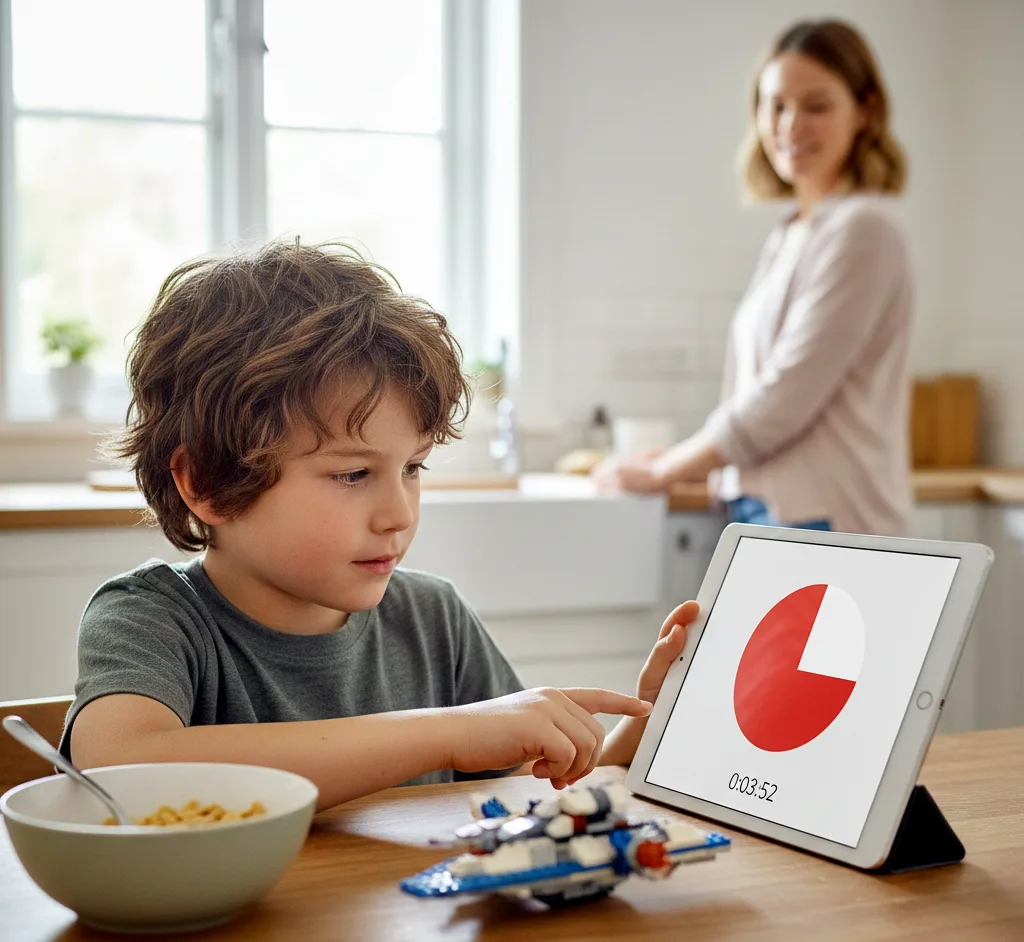
Children with ADHD often struggle with time blindness. Verbal warnings like “five minutes” feel abstract and hard to grasp. Instead, swap words for visual cues.
- The Action: Use a countdown clock or a visual timer app where a red disk shrinks as time passes.
- The Result: Watching time “disappear” makes transitions feel fair, predictable, and less stressful.
3. Implement the “Touch and Reconnect” Rule

Transitions work best when your child is fully paying attention.
- The Action: Get on their level, gently place a hand on their shoulder, and wait for eye contact. Then, speak in a calm, low voice. Make sure your child is focused on you before starting the transition.
- The Result: This physical “reconnection” breaks the hyperfocus loop safely and lowers the chance of a meltdown.
4. Offer “The Transition Choice”

Kids with ADHD often resist commands, but they respond better when given choices.
- The Action: Instead of saying, “Time to get ready for bed,” ask: “Do you want to brush your teeth first or put on your pajamas first?”
- The Result: The bedtime routine feels less like an order and more like a choice. Your child feels more in control, so the transition becomes smoother and calmer.
5. Use “Routine Anchors”

Kids with ADHD do better when transitions are predictable. Predictable rituals help ADHD brains know what’s coming next.
- The Action: Read the same short story each night before bed, or play a favorite song in the car every time you leave the park.
- The Result: These routines give your child something positive to expect, making the transition feel less sudden and more comforting.
Practical Tips for Parents Managing ADHD Transitions in Kids
If you are in the middle of a busy day, keep these “Quick Wins” in mind to de-escalate tension and help your child move smoothly from one activity to the next.
- Give a 2-minute visual warning before transitions.
- Use a consistent “transition song” or ritual.
- Offer small choices during tasks.
- Keep instructions calm, short, and clear.
- Acknowledge feelings: “I know it’s hard to stop playing.”
- Pair movement with transitions: hop, jump, or walk to the next activity.
- Praise success: “Great job moving from play to homework”.
Key Takeaway
ADHD transition difficulties are not a parenting failure or a character flaw in your child. They reflect how the ADHD brain handles change, stimulation, and emotional regulation.
When a child resists leaving the park or melts down at homework time, the issue is rarely stubbornness. It’s usually a nervous system that needs more time, structure, and support to shift gears.
Core steps to make transitions smoother:
- Prepare the brain with visual cues and clear warnings.
- Reduce surprises with predictable routines.
- Bridge high-energy activities with short “reset” moments.
- Stay calm and validate big feelings.
Progress may be gradual, but over time, these small adjustments build real skills. With consistency and understanding, your child can handle change with greater confidence—and you can find more peace in your daily routine.
Frequently Asked Questions (FAQ) About ADHD Transition Difficulties in Kids
Q1. Why do kids with ADHD struggle with transitions?
Transitions require stopping one task, shifting attention, regulating emotions, and starting something new. ADHD affects executive function skills that manage this process, so even small changes like moving from play to dinner can feel overwhelming.
Q2. At what age do ADHD transition problems become noticeable?
Many parents notice struggles in preschool or early elementary years. Challenges often become more obvious as school routines, homework, and structured schedules increase the mental demand on a child.
Q3. How long do ADHD transition meltdowns usually last?
It varies by child. Some last a few minutes, while others continue longer if the child feels rushed or misunderstood. Consistent routines and visual supports are the best way to shorten these durations over time.
Q4. Do visual timers help ADHD kids with transitions?
Yes. Visual timers make time concrete. Because many children with ADHD struggle with “time blindness,” seeing a physical countdown helps them mentally prepare for change and reduces the “shock” of the transition.
Q5. Should I give consequences for transition meltdowns?
Consequences alone rarely solve the problem because the root issue is neurological, not a lack of discipline. Instead, focus on preparation and emotional support. When the brain feels supported and the transition is structured, behavior usually improves naturally.
Q6. Why are transitions from fun activities the hardest?
Fun activities release dopamine, which boosts motivation. When that activity ends, dopamine levels drop sharply. The brain resists switching to a “boring” task like homework because it is physically craving that stimulation.
Q7. Can ADHD transition difficulties improve over time?
Yes. With consistent routines and supportive strategies, children can strengthen their executive function and emotional regulation. While transitions may never be effortless, they can certainly become a smooth, manageable part of your day.
Q8. Do transitions affect school performance for kids with ADHD?
Yes. Difficulty shifting between subjects, activities, or classroom routines can impact focus and learning. Teachers often notice challenges during transitions like moving from recess to classwork or switching between assignments.
Q9. How can parents prepare their child for transitions outside the home?
Transitions in public places, like leaving the park or finishing a playdate, can be especially tough. Using consistent cues such as a “transition song,” a countdown timer, or a predictable goodbye ritual helps children feel prepared and reduces resistance.
Q10. Can therapy or professional support help with ADHD transitions?
Yes. Behavioral therapy, parent coaching, and occupational therapy can provide tools to strengthen executive function and emotional regulation. Professional guidance often helps families create personalized routines that make transitions smoother.
References
📚 Click to view references
- Deshmukh MP, Khemchandani M, Thakur PM. Exploring role of prefrontal cortex region of brain in children having ADHD with machine learning: Implications and insights. Appl Neuropsychol Child. 2026 Jan-Mar;15(1):71-83. View Source
- Barkley, R. A. (2012). This is how you treat ADHD based on science. Keynote lecture at the 2012 Burnett Seminar. View Source
- National Institute of Health (NIH). (2014, September). Focusing ADHD: How the Brain Manages Attention. View Source
- Shaw P, Eckstrand K, Sharp W, et al. Attention‑deficit/hyperactivity disorder is characterized by a delay in cortical maturation. Proc Natl Acad Sci U S A. 2007. View Source
- Sadozai, A.K., Sun, C., Demetriou, E.A. et al. Executive function in children with neurodevelopmental conditions: a systematic review and meta-analysis. Nat Hum Behav 8, 2357–2366 (2024). View Source
- Blum K, Chen AL, Braverman ER, et al. Attention-deficit-hyperactivity disorder and reward deficiency syndrome. Neuropsychiatr Dis Treat. 2008 Oct;4(5):893-918. View Source
- Antony EM, Pihlajamäki M, Speyer LG, Murray AL. Does emotion dysregulation mediate the association between ADHD symptoms and internalizing problems? J Child Psychol Psychiatry. 2022 Dec;63(12):1583-1590. View Source
- Wennberg B, Janeslätt G, Kjellberg A, Gustafsson PA. Effectiveness of time-related interventions in children with ADHD aged 9-15 years: a randomized controlled study. Eur Child Adolesc Psychiatry. 2018 Mar;27(3):329-342. View Source
