
Written by: MediHealth PRO Editorial Team
Scientifically Reviewed by: Dr. Amit Pande, PhD
Molecular Biologist & Independent Scientific Advisor
Medically Reviewed by: Dr. Arghyadeep Marik, MD
Independent Medical Reviewer, MediHealth PRO
A baby who wakes up again and again at night can be exhausting and frustrating for any parent. A 4-month-old may suddenly start waking every few hours, while a 2- or 3-year-old may begin battling bedtime. But these sudden shifts do not always mean a child has developed a bad sleep habit or has an underlying health problem.
As a child grows, the brain and sleep patterns continue to develop. New developmental skills, shifting sleep cycles, separation anxiety, and an evolving body clock can all temporarily disrupt nighttime sleep. These phases are often grouped together under a single label: sleep regression.
But sleep regression is not just one thing. Several developmental processes in the brain and body contribute to these changes, and they vary depending on a child’s age. This post explores why babies and toddlers wake up at night, how brain development shapes sleep, and how developmental changes influence sleep patterns over the early years.
Why Babies Wake Up at Night (Quick Answer)
Babies and toddlers may wake up more often at night because their brains are developing, new skills are emerging, sleep cycles are changing, and their internal body clock (circadian rhythm) is still taking shape. These changes are often described as sleep regression and can lead to more frequent night waking, shorter naps, and bedtime resistance at different stages between 4 months and 4 years. Teething and changes in feeding or routines can also temporarily affect sleep.
Why Babies Wake Up at Night During Sleep Regression
The main reason babies wake more often during these periods is that sleep itself is changing as the brain matures. Below are the five mechanisms that explain this.
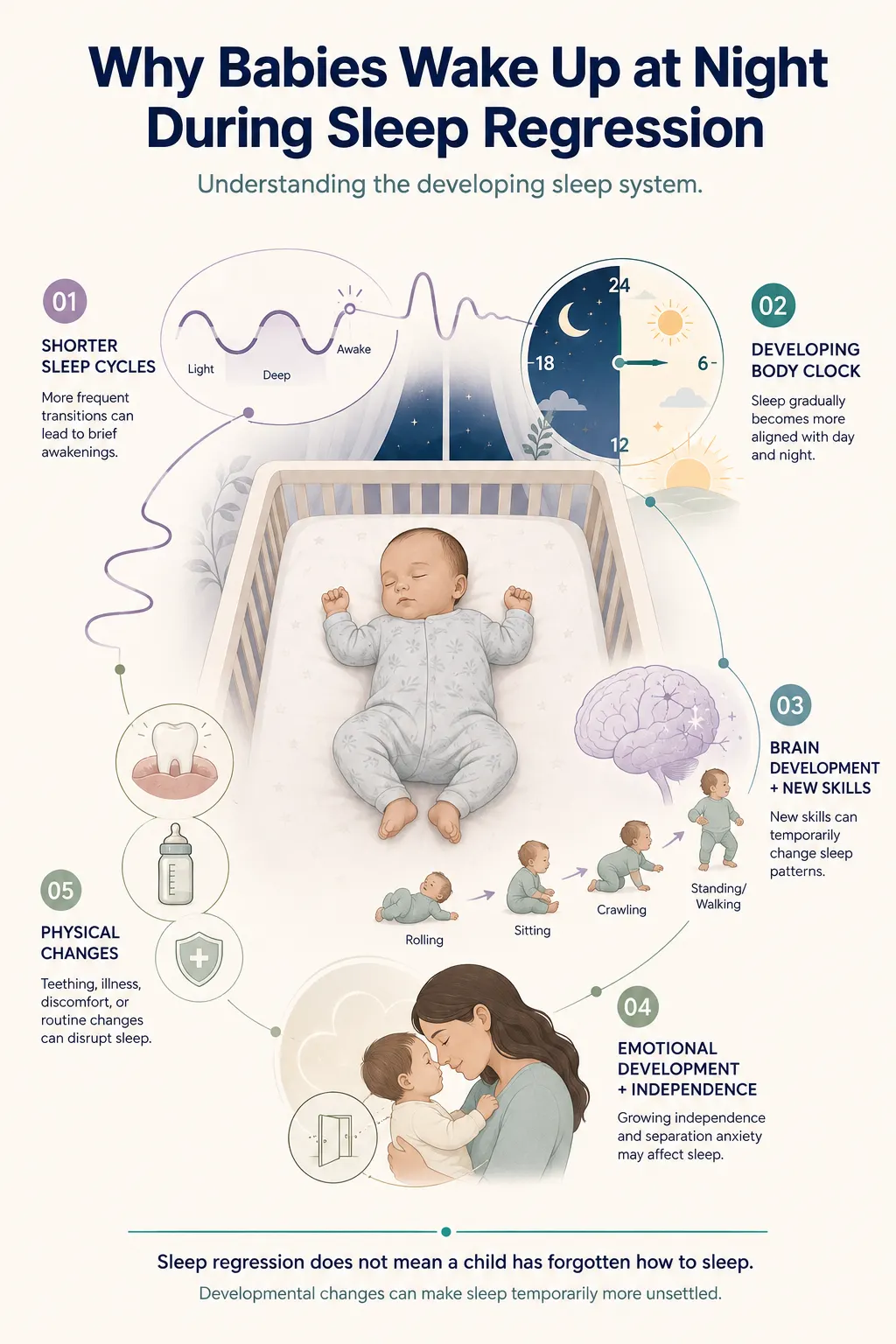
1. Shorter Sleep Cycles and Nighttime Awakenings
Babies do not sleep in the same way as older children or adults. Their sleep cycles are shorter, with more frequent transitions between lighter and deeper sleep. This pattern shifts as sleep becomes more organized during the early years of life.1
These transitions can lead to brief awakenings. The ability to return to sleep after waking also develops over time, so some babies may fully wake between sleep cycles rather than settling back to sleep on their own.
2. The Circadian Rhythm and the Body Clock
A baby’s internal body clock, known as the circadian rhythm, helps regulate when a baby feels sleepy and when they are alert. In newborns, this system is not yet established, so sleep is spread across both day and night.
As the circadian rhythm strengthens during the first few months, sleep becomes more strongly linked to the day-night cycle.2 While this rhythm is taking shape or temporarily changes during a period of rapid development, a baby may wake more often at night or have difficulty settling back to sleep.
This is one reason sleep can become less predictable during a sleep regression. A baby may still be capable of sleeping for longer periods, but the timing of sleep and wakefulness is shifting as the brain and body change.
3. Brain Development and Changing Sleep Patterns
During infancy and early childhood, the brain is constantly developing. As babies learn new skills, such as rolling, sitting, crawling, standing, walking, and communicating, they also become more aware of the world around them. All of these changes can temporarily affect sleep.
The brain is also developing the systems that help regulate sleep, wakefulness, emotions, and responses to new experiences. As these abilities develop, a child who was easy to settle may suddenly take longer to fall asleep, wake more often during the night, or need extra reassurance to return to sleep.
4. Emotional Development and Growing Independence
As children grow, they become more aware of their parents, caregivers, surroundings, and their own preferences. This emotional development is an important part of early childhood but can sometimes affect sleep.
Separation anxiety, increased independence, stronger preferences, and a growing desire to explore may contribute to bedtime resistance or more frequent night waking, especially during the toddler years. These changes can occur alongside developmental milestones that children reach as they grow.3
5. Physical Changes That Can Disrupt Sleep
Developmental periods can also overlap with temporary physical changes that affect sleep. Teething, illness, changes in hunger, growth-related discomfort, or adjustments in feeding and daily routines may lead to more frequent waking.
The American Academy of Pediatrics notes that teething can cause gum discomfort during infancy.4 These physical factors can add to sleep disruption but are not necessarily the main reason behind a sleep regression.
Sleep Regression Timeline: What to Expect at Each Age
Sleep changes do not follow a single pattern. At different ages, developmental milestones, changing sleep needs, circadian rhythms, and emotional development can influence how a child sleeps.
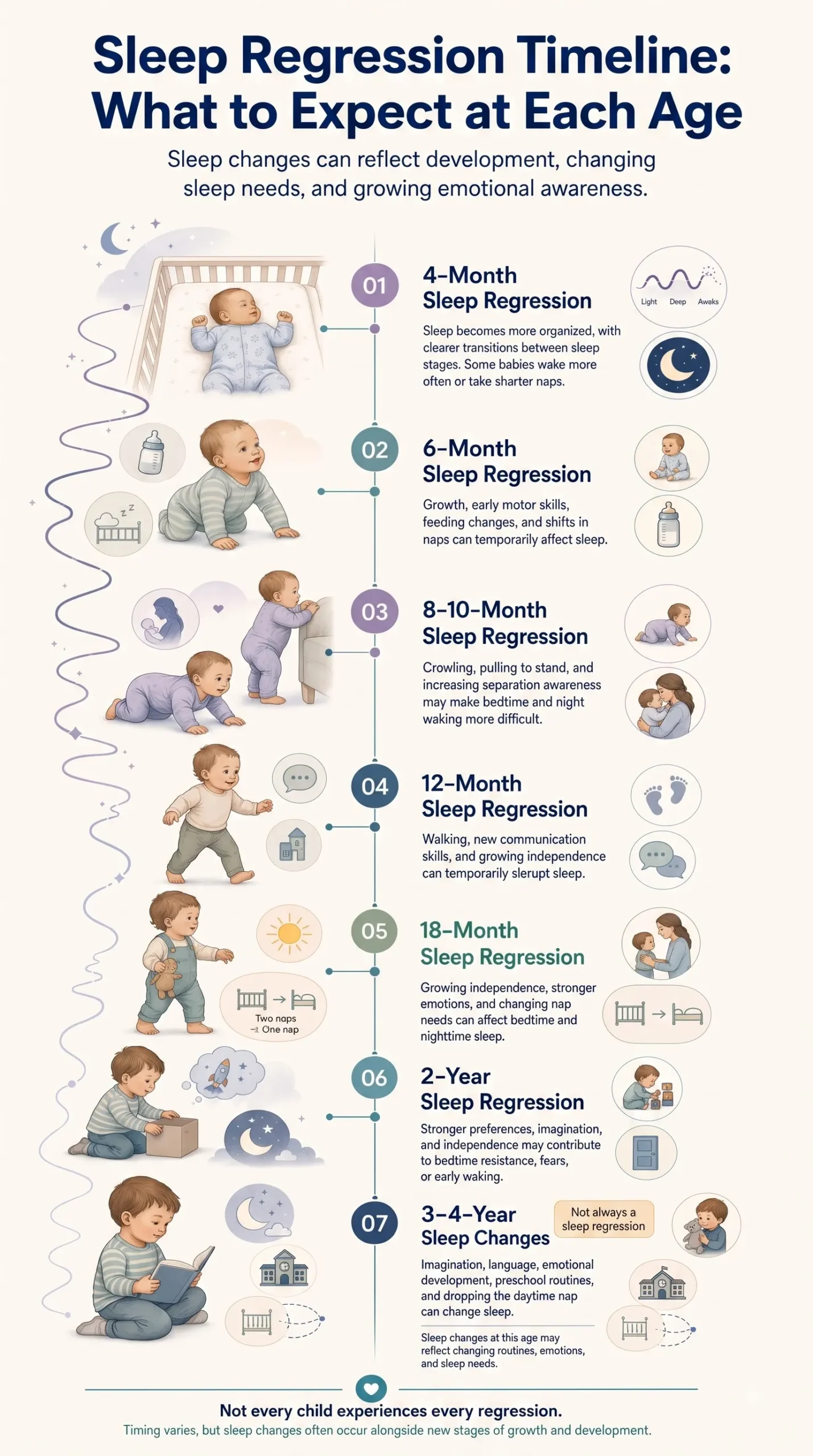
4-Month Sleep Regression
This is often the first regression parents notice. Around this age, a baby’s sleep becomes more organized, with clearer transitions between lighter and deeper sleep stages.
This change can lead to more frequent night waking and shorter naps as the baby adjusts to the new sleep structure.
Learn more in our 4-month sleep regression guide.
6-Month Sleep Regression
At this stage, growth, early motor milestones such as rolling and sitting, and changes in feeding patterns may affect sleep. Some babies may also experience shifts in their nap schedule (3-to-2 Nap Transition), which can temporarily influence nighttime sleep.
Learn more in our 6-month sleep regression guide.
8 to 10 Month Sleep Regression
This regression often overlaps with crawling, pulling up to stand, and increasing separation awareness.
At this age, babies may notice more clearly when a parent leaves the room. This can make it harder for them to settle at bedtime or fall back asleep after waking during the night.
Learn more in our 8 to 10 month sleep regression guide.
12-Month Sleep Regression
Around the first birthday, many babies are learning to walk, communicate more, and explore their independence. These developmental changes can temporarily disrupt sleep.
Learn more in our 12-month sleep regression guide.
18-Month Sleep Regression
This stage is closely linked with growing independence and stronger emotional awareness. Toddlers may resist bedtime, test limits, and wake at night seeking comfort or connection.
Some children also begin transitioning from two naps to one, affecting their daily sleep pattern. Language development and increased mobility can also influence sleep during this period.
Learn more in our 18-month sleep regression guide.
2-Year Sleep Regression
Around age two, toddlers develop stronger preferences, imagination, and independence. These changes can contribute to bedtime battles, resistance to naps, nighttime fears, or early morning waking. If early waking becomes a regular problem, see our guide to baby and toddler early morning waking.
Not every child goes through every regression, and timing can vary from child to child. What remains consistent is that these sleep changes often reflect a developing brain and body adapting to new stages of growth and learning.
Learn more in our 2-year sleep regression guide.
3–4-Year Sleep Changes
Between ages 3 and 4, children’s imagination and emotional awareness become more complex. Nighttime fears, nightmares, or worries about being alone can sometimes make it harder to settle at bedtime or return to sleep after waking.
This stage may also coincide with dropping the daytime nap or starting preschool, both of which can change a child’s daily routine and sleep needs. These changes do not necessarily represent a sleep regression, but they can temporarily affect bedtime, nighttime sleep, or the timing of sleep.
If a child is beginning to outgrow the daytime nap, see our guide to the 1-to-0 nap transition for ages 3–5.
Signs of Sleep Regression in Babies and Toddlers
Sleep regression can look different depending on a child’s age and stage of development. Some children have more nighttime waking, while others show changes in naps, bedtime behavior, or their ability to settle back to sleep.
Common signs that a baby or toddler may be experiencing a sleep regression include the following.
- A child who previously slept longer stretches may begin waking multiple times during the night.
- Daytime naps may become shorter or more difficult as sleep patterns change.
- A child may suddenly protest bedtime, take longer to fall asleep, or need more reassurance to settle.
- Babies and toddlers may seek more parental comfort, especially during periods of separation anxiety or emotional development.
- A child’s usual sleep schedule may become less predictable during developmental transitions.
These changes are usually temporary and often occur alongside normal developmental progress. Ongoing sleep difficulties, signs of illness, or changes that significantly affect a child’s daytime behavior are worth discussing with a pediatrician.
Is It Hunger or a Sleep Regression?
When a baby starts waking more at night, it can be hard to tell whether they are hungry or going through a sleep regression. How they feed and how quickly they settle again afterward can offer useful clues.
| What to Notice | More Likely Hunger | More Likely a Sleep Regression |
|---|---|---|
| Night waking | Wakes ready to feed | Wakes more often without clear hunger cues |
| Feeding | Takes a full, eager feed | Feeds briefly or mainly seeks comfort |
| After feeding | Settles and sleeps longer | May wake again soon after settling |
| Daytime feeding | May seem hungrier than usual | Usually feeds normally during the day |
| Sleep pattern | Waking follows longer gaps between feeds | Sudden increase in night waking despite a similar routine |
These patterns can overlap. A baby may be hungry and going through a sleep regression at the same time, especially during periods of rapid growth and development. When in doubt, feeding is always a reasonable response to night waking.
How Long Do Sleep Regressions Last?
Sleep regressions are usually temporary, but there is no fixed timeline for how long they last. Many temporary sleep disruptions improve within a few weeks, although the timing can vary considerably from child to child.
How long sleep changes continue can depend on a child’s age, developmental stage, sleep needs, daily routine, and other factors affecting sleep. Teething, illness, changes in naps, or shifts in family routines may also prolong disrupted sleep.
A temporary increase in night waking does not mean a child has lost previously learned sleep skills. As children adjust to developmental changes and their sleep patterns settle, sleep often becomes more predictable again.
If sleep problems persist, worsen, or are accompanied by other symptoms, consider discussing them with a pediatrician to look for other possible causes.
How Much Sleep Do Babies and Toddlers Need?
Night waking is not always a sign that a child is getting too little sleep. What matters is the child’s total sleep over 24 hours, including naps. Sleep needs change with age, and there is a normal range rather than one exact number for every child.
| Age | Recommended Sleep in 24 Hours |
|---|---|
| 4–12 months | 12–16 hours, including naps |
| 1–2 years | 11–14 hours, including naps |
| 3–5 years | 10–13 hours, including naps |
These ranges are based on recommendations from the American Academy of Sleep Medicine. The CDC also provides the same age-based sleep ranges.5 These recommendations look at total sleep across 24 hours, so some night waking can still be normal when a child is getting enough sleep overall.
Signs a Sleep Regression May Be Improving
Sleep may not return to normal all at once. As a child adjusts to developmental changes, parents may notice small signs that nighttime sleep is becoming steadier.
Parents may notice a sleep regression easing when a few changes appear together.
- A child begins sleeping for longer stretches or wakes fewer times during the night.
- Bedtime resistance decreases, and the child settles more comfortably into the usual routine.
- Naps start returning to a pattern that better matches the child’s age and needs.
- Babies and toddlers become better at returning to sleep on their own after brief awakenings.
These changes usually happen as children adjust to new developmental stages and their sleep regulation settles. Consistent routines and calm responses can support children through these temporary changes.
How to Help Your Baby or Toddler During a Sleep Regression
Sleep regression does not mean a child has developed bad sleep habits or that previous progress is gone. During these periods, the goal is to keep sleep as familiar and predictable as possible while a child adjusts to new developmental changes.
A few simple changes can make difficult nights easier for both parents and children.
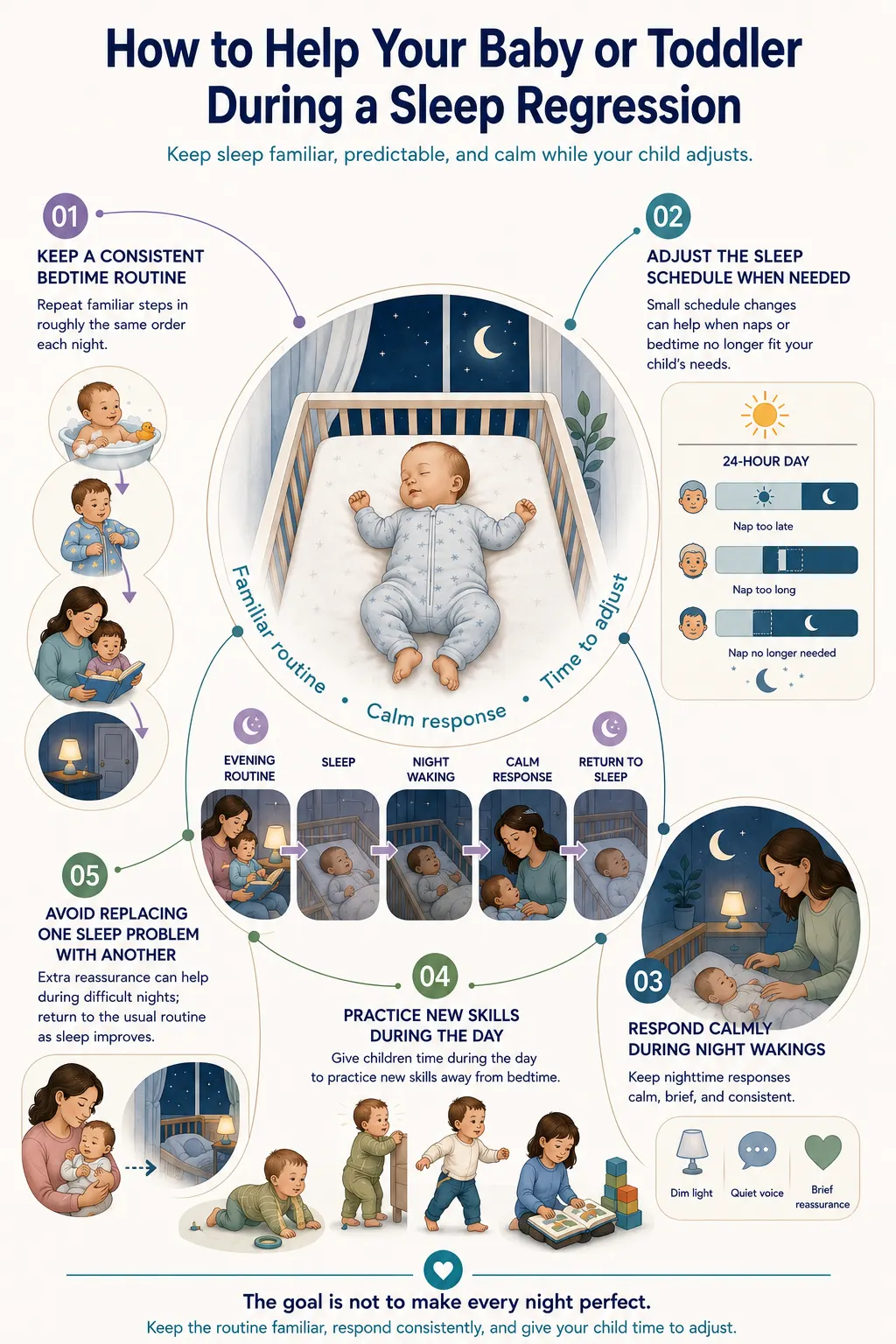
1. Keep a Consistent Bedtime Routine
A familiar bedtime routine helps a child know that it is time to wind down. Keep the steps simple and repeat them in roughly the same order each night.
For example, a bath, pajamas, a short story, and then lights out can work well. Older toddlers may also respond well to the same calming phrase each night.
The routine does not need to be long. What matters most is that it feels familiar and consistent.
2. Adjust the Sleep Schedule When Needed
A child’s sleep needs change as they grow. A nap that worked well a few months ago may now be too long, too late, or no longer needed.
When a sleep schedule no longer matches a child’s needs, parents may notice signs such as regularly refusing a nap, taking much longer to fall asleep at bedtime, or waking unusually early in the morning.
Making small schedule changes can help bring daytime sleep and bedtime back into balance.
3. Respond Calmly During Night Wakings
Night waking can be exhausting, especially when it happens several times. A calm, brief, and steady response can help.
Keeping the room dark or dim, avoiding stimulating play, and using a quiet voice can help. Give a child the reassurance they need without turning the waking into a long interaction.
For infants, always follow NICHD Safe to Sleep guidance6: place a baby on their back on a firm, flat sleep surface, and keep pillows, blankets, toys, and other loose items out of the sleep space.
4. Give New Skills Time During the Day
Babies and toddlers are constantly learning. Crawling, walking, talking, and becoming more independent can all change how a child behaves around sleep.
Giving a child plenty of safe opportunities to practice new skills during the day can help. Active play, movement, talking, reading, and age-appropriate exploration give children time to practice these skills away from bedtime.
5. Try Not to Replace One Sleep Problem With Another
When a child is waking repeatedly, it is natural to try whatever gets everyone back to sleep. Extra comfort is not a problem, and some children need more reassurance during difficult periods.
For example, if a child suddenly needs a parent to stay beside them until they fall asleep, that extra reassurance may be helpful during a difficult phase. Once sleep improves, returning to the usual bedtime routine can help the child settle more easily and prevent the temporary change from becoming a long-term sleep pattern.
The aim is not to make every night perfect. Keep the routine familiar, respond consistently, and give a child time to adjust.
When Sleep Regression May Need Medical Attention
Most sleep regressions are temporary and improve as children adjust to developmental changes. Some sleep difficulties may be linked to an underlying health issue rather than a typical developmental phase and may need medical evaluation.
Sleep problems that are persistent, worsening, or accompanied by other symptoms affecting a child’s health, breathing, or daytime functioning are worth discussing with a pediatrician.
Signs That May Need a Pediatric Evaluation
- Frequent snoring, gasping, pauses in breathing, or unusual breathing patterns during sleep.
- Unusual daytime sleepiness, difficulty waking, or trouble staying alert during the day.
- Repeated jerking, stiffening, or sleep movements that look different from a child’s usual patterns.
- Night waking or bedtime struggles that continue well past the expected timeframe or keep getting worse.
- Pain, reflux symptoms, itching, or other physical discomfort that appears to be interfering with sleep.
When to Seek Help
When it is unclear whether a child’s sleep changes are part of a regression, a pediatrician can look at the overall pattern and check for other possible causes. Keeping a simple sleep diary with bedtime, night wakings, naps, routines, and daytime behavior can help during that evaluation.
Bottom Line
Temporary sleep regressions are common in early childhood and do not necessarily mean that something has gone wrong. They reflect a developing brain that is reorganizing sleep cycles, establishing more predictable circadian rhythms, and adapting to new developmental skills and experiences.
Many temporary sleep disruptions improve within a few weeks, although the timing can vary considerably from child to child. Patience and calm, consistent routines during this period often help more than searching for a single solution.
Pay attention to signs that do not fit a typical developmental pattern, and speak with a pediatrician if sleep difficulties continue or raise concerns.
Every child moves through these stages on their own timeline. Understanding the biology behind sleep regression may not make difficult nights disappear, but it can help parents understand what is happening and respond with greater confidence.
FAQ About Baby Sleep Regression
Why does my baby suddenly wake up at night?
Babies may wake more often because of changing sleep cycles, developmental milestones, sleep regressions, hunger, discomfort, illness, or changes in their routine.
Why does my baby wake up at night but seem fine during the day?
A baby can sleep poorly at night and still seem happy and alert during the day. Temporary developmental changes, shifting sleep patterns, or a changing sleep schedule may cause nighttime waking without affecting daytime behavior.
Why is my baby waking every hour all of a sudden?
Frequent waking can occur during developmental changes or sleep regressions. Illness, discomfort, hunger, and sleep associations can also contribute to repeated waking.
What causes sleep regression in babies?
Sleep changes may be linked to changing sleep cycles, circadian rhythm development, new skills, emotional development, and changing daily sleep needs.
What age do babies have sleep regressions?
Sleep disruptions are commonly noticed around 4 months, 6 months, 8 to 10 months, 12 months, 18 months, and 2 years, although timing varies and not every child experiences each stage.
How long does sleep regression last?
There is no fixed duration. Many temporary sleep disruptions improve within a few weeks, but the timing varies from child to child.
Is sleep regression a sign of a problem?
Usually not. Persistent or worsening sleep problems, breathing difficulties, unusual movements, excessive daytime sleepiness, or other concerning symptoms are worth discussing with a pediatrician.
Can sleep regression happen at 2 years old?
Yes. Around age 2, growing independence, language development, imagination, emotions, and changing sleep needs can contribute to temporary sleep difficulties.
Why did my baby start fighting naps?
Nap resistance can happen during developmental transitions, sleep regressions, or changes in a child’s sleep needs and daily schedule.
Scientific References
📚 Click to view references
- Sleep and infant development in the first year. Pediatric Research. Available at: Pediatric Research
- Developing circadian rhythmicity in infants. PubMed, National Institutes of Health. Available at: PubMed
- Centers for Disease Control and Prevention. CDC’s Developmental Milestones. Learn the Signs. Act Early. Available at: CDC Developmental Milestones
- American Academy of Pediatrics. Teething: 4 to 7 Months. HealthyChildren.org. Available at: HealthyChildren.org
- Centers for Disease Control and Prevention. About Sleep. Available at: CDC About Sleep
- Eunice Kennedy Shriver National Institute of Child Health and Human Development. Safe Sleep Environment. Safe to Sleep. Available at: Safe to Sleep
